


Nunavik students hold out of this world chat session
Orbiting astronaut answers questions
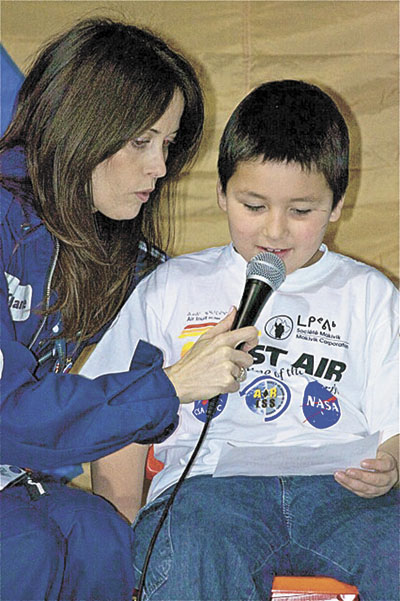
Arsaniq student Jamie Yaaka asked astronaut Paulo Nespoli about how the northern lights look from space. (PHOTO BY YAAKA JAAKA)

A group of students from Kangiqsujuaq’s Arsaniq school got to speak to an astronaut aboard the international space station via radio contact Jan. 31. Students learned that the space station is about the size of Canadian football field and it covers such a vast distance that astronauts see 16 sunrises and 16 sunsets every day. (PHOTO BY YAAKA JAAKA)
Students at Arsaniq school in Kangiqsujuaq went where few have gone Jan. 31 when they made radio contact with the International Space Station.
About a dozen students were invited to ask questions of Paulo Nespoli, an Italian astronaut and flight engineer, who is one of six aboard the space station for a six-month period.
As part of a NASA-sponsored education program that visits schools across the globe, a group called ARISS – Amateur Radio International Space Station – linked Kangiqsujuaq to the space station via a radio station in Argentina.
That gave students a 10-minute window to make contact with the space station, which was drifting about 400 kilometres above South America Monday afternoon.
Student Jamie Yaaka asked Nespoli if the northern lights look different from space.
They’re bigger and more beautiful, Nespoli responded, especially when the station is closer to either the north or south pole.
The stars and moon are sharper and clearer, he said.
Students were curious to know how astronauts lived day to day while floating through space.
For instance, how do astronauts shower?
They don’t, Nespoli said, the crew can only “wipe down” and change their clothes once every two weeks.

And did you know that the space station crew recycles their sweat and urine to make fresh drinking water?
That tidbit drew an audible “ewwww” from students.
But the unique glimpse into outer-planetary life made up for it.
Some more impressive facts: the space station is about the size of Canadian football field and it covers such a vast distance every day that astronauts see 16 sunrises and 16 sunsets every 24 hours.
To put it in Canadian terms, ARISS’s education coordinator Lori McFarlane tells students that it takes about six hours to fly coast to coast across Canada in an airplane.
“In the space station, it would take about 10 minutes,” she said. “That’s why we only have a window of about 10 minutes to make contact with them.”
And that is Kangiqsujuaq’s 10 minutes of fame, she said, because through the ARISS program, the space station can only make contact with one school somewhere in the world per week.
The rest of its communication is through NASA’s mission control in Houston, Texas.
“It’s quite an honour,” McFarland said. “You’re making history because you’re talking to someone who’s not even on the planet.”
The event can put a small and isolated village on the map, too, McFarlane added, because the audio from the space contact is broadcast throughout the world.
Typically – and depending on how close the space station is to the school – ARISS will bring its own radio equipment to make direct contact.
But due to the space station’s location over South America, combined with the cost of shipping equipment to a northern village, the contact was made via another radio station.
Makivik Corp. sponsored the ARISS crew’s transportation and accommodation.
McFarlane and her husband Steve – the Canadian coordinator for ARISS – have been involved in about 20 space station contacts at schools across the country.
A handful of them have been in Nunavik and Nunavut, where McFarlane says they always get an enthusiastic reception.
ARISS’ next northern stop is planned for Simon Alaittuq school in Rankin Inlet sometime in 2011.
(0) Comments