


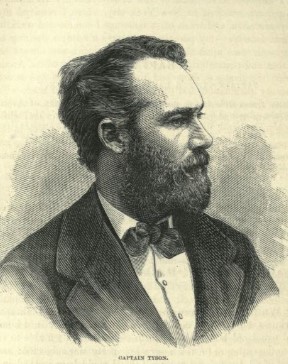
Captain George Tyson led an American expedition in 1877 to try to go further north than a British expedition had gone into the High Arctic. (Image courtesy of E. Vale Blake. Arctic Experiences. New York: Harper and Brothers, 1874)
An Early Inuit relocation scheme – Part 1
On August 13, 1877, an unusual expedition left New London, Conn., bound for Cumberland Sound on the southeastern coast of Baffin Island. Known officially as the Howgate Preliminary Arctic Expedition, it was to be the first stage of a much grander enterprise planned by Captain Henry W. Howgate of the United States Army.
Howgate had been inspired by the recent British expedition to the High Arctic led by George Nares. With two ships, Nares had tried to reach the North Pole by way of Smith Sound, the narrow channel separating Ellesmere Island from Greenland. One ship, the Alert, had reached a point on Ellesmere Island farther north than any other ship had ever gone and wintered there.
Howgate thought that Americans should do one better than the British. He wanted to establish a permanent scientific colony at Lady Franklin Bay. For that, he would need Inuit — for he knew that none lived that far north — and dogs and skin clothing.
And so a plan was hatched that a preliminary expedition would travel to Cumberland Sound and winter there. It would be under the command of Captain George Tyson, a whaler well known to the Inuit of the sound. During the winter, Tyson would hire Inuit who were willing to relocate to Ellesmere Island and collect supplies. Two scientists would accompany the preliminary expedition. Because the entire scheme was underfunded, it was planned that Tyson would also hunt whales to support the expedition financially. The following spring, the vessel would travel across Davis Strait to Greenland where it would liaise with a larger ship from the U.S., to which the Inuit would transfer for the trip to Ellesmere Island.
The expedition, aboard the tiny vessel, Florence, reached Cumberland Sound in September. She headed first for Naujartalik (Niantilic), a popular destination for whalers on the southern coast of the sound. There, Tyson learned that four whaling ships were planning to winter there, and two others at Kekerten on the northern side of the sound. Tyson knew that both were popular wintering places because early ice breakup would allow early spring whaling.
But the competition for trade would not augur well for the success of his efforts to acquire skin clothing and encourage Inuit to join his expedition. So he decided that he would have to be farther up the sound. He put into winter quarters on Oct. 7 at the head of the sound at a place the whalers knew as Ananito Harbour, or Annanatook Harbour, the place later spelled by Franz Boas as Anarnitung — the Inuit place name Anarnituuq.
The expedition’s two scientists were Ludwig Kumlien, an ornithologist and naturalist, and Orray Taft Sherman, a meteorologist. They immediately set to work. Tyson busied himself collecting skin clothing, purchasing dogs and convincing Inuit to relocate. Three Inuit families had been living at Anarnituuq when the Florence made anchor there. But over the winter, the location became a popular destination for more Inuit coming to trade with Tyson.

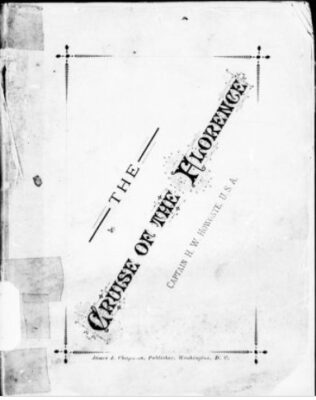
“The Cruise of the Florence” is a scarce book telling about the Inuit relocation scheme.
Tyson described his efforts to convince Inuit to relocate to Ellesmere Island: “I have had several conversations with the Esquimaux in regard to their going with us to the East Land, as they always call the coast of Greenland. Some say they will go; others fear to go. The latter are afraid of the ‘mulling’ (sea) in such a little vessel as the Florence. Others, again, have mothers who do not want them to go; then, again, brothers and sisters, uncles and aunts and cousins, and I do not know what else.”
Five men promised to go, as did several from Naujartalik. In the spring, the disadvantages of Tyson’s choice of wintering harbour became apparent. His ship was firmly locked in the grip of the ice, while the other ships which had wintered farther to the mouth of the sound had been released from their harbours and gone about the business of whaling. By the time the Florence was free, there was no time for whaling.
When the ship left harbour, it carried ten Inuit (four men, two women and four children) who had agreed to relocate to Ellesmere Island. They were Nep-e-ken and his family; Al-o-kee; a man named Ete-tun and his family; and a man nicknamed Chummy. He is also referred to as Thu-nu-ping-nar or Shu-mar-ping-uter. What this confusing agglomeration of letters was intended to represent in Inuktitut is a mystery to me.
Nep-e-ken had worked successfully for other whalers, and just the year before Captain Keeny of the Isabella had given him a whaleboat as a reward for his services. He was in his mid-40s and had adopted the name “Tyson.”
The real Tyson explained: “When the ships first commenced to winter in the gulf, some twenty-five years ago, the captains who hired the Esquimaux — and they all did so — finding it difficult to recollect their native cognomens, would give them English names; as, Tom, Charley, Dick, or Harry, and others, again, which were not quite so euphonious to the ear. This youngster… was baptized Tyson; I know not for what reason, unless it was because he was so handsome!”

Nep-e-ken was a great hunter; Tyson called him “the Nimrod of the gulf.” American captains vied for his services, and he was the boss of a boat’s crew. His wife was O-cas-e-ak-ju and, a capable hunter of deer, seal and polar bear, she was “good with the rifle and the spear.”
The couple had two adopted children. One of them was a boy of about five, named As-see-wer – probably the Inuit name Aasivak. The whalers had nicknamed him ‘Boatswain.’ Tyson noted, “I know that he can chew and smoke equal to an old tar.” He added, “They commence young in this country. I have seen some of the little girls, not older than this boy, chewing and smoking tobacco.”
Ete-tun’s wife was Kim-ik-pak-jic, (probably Kimipiarjuk), whom the whalers called Polly. She gave birth to a baby on board the ship on May 1, 1878. Alokee was single and had expressed a desire to get a wife before he left on the expedition. Chummy was single, and trusted Tyson implicitly, having been to the United States for a winter with him in 1861. Indeed, on his return to Cumberland Sound the following year, he appears on the crew list as Chummy Tyson.
In the next instalment, the expedition leaves Cumberland Sound for Greenland.
Taissumani is an occasional column that recalls events of historical interest. Kenn Harper is a historian and writer who lived in the Arctic for over 50 years. He is the author of Give Me Winter, Give Me Dogs: Knud Rasmussen and the Fifth Thule Expedition, and Thou Shalt Do No Murder, among other books. Feedback? Send your comments and questions to kennharper@hotmail.com.

(0) Comments