


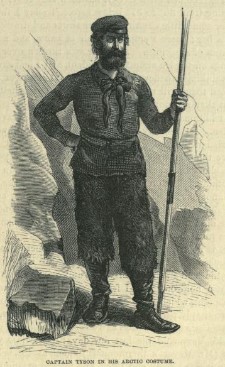
On July 13, 1878, Capt. George Tyson encountered Inuit travelling by boat, off on a caribou hunting trip. (Photo from “Arctic Experiences,” by E. Vale Blake, page 239)
An early Inuit relocation scheme – Part 2
On July 13, 1878, the Florence was finally free of ice and left its winter harbour.
That same day Capt. George Tyson encountered a party of Inuit travelling by boat in the sound, off on a caribou hunting trip.
From them he learned that the other Inuit who had promised to accompany him had changed their minds and already gone inland hunting caribou. He prevailed on some of the newcomers to join his venture, but they declined.
Three days later, Tyson put in at the American whaling station at Kekerten to pick up skins.
He noted, “We were employed today preparing a place in the vessel’s hold for the Esquimaux to live during the passage to Greenland.”
There he took one more man, three women and two children. Was one of these women a wife for Alokee?
With these additions, the complement of Inuit was 15, five each of men, women and children.

“And I think that will be enough,” noted Tyson.
There were also 30 dogs and a number of sleds aboard.
They crossed the sound to Blacklead Island where “I took a boat and an Esquimaux crew and went on shore to allow the Esquimaux to have a talk with their friends and relatives. We bade them good-by and returned to the Florence. Set sail at 4 p.m.”
On Aug. 5 they were off Godhavn, Greenland, where Tyson put his dogs ashore on an outer island.
The governor was absent, but had left orders with his subordinates that there should be no communication between vessel and shore.
Tyson wrote, “I asked the reason for this strange order, and was informed that one Capt. Adams of the Scotch steamer Arctic had been here in the early spring and told the governor that the Esquimaux and crew of the schooner Florence were all diseased.”

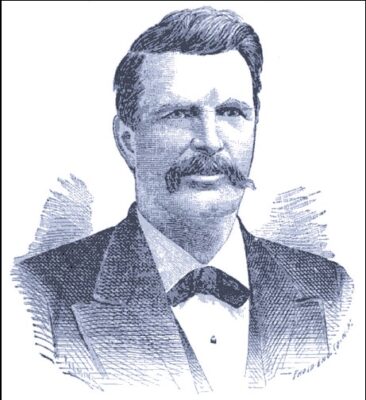
Henry W. Howgate conceived of the relocation scheme. (Photo courtesy of Wikipedia)
That situation had not changed by Sunday, Aug. 11, when Tyson, with his Inuit friends still aboard, wrote, “It is Sunday, and the little bell on shore summoned the people to church. We have no communication with them. Every day the boats from shore, containing the half-breeds of the settlement, come around the schooner to gaze upon the West Land Esquimaux, but none of these visitors are allowed on board.”
The following day, Tyson had more details on the reasons why he and his Inuit were not allowed ashore: “Mr. Smith, the inspector, sent a boat… with a request for me to come on shore, as he wished to see me. He says that the surgeon and captain of the steamer Arctic informed him that there was a great deal of sickness among the Esquimaux in the gulf, and that it was only to protect his own Esquimaux from disease that he issued the order forbidding communication with us.”
The governor told Tyson that he had read in a Danish newspaper that Howgate’s planned expedition to Ellesmere Island had been postponed, but urged Tyson to wait until the arrival of the next Danish ship in case it carried instructions for him.
By Aug. 22 a Danish vessel had arrived but it brought no news for Tyson. He had run short of supplies and had already purchased 1.5 tons of coal, 18 kilograms of sugar, 18 kilograms of coffee and 11 kilograms of tobacco. Now he bought another half ton of coal, 125 kilograms of bread, 18 kilograms each of sugar and coffee, and another 11 kilograms of tobacco.
With no news from the United States, Tyson, disappointed, left Greenland. He had been ashore, as had the two scientists, but it appears that the only Greenland soil the Westland Inuit set foot on was the island where the dogs had been disembarked, and to which the Inuit went periodically to tend to them.
There is no indication that they met any Greenlanders except those who came out to the ship by qajaq but who were not allowed onboard. They may have communicated verbally over the side of the ship.
The weather was unpleasant for most of the Davis Strait crossing. It was with relief that Tyson reached Naujartalik Harbour on Aug. 31. The scientist Ludwig Kumlien noted that they enjoyed a few days of rest there, “rest from the howling of the wind and wave and from the far less musical squall of the juvenile Eskimo and the fiendish howls of the dogs.”
On Sept. 2, Tyson formally discharged the Inuit, noting, “I gave them one boat, four guns, all the remaining ammunition, two opera-glasses, one suit of clothing each, nearly all of the Danish bread we bought at Disco, some little molasses, and one tent.”
He took on water for the homeward voyage, but bad weather prevented his departure until Sept. 13. The Florence reached St. John’s, N.L., on Sept. 26, and remained there for a week and a half. She finally reached New London on Oct. 30.
Capt. Howgate, who conceived this madcap venture, had thought that “the peculiar nature of her mission lifted the enterprise from the level of an ordinary whaling voyage to the higher plane of geographical discovery.”
In fact it was successful in neither.
Thus, the first scheme to relocate Inuit in Canada ended with no result.
Taissumani is an occasional column that recalls events of historical interest. Kenn Harper is a historian and writer who lived in the Arctic for over 50 years. He is the author of Give Me Winter, Give Me Dogs: Knud Rasmussen and the Fifth Thule Expedition, and Thou Shalt Do No Murder, among other books. Feedback? Send your comments and questions to kennharper@hotmail.com.
(0) Comments