


Banishment might be made-in-Nunavik solution region needs
Makivvik proposal fraught with complexities but worth exploring in face of changing northern crime
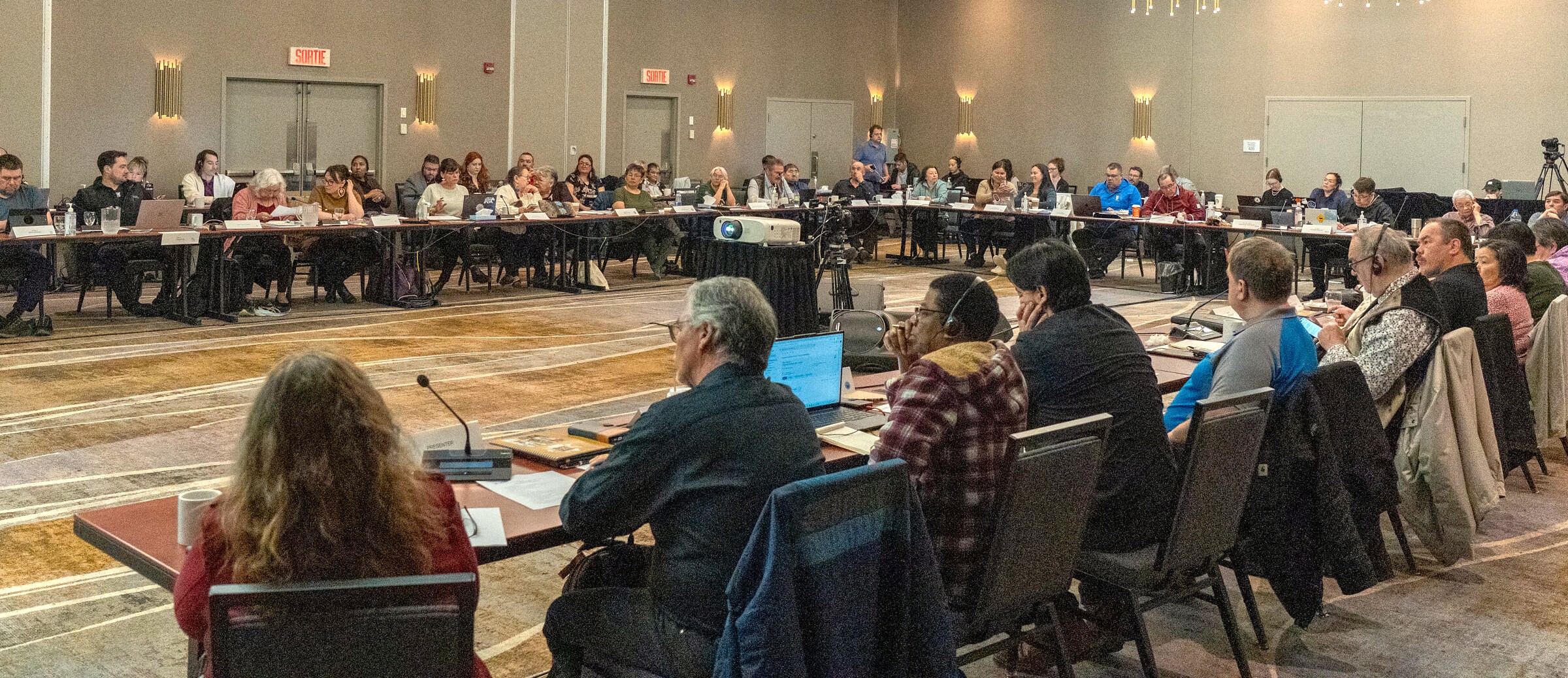
Government and organizational leaders from across Nunavik are seen at a meeting in Montreal in mid-April discussing regional issues such as policing and health care. (Photo by Cedric Gallant, special to Nunatsiaq News)

Desperate times call for desperate measures.
That appears to be what’s behind Makivvik Corp.’s recent announcement that it’s considering how to potentially banish from Nunavik’s 14 communities the troublemakers involved in drug-trafficking or bootlegging alcohol.
The idea came up during the three-day meeting of all of Nunavik’s public organizations held in Montreal in mid-April. Holding that meeting itself — an annual opportunity to put all the region’s organizations under the same roof to brainstorm solutions — is positive and productive.
Makivvik’s lawyer Jean-François Arteau gave a presentation about the idea of banishing drug-traffickers and bootleggers. Drug- and alcohol-related violence causes a lot of suffering among Nunavimmiut, he said.
Makivvik president Pita Aatami underlined the seriousness of the drug problem: “People are dying because of illicit drugs.”
The justice system works differently in the North from how it works in the south, especially in the cities. The impact of illicit drugs can arguably have a harder, more devastating impact in small, remote communities than in bigger cities in southern Canada.
And the under-resourced court system means the trials of people accused of drug-trafficking or bootlegging can drag on much longer than in the south.

On the other hand, the justice system currently puts a heavy emphasis on the importance of keeping Inuit and northerners close to home as part of their healing and rehabilitation. So banishing troublemakers from their communities might make things markedly worse for those individuals in the name of protecting communities from them.
It would be a drastic measure, and it would be fraught with legal complexities. For example, any official government policy to banish people from a community would appear to fly in the face of the Canadian Charter of Rights and Freedoms.
The Charter’s mobility rights give Canadians the ability to move freely within the country. So it’s hard to imagine how any policy implemented by Makivvik, Kativik Regional Government or the federal government could withstand a Charter challenge.
Because the Charter only deals with the relationship between individuals and their governments, there might be room for employers or other private organizations to enact their own policies for removing troublemakers from a community.
Banishment is something some First Nations use in communities whose local rules are controlled by band councils. But the James Bay and Northern Quebec Agreement doesn’t allow for banishment policies.
Arteau described options where employers — because they often control housing — could play a role in keeping troublemakers out of communities. Similarly, landholding corporations could use their clout to impose anti-drug and anti-alcohol policies on Inuit-owned lands.

It’s not surprising that Makivvik is looking for new ways to deal with serious or hardened criminals in Nunavik’s communities.
Across the North, there seems to be a shift taking place in the type of crime that is occurring.
In the same week Nunavik leaders were exploring the idea of banishments, the commanding officer of Nunavut’s RCMP said organized crime is driving the trafficking of drugs in the territory.
Overcoming the legal hurdles to banishing people will be a tall order. But as northern leaders look for innovative solutions that work for their communities, it’s important to acknowledge that made-in-the-North solutions might be appropriate to tackle uniquely northern social problems like combating the devastating effects of illicit drugs.
If only there was a place to banish people, let’s call it a jail, after a due process, let’s call it a trial. This policy will eventually lead to witch hunts to anyone someone vocal does not like seen enjoying a drink or a joint.
The real question here is, why are people turning to drugs and alcohol and causing these problems?
This is a deeper issue that is being missed. By not addressing the deeper issues this is just a band aid solution, nothing more.
But there’s also section 1 of the Charter that says our rights are limited to what is acceptable in a free and democratic society. If the harm of drugs in these communities is so great, maybe banishment could be argued as a reasonable limit on section 6 rights? By way of analogy, you’re free to move about the country but you can’t just enter anyone’s home at will.
The Charter of Rights and Freedoms has a not-withstanding-clause that is being brought into use more often, options can be explored and set in motion with Quebec approval. The ones most at odds with a banishment (which can be a year or 5 long depending) are the ones reaping financially with the status quo directly or indirectly. The Innu community of Shisasabi, Labrador shows how bad things can get if not properly addressed and dealt with.
The notwithstanding clause (section 33) cannot be applied to mobility tights (section 6).
Sheshatshiu, Labrador is across from the river from the town of North West River. It was left to its own resources with and when high grade coke flooding in, resulted – many deaths over a short period. The police did little until they were pushed to step in by the Innu themselves.
It would probably better serve the people if they tackled the root cause of the issue instead of moving people around. Are they banned from all 14 communities if 1 bans them? Or do they just get to move to a different community and start the trafficking back up? Why not try and rehabilitate?
You know there’s only one category of people they want to move around and banish without being accountable to anyone, and these people are about 2% of the issue.
Nunavut has been banishing their criminals to Iqaluit for 27 years now.
Don’t forget s. 33 of the Charter that protects First Nations, Inuit and Métis ancestral and treaty rights. Banishment is part of many Indigenous nations, including Inuit, legal traditions and it would be protected by the Charter in any event. Banishment is thoroughly documented as a part of Inuit legal traditions and while in the past it meant almost certain death, nowadays it’s much softer and no one risks unusual death but the communities have also the right to keep their citizens safe.
You are referring to section 35 of the Constitution act of 1982. Precedence would state that if banishment is currently used lawfully based on section 35 for a group of people in Canada, and with the proof that this is also true with Inuit, then banishment is likely a legal precedent under section 35.
I grew up in Nunavut, I remember of a story when I was younger of someone getting essentially banned from the Hamlet. This was 20 some years ago. I assume this could still essentially happen.
Just say No!
As someone who has had their reputation “dragged through the Mud” by those “in the highest doors of power” in Nunavik, I can see this being abused if it ever comes to pass, by one of the many Nunavik narcissistic hollow leaders – past or present!
I agree with you Vic , but that life in the socialist republic of nunavik.
The only way to ensure no abuse if this is to pass as some sort of law in Nunavik, is if anyone known to falsely accuse anyone of events that would be seen as cause for banishment, be themselves banished for their false statements.
Maybe there’s still hope,,,,,,. But we need some reality checks. Yes ideas like banish ment are reasonable consideration. It’s drastically out of control, so banning the dealers must be on the table. As one commenter points out as well, stop denying and address the root cause. Admit that addiction and crime dont always go hand in hand, but they do have a relationship. Leaders must step up with more courage and determination to get the help people need. I can tell Makivik president is determined and need more support. There is hope yet. Can be done.
@ Almost the point of no return
Since NN seems to go out of their way to ensure someone/anyone with a complement to Makivvik Corporation, have their view posted, I would expect they give equal time to those with opposing views, as my reputation was sullied by Makivvik Executives and it is those who I mainly fear will enact reprisal to the Nunavik beneficiaries that try to hold them accountable.
We all know lines are meant to be crossed.
So, with that in mind and once/if there is some sort of directive to “banish” people for drug related activity, where does the line end?
Murder, rape, and child abuse among many, many other activities some would consider a worst offence than drug related activities.
Do we than look to banishment for these crimes as well?
Once one starts down this road, it is indeed a very slippery slope.
Maybe enforcement of existing laws could be a good first step.