


Buy Canadian? Bring it on
New policy to use Canadian materials to build public infrastructure creates opportunities for the North
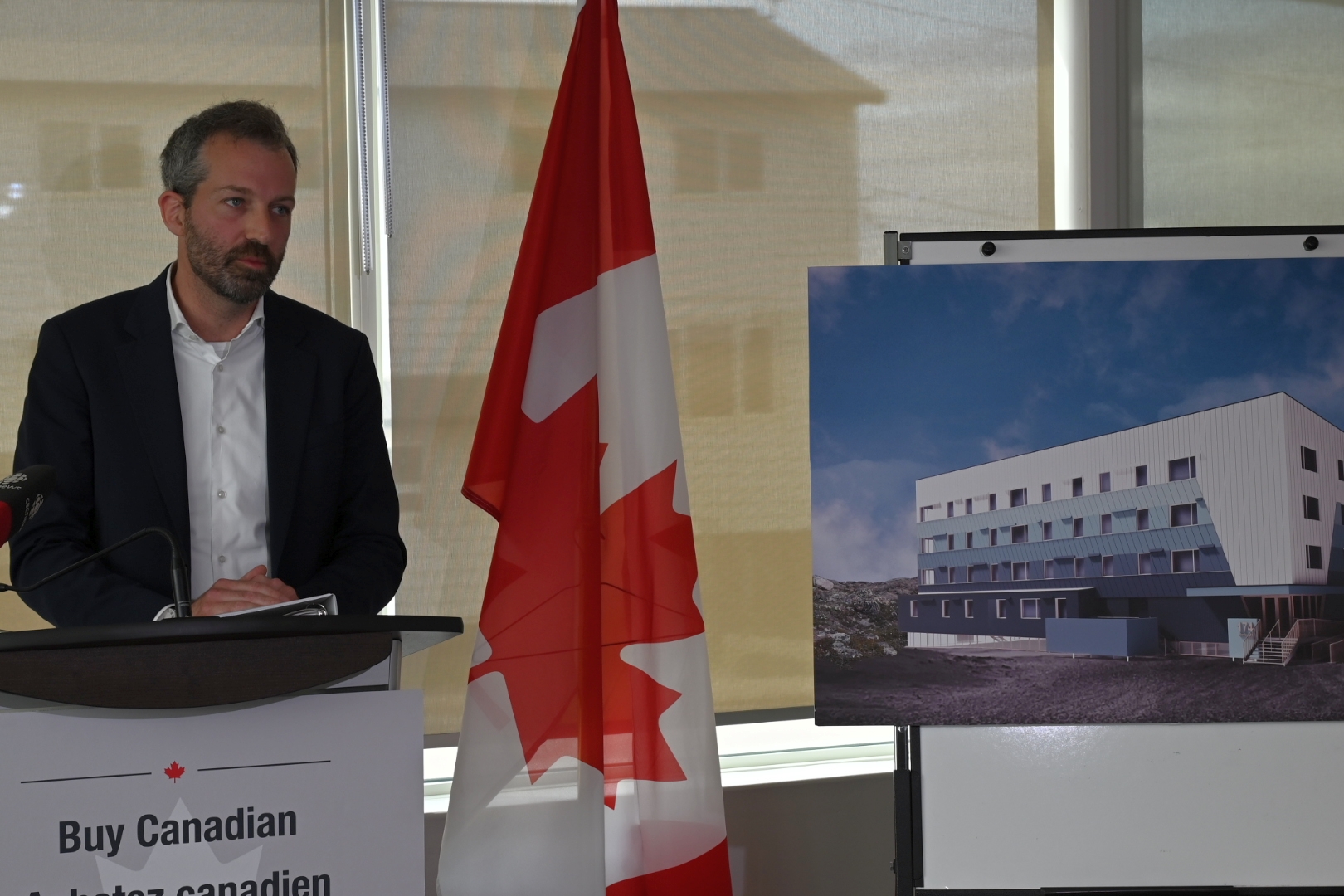
Joël Lightbound, federal minister of public works and procurement, answers questions Tuesday at a news conference announcing Arctic Fresh Projects as the recipient of a $35.6-million contract to build a federal government employee housing complex in Iqaluit. (Photo by Mosha Folger)

What’s good for Canada is often good for Nunavut and Nunavik. So, as the federal government pushes its Buy Canadian policy to use Canadian-made materials in the construction of new public works projects, it creates a new opportunity for the North.
Federal Public Works and Procurement Minister Joël Lightbound announced Tuesday the government had picked Inuit-owned Arctic Fresh Projects Inc. to build a $35.6-million, 23-unit apartment building in Iqaluit. It will provide housing for some of the approximately 200 federal government employees in the city.
It’s also one of the first government contracts awarded under the new Buy Canadian policy, a government news release said. Its construction will use predominantly Canadian steel, aluminum, and lumber.
“We’ve been very focused on what we can do to shore up the Canadian economy,” Lightbound said.
Talk about good timing. The news came the day after U.S. President Donald Trump announced a whopping 50-per-cent tariff on a host of Canadian products — including hockey sticks, of all things —beginning in mid-August.
The Buy Canadian policy came into effect in December, spelling out rules to prioritize Canadian suppliers and Canadian-made materials when the government builds new projects. One of the policy’s goals is to help Canadian industries respond to a decline in their traditional U.S. markets.
In the past year and a half, Prime Minister Mark Carney has shown an eagerness to build big things as one way to strengthen the Canadian economy, especially in these uncertain economic times caused by the Trump administration’s unpredictable trade policies.

There are countless public works projects that need to be built across Nunavut and Nunavik — airport runways, harbours, ports, electricity generators. All of them could use federal financial support.
Health care is another area where Nunavut needs more help building facilities closer to home, a point Premier John Main made Wednesday at a conference of Canadian premiers in Charlottetown.
“We want to build care closer to home. And we need a strong partnership from the federal government that recognizes our increased spend,” Main said at the conference.
Since Ottawa sees the construction of public projects — using Canadian materials — as a way to bolster the Canadian economy, Nunavut and Nunavik should lean into that.
The recipe is simple: Ottawa wants to build more public infrastructure projects to boost the economy in uncertain times. It wants to use Canadian-made materials in their construction. Nunavut and Nunavik need many more infrastructure projects that are going to need federal financial support.
If Ottawa is aggressively promoting the use of Canadian construction materials, the North is an ideal market for those products that, once upon a time, were traditionally bound for the U.S.
I can appreciate avoiding purchasing American materials. But buying Canadian leads to Canadian companies gouging us, they have no loyalty to anything but the dollar. We should just support a “avoid USA” policy, which would still allow Asian and European suppliers to create a competitive atmosphere and ensure the best for end of the line consumer.
These days so much of what the government does is performative as opposed to substantive. They want to make you think that some initiative is a big deal when it really isn’t. With that in mind, I wonder how many previous federal housing projects have been built without using Canadian building materials? I wouldn’t be surprised if all the previous ones were also built primarily with Canadian materials. I could be wrong but I suspect that this announcement is no big deal.
Corey – please tell me there’s a counterpoint editorial coming that calls out spending 1.5 million per apartment on this project! This feel-good fluff masquerading as an editorial is the clearest sign yet that Nunatsiaq is drifting further and further away from the reality of actual Nunavummiut.
One of the main reasons the Government of Canada tolerates sending billions of dollars north to Nunavut every year is that they know full well that most of this money is spent hiring southern Canadians and buying stuff from southern Canadian companies.
According to GN’s own NNI reports, around 75% of their spend is with southern business, and I am sure the Feds are not that far behind.
This in turn supports the economy is places in Canada that have way more votes than up here.
We call it economic leakage. Ottawa, if pressed privately, would call it expansionary fiscal policy while ignoring the fact that they are actively crowding out private investment up here while also driving up northern inflation.
The reason large government expenditures crowd out private investment in Nunavut is that the focus up here tends to be on participating in the public service; almost the entire training effort of the Government of Nunavut is for their own positions; nurses, teachers, social workers, wildlife officers and management positions.
The cream of the crop in terms of Nunavut human resource capacity for decades has been directed towards government work. Training our young people in commerce, construction, and mining (with transferrable skills) is an afterthought.
Government staff housing is relatively plentiful and further dampens the entrepreneurial and independent spirit of our young people.
We have set ourselves up as the consumers of Ottawa’s largesse.
Encouraging Ottawa to spend more money up here because they will buy and use Canadian materials is completely besides the point; Canada’s northern defense commitments already dwarf whatever our business community and workforce can handle.
Nunavut’s economy will continue to leak like a sieve until we get serious about creating the capacity to actually do something with the firehose of taxpayer money we continue to be dowsed with.
That starts with stop treating Nunavut Arctic College like GN’s hiring firm, and hoping upon vain hope that our new University is something more than simply a kumbaya Inuit culture love fest.