

Canadian Rangers quietly, confidently assert Arctic sovereignty
Op-ed | Unique service deserves more recognition
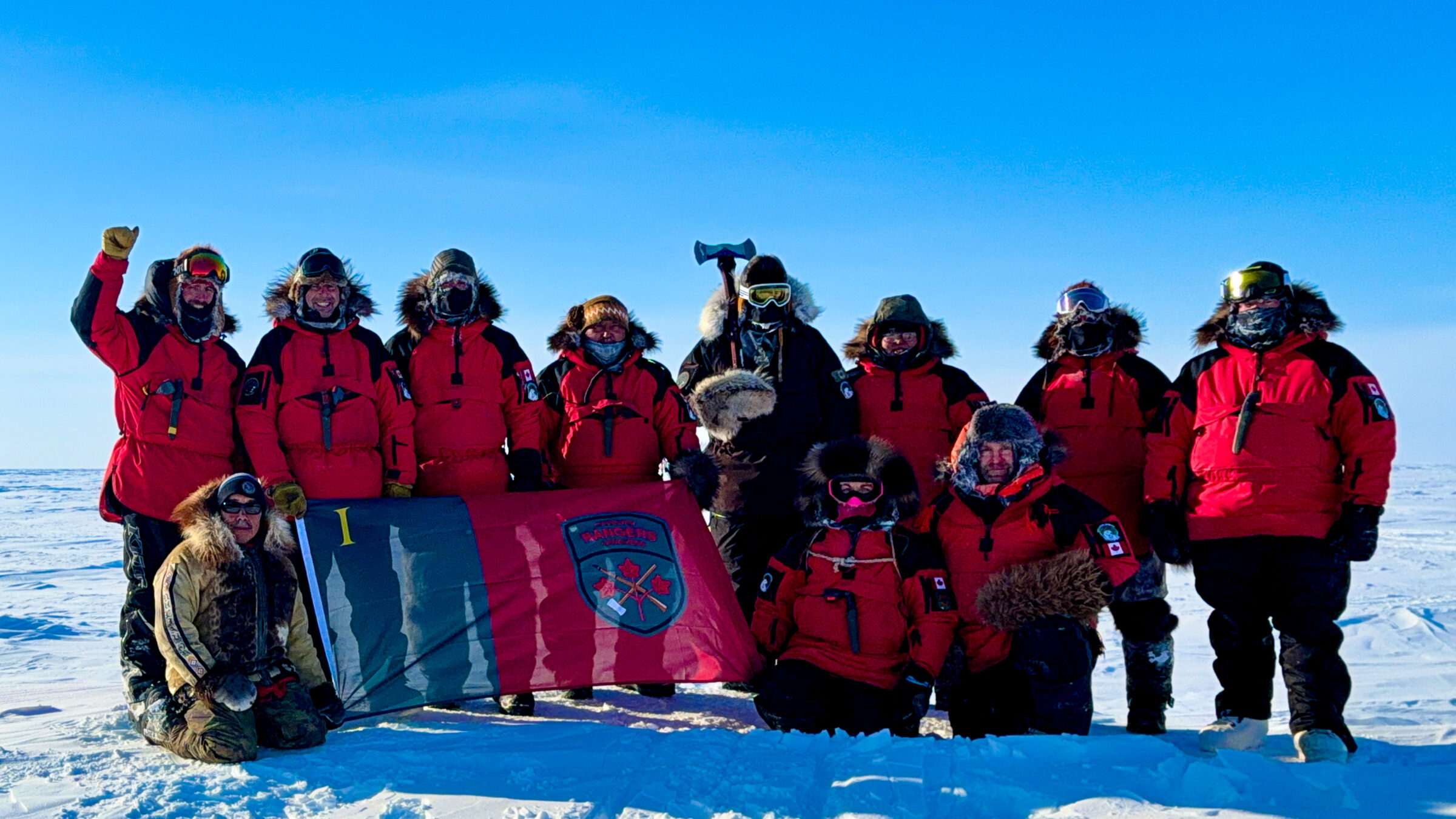
Canadian Rangers participate in Operation Nanook Nunalivut at Terror Bay, the final resting place of Franklin’s ship HMS Terror, on March 18. (Photo courtesy of Sgt Jim Welsh)

Whitney Lackenbauer
In 1946, military planners hauled out polar projection maps in recognition that the Canadian Arctic had become a strategic frontier in the atomic age. Was this a potential route for invasion? What would it take to defend it?
To test mobility, equipment and logistics in extreme Arctic conditions, the Canadian army and air force conducted Operation Muskox: a 5,000‑kilometre journey starting in Churchill, Man. Forty-eight soldiers in 11 four-and-a-half-ton snowmobiles projected north through the Kivalliq Region to Baker Lake, then proceeded to the Arctic coast at Perry River before moving west through the Kitikmeot Region to Kugluktuk.
From there, they travelled along the Mackenzie River into northeastern British Columbia, before a train carried the worn-out snowmobiles for the final stretch to Edmonton.
The resources and effort needed to complete Operation Muskox demonstrated that no enemy force could mount an overland invasion of North America through the Arctic, and that Canadians could do what others could not.
Fast forward to 2026, and international eyes are again on the Arctic.
Exaggerated rhetoric about a newly “accessible” Arctic has fed perceptions that climate change is opening the region to whoever wants to head there to pass through, or to extract its bounty of mineral and energy resources.
In response, successive governments have promised to increase Canada’s military footprint in the Arctic. The most recent announcement is a $35-billion plan to modernize and expand military infrastructure, including upgrades to forward operating locations that enable Norad operations, northern operational support hubs and nodes, and multi-use infrastructure, such as runway improvements and road construction, in various locations.
These investments are needed, but vague statements about the military’s imperative to enhance sovereignty can obfuscate that we have the internationally recognized right to control our northern lands, seas and resources.
We have a persistent footprint throughout the Arctic in the form of the Canadian Rangers — a uniquely Canadian way of sustaining a defensive capability throughout a sparsely populated homeland that does not face an acute military threat.
They are not combat forces, but they are elite operators in the region. Their service as the eyes, ears and voice of the Canadian Armed Forces in the North — and of northerners in the military — deserves more recognition.
Amid all of the high-level announcements and strategic messaging about rising competition, 1st Canadian Ranger Patrol Group completed a long-range patrol across the Arctic coastline.
A core team left Inuvik by snowmobile in mid-February, headed north to the Arctic coast where they endured whiteouts and high winds in the coldest winter in recent memory, and pushed east to the Kivalliq Region, pivoted south along the Hudson Bay coast, and arrived in Churchill in mid-March.

Supported by the noble Twin Otter crews of the Royal Canadian Air Force’s 440 (Transport) Squadron and other military elements, their route retraced much of Operation Muskox’s in reverse, using modern equipment coupled with age-old local and traditional knowledge and experience.
The Rangers’ snowmobile tracks may be temporary, but the sovereignty they exercise is enduring.
In an uncertain world, they demonstrate practical expertise and resourcefulness.
While we are rightly worried about external forces, it is also time to celebrate the strength and capacity that resides in the Canadian North — and the Rangers’ unique form of dedicated service.
Whitney Lackenbauer, Ph.D., is Canada Research Chair in the Study of the Canadian North at Trent University and the network lead of the North American and Arctic Security Network.

Defence needs to be focused on possible threats.
If Canada were to buy submarines from Korea, they could be used, for example, to prevent an invasion of Newfoundland by the Navy of Madagascar.
If anyone were to invade Canada by landing troops anywhere in Nunavut and moving south, they would best be dealt with by the forces of General Winter and Air Marshal Mosquito.
The only credable military threat to Canada comes from the USA. To defend Canada from a military attack by the USA, submarines would be of no use, because they would not come by sea. Also, F35 aircraft would be useless, because the USA would disable them remotely before invading.
The primary USA military threat to Canada is the 10th Mountain Division, based in upstate New York. They are about 90 minutes from Ottawa and specialize in urban warfare.
Ukraine and Afganistan have shown that a significant drone force could provide a credible defence.