


CanNor minister announces
$13M for 4 Nunavut projects
Remote-operated vehicles, new space for Ampere get funding
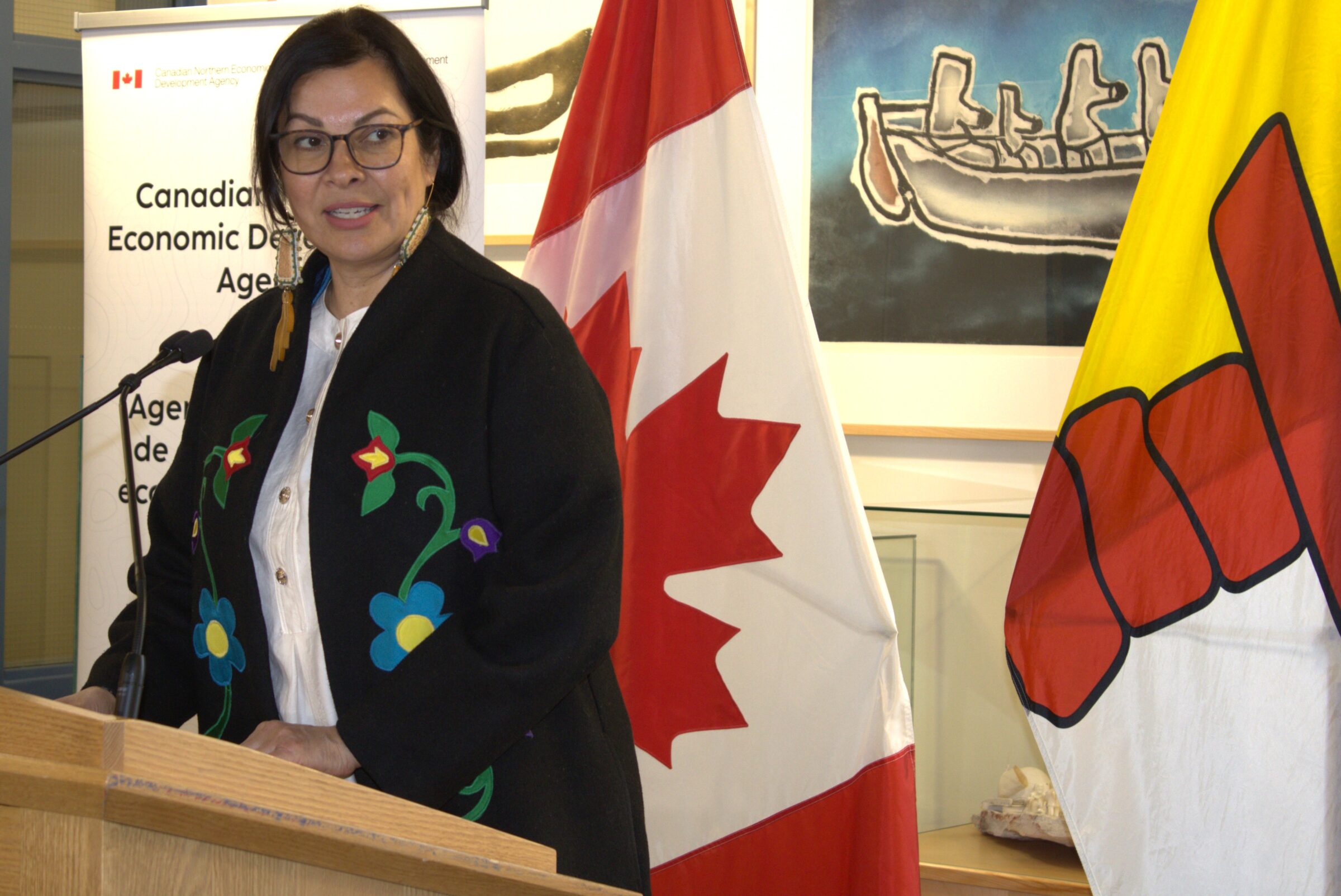
Northern and Arctic Affairs Minister Rebecca Chartrand announces $13 million for four projects Wednesday at the legislative assembly building in Iqaluit. (Photo by Daron Letts)

Updated April 22 at 4 p.m. ET
Remotely operated vehicles will soon criss-cross Qikiqtaaluk waters, collecting geographical information to enhance existing underwater maps of the region, said federal Northern and Arctic Affairs Minister Rebecca Chartrand in Iqaluit on Wednesday.
The $4.5-million vehicles from Inuit-owned Sedna ROV Services Inc. are one of four projects that will share $13 million announced this week from the Canadian Northern Economic Development Agency, or CanNor, across all three Nunavut regions.
“The vehicles are going to be used to help with mapping and surveying,” said Chartrand, who is also the minister responsible for CanNor.
The robots will be able to gather information that could be used for mineral exploration and national defence, she added.
Three other projects are also being funded.
West Kitikmeot Resources Corp., proponent and developer of the Grays Bay Road and Port Project, will receive close to $4.5 million to gather baseline environmental information and prepare early design work in advance of further development.

Inuit-owned Nukik Corp. will get $3 million to lead environmental and archeological studies in support of its Kivalliq Hydro-Fibre Link Project.
That project, still in the development phase, would connect five communities in the Kivalliq Region to the North American power grid through Manitoba and provide them high-speed internet access.
Also, Ampere — an Iqaluit-based technology education organization — will receive just over $1 million to complete design and pre-construction work on a 7,000-square-foot building, doubling the size of its current operation in the city.
Calling it an economic development hub, Kevin Kelly, Ampere’s director of Nunavut operations, said businesses will be invited to use the space for their own needs.
“We will also be able to significantly expand our programming capacity,” he said, including adding space to house a 3D printing station to create products using plastic and steel.
Note: This story was updated to correct Kevin Kelly’s job title

(0) Comments