


Crown questions expert witness in murder trial
Danny Paul Eyaituk told the court last week he had lied to mental health practitioners
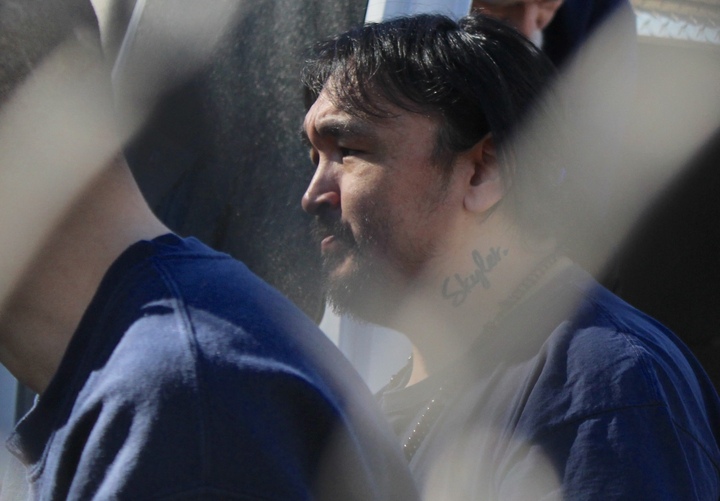
Danny Paul Eyaituk makes his way to an Iqaluit courtroom for the third week of his first-degree murder trial. (Photo by Arty Sarkisian)
Updated on Monday, June 29, at 10:20 a.m. EDT.
The prosecution in a first-degree murder trial questioned some of the conclusions an expert defence witness made about the accused’s mental state, on Thursday.
Danny Paul Eyaituk, 40, is on trial for first-degree murder in the death of his wife Annie Tracy Oqaituq, 36, who was found dead in their home on April 19, 2024. The trial began in Sanikiluaq on June 9 but was moved to Iqlauit on Wednesday after a weeklong delay.
On Wednesday, forensic psychiatrist Dr. Maryana Kravtsenyuk went through a report that defence lawyer Alan Regel asked her to prepare to assess whether Eyaituk could be found not criminally responsible for Oqaituq’s death.
Canada’s Criminal Code says a person cannot be held responsible for a crime committed while suffering from a mental health disorder that makes them incapable of appreciating the nature and quality of the act.
From November 2023 to February 2024, Kravtsenyuk said, Eyaituk was using cocaine and cannabis on a daily basis with “increasing paranoia, disorganized thinking, non-sensical responses; [there are] references to delusions; hearing his deceased grandfather, seeing dead people, visual hallucinations and emotional liability were all described in those clinical records.”
Yet Eyaituk testified earlier in the trial that he was having hallucations leading up to his wife’s death.

On Thursday, Crown lawyer Emma Baasch focused on Kravtsenyuk’s report, which didn’t mention the hallucinations.
Eyaituk testified last week he disagreed with details in his medical records and in some cases lied to staff at the Sanikiluaq health centre, Baasch said.
Kravtsenyuk recognized that Eyaituk sometimes lied to staff at the Sanikiluaq health centre, to which Baasch questioned the reliability of her conclusions.
“I provided an opinion based on the totality of information that was made available to me at the time,” Kravtsenyuk said.
It affects the weight attached to any individual statement, but doesn’t invalidate the entirety of the assessment, she added.
Earlier Thursday, Kravtsenyuk continued to detail Eyaituk’s mental state in the months leading up to the day he allegedly murdered his wife.

Based on her expertise, she said it was clear to her Eyaituk had suffered multiple bouts of drug-induced psychosis, including on the day of the alleged shooting.
Drug use can be a contributing factor in sudden changes in mental health, she said, adding that his mental health breakdowns all occurred in the context of his substance abuse.
During the first week of the trial, a youth witness who cannot be identified due to a publication ban described Eyaituk as having gone suddenly “crazy” just before the incident.
Regel asked if Eyaituk was in the middle of a drug-induced psychotic episode at the time of the shooting.
The clinical record indicates “significant psychiatric impairment in the months leading up to the shooting and on the day of the shooting,” Kravtsenyuk said.

Kravtsenyuk said she could not be certain of the accused’s state of mind at the exact moment of the incident. However, he was not completely “detached from reality at the material time. There was evidence of some organized behaviour immediately following the incident.”
Last week, Eyaituk said he tried to call police and sought help from others after Oqaituq’s death.
The trial adjourned at noon, with no clear trial date determined for the continued proceedings.
Correction: This article has been updated to report the correct title of psychiatrist Dr. Maryana Kravtsenyuk.
(0) Comments