


Education must continue to be the counter to denialism
Survivors, advocates emphasize need to confront attempts to deny, downplay residential school history, impact
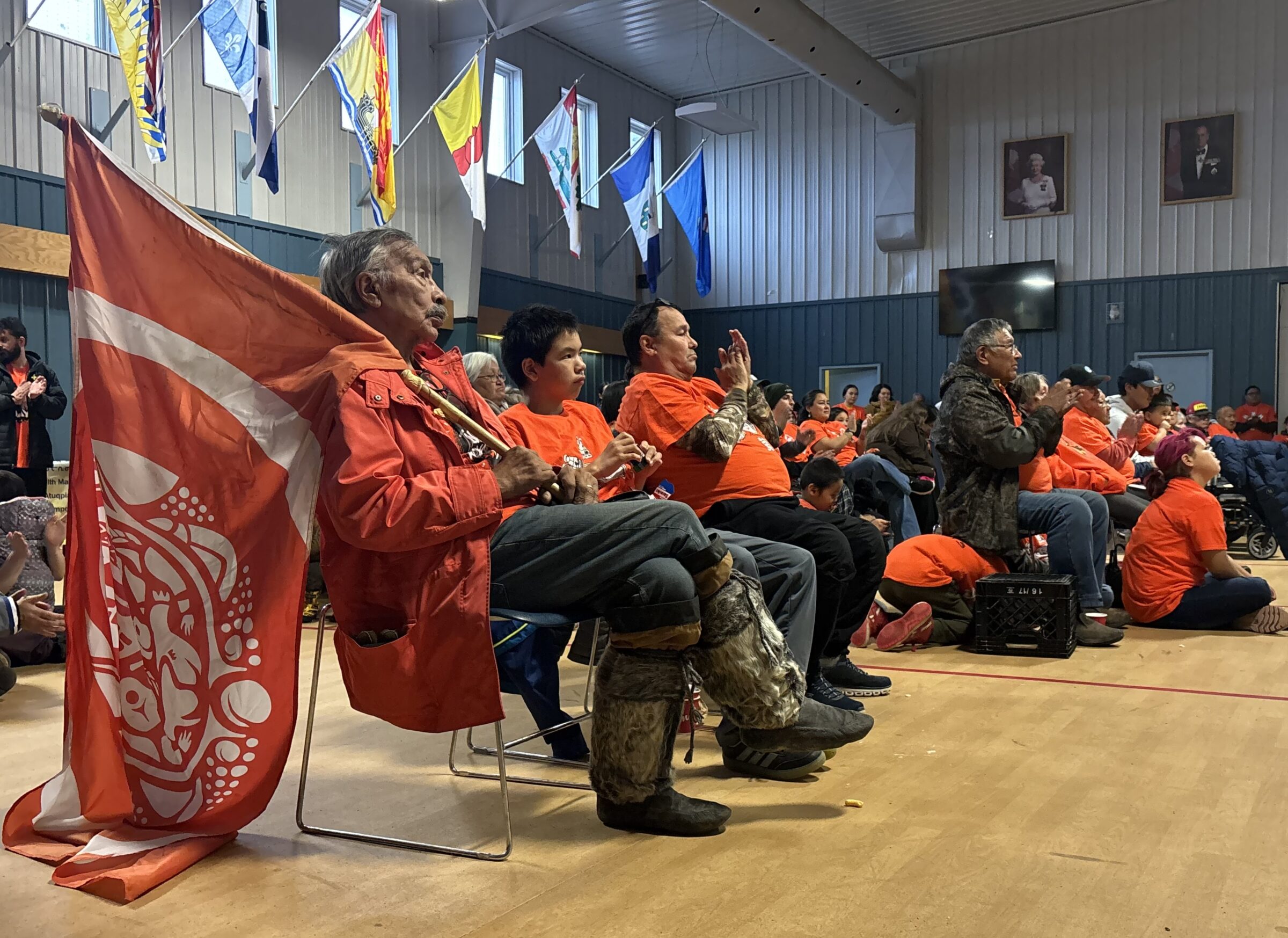
Residential school survivor Jack Anawak holds the Survivors’ Flag during the sixth annual National Day for Truth and Reconciliation gathering in Iqaluit on Wednesday, hosted by the Qikiqtani Inuit Association. The event was held indoors due to rainy weather. (Photo by Daron Letts)
Education remains the best way to ensure Canadians understand the legacy of residential schools, to preserve the memories of children who died, and to care for survivors.
Earlier this week, after the Second Sons white nationalist group held an ominous demonstration just outside the Tk’emlúps te Secwépemc reserve near Kamloops, B.C., it became easier to understand the calls to criminalize residential school denialism.
A recurring theme at the National Day for Truth and Reconciliation ceremony on Parliament Hill, residential school denialism is becoming an alarming, disturbing phenomenon.
“We must … confront all forms of denialism that persist despite extensive historical records and an indisputable body of evidence, including first-hand survivor testimony,” Gov. Gen. Louise Arbour said during Wednesday’s event. “This leaves no room for doubt about the history and impact of the residential schools.”
Several speakers spoke to the harms caused by denialism, which is the belief that either children didn’t die at residential schools or that survivors’ experiences were not as bad as they have made it out to be.
In fact, over a century and a half, approximately 150,000 Indigenous people attended residential schools. The Truth and Reconciliation Commission’s final report notes 3,201 deaths in residential schools. Its former commissioner, Murray Sinclair, believes at least 6,000 children died as a result of their time in residential schools.
National media have reported on what appeared to be Second Sons members’ deliberately provocative acts in the days leading up to Sept. 30, the annual National Day for Truth and Reconciliation.
On the social media platform X, Prime Minister Mark Carney called “the cowardly act” an “abhorrent” display and added it was a “stark reminder” of Canadians’ responsibility to confront the consequences of the residential school system that are felt today.
He paid tribute to the courage of survivors who have shared their stories so all Canadians can work toward reconciliation.
Nunavut survivors like Iqaluit’s Jack Anawak — once again a fixture at the city’s gathering at the cadet hall — and Cambridge Bay’s Jeannie Ehaoloak, who spoke in Ottawa, contribute to that truth-telling.
In June, Nunavut Sen. Nancy Karetak-Lindell tried unsuccessfully to criminalize residential school denialism.
She tried to amend the Liberal government’s Combatting Hate Act that would have made it a crime to “willfully promote hatred” against Indigenous Peoples by “condoning, denying or downplaying the Indian Residential Schools system.”
Karetak-Lindell’s amendment was supported by the Senate’s human rights committee but was defeated in the Senate.

A week later, this editorial space argued that education — not jail time — is the way to counter the denial of the harmful effects of residential schools.
As abhorrent as the Second Sons’ actions were, the most effective way to counter the misinformation that deniers spread is with the spread of accurate information.
The residential school system is a horrible, dark, painful chapter in Canada’s history. But it’s one Canadians need to come to terms with.
Neither NN, any other mainstream media, nor any reigning Canadian institutions is willing or able to educate anyone about indigeneity. In order for that to change the ideas that are discussed would need to include all evidence and all perspectives on that evidence. Anything else is baseless doctrine whose intent would be to indoctrinate with fake ideas. People who advocate for criminalizing perspectives are advocating undemocratic and unethical systems. They should be at best dismissed, but more justly, reprimanded.
“Perspectives.” Tell me, where do you draw the line between “perspective” and “denial” and on what subjects?
Your ‘denialism’ is my legitimate perspective. It is your job to convince me that your take has merit. I believe nothing from you without evidence, it is your role to provide it. This is how it is for ever single subject in daily life. All subjects are open to critical review and questioning – all of them
When someone provides evidence that is counter to your false premises or if someone asks you for evidence to support your premises you deem the other person as a denier. By your definition I am a denier and by your using thst definition you lose more credibility. That fits perfectly with you pretending that your false premises are truth
I do not understand why you said “indigeneity”. All the evidence is public posted, as most commission results are. It seems that the deniers are racist, why else be so motivated to believe? Truth is the first step
I agree with the author of this column. It is true what the late Senator Murray Sinclair said – that it was education that got us into this mess and it will be education that will get us out.
The truth is that residential schools were horrible places. Many children were physically and sexually abused there and these schools engaged in cultural genocide by attempting to wipe out indigenous culture and language. That truth was been well established by the testimony of survivors and the historical record.
Unfortunately (in my view), some people decided a while back that this truth was not good enough, and did not provide enough shock value for Canadians. As a result, a new narrative was developed in which children were actually murdered at these schools or otherwise died as the result of foul play and were buried in unmarked graves. As of today, there is no evidence to support this narrative even though the federal government provided considerable funds for excavations.
For me, I’m going to stick with the proven truth being that, while these schools were terrible places, there is no evidence to suggest that children were murdered or died as a result of foul play. We have freedom of thought, opinion and expression in this country which applies to me as much as it does to our political leaders who want us to believe something where there is no evidence to support it.
Who said anything about murder or foul play? The undisputed fact is that large numbers of children died at these schools. Some deaths likely would have occurred regardless of place but given the terrible living conditions, including inadequate food, and well-documented lack of proper medical care, for some children being sent to a residential school was a death sentence.
When I hear that people are doubtful that some number of indigenous children died at residential schools because no mass graves have been found (yet), it seems to me that they are making a distinction without a difference.
I would ask, why do you wish to point out that no mass graves have been found yet? Is it that you care that deeply about forensic science? How is it you suddenly get a hankering for Post Confederation Canadian History 101?
No, I do not think that this is what is happening here.
What I think motivates people to make this point is that it deeply offends them that their race, culture or religion is the subject of such accusations; that they believe their race, culture or religion did observe some bounds of human decency and does not deserve such blame. This is the core feeling behind denialism.
The sad truth is that ANY group of people, if they have God on their side, will treat a sufficiently different separate group of people as subhuman. That includes White European Protestants and Catholics. That is the ghastly lesson here.
That a dominant culture made it it’s business to erase another culture by abusing and neglecting children is horrendous enough on itself. No mass graves is no absolution from anything.
All Canadians including indigenous people need to acknowledge this so we can all move on to the hard work of building our just city on the hill.
There are some broad ideas of what denialism means. Asking for evidence supporting allegations of foul play, murder and genocide (as defined by the UN, not just a synonym for “racialism”) is apparently enough to some to be jailed and cancelled.