


Education, not jail time, is answer to residential school denialism
Senate votes down Sen. Nancy Karetak-Lindell’s proposal, leaving awareness the battleground against ‘downplaying’ harms
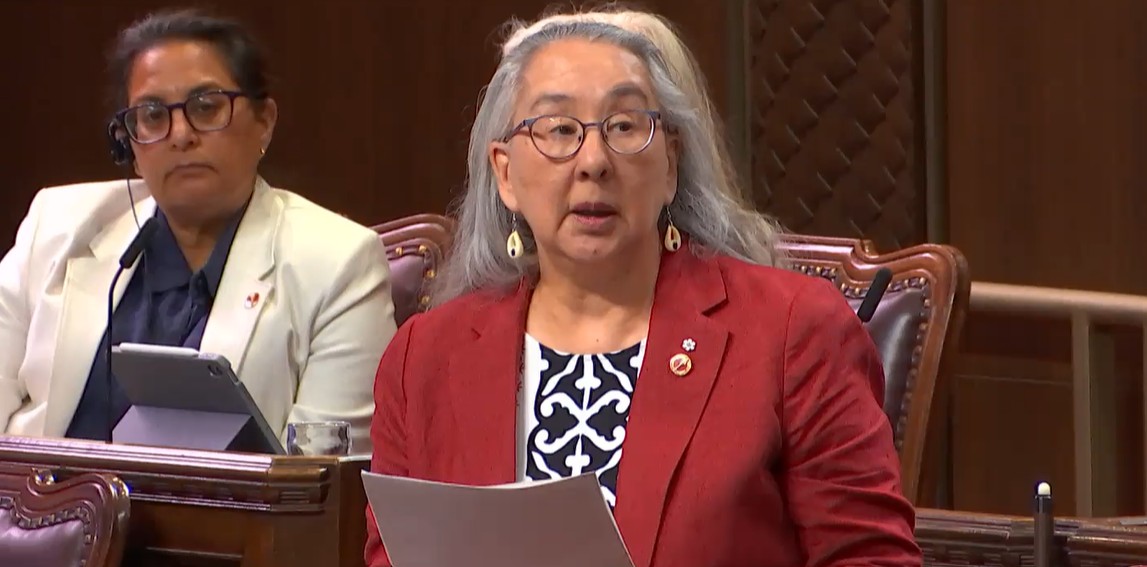
Sen. Nancy Karetak-Lindell makes the case to include residential school denialism in a new law aimed at combatting hate. The Senate voted against her amendment that would have seen people guilty of downplaying the harms caused by residential schools with up to two years in jail. (Screenshot courtesy of Senate ParlVu)

Education — not jail time — should be the way to counter the denial of the harmful effects of residential schools after the Senate chose not to include it in changes to a new law against hate-motivated crimes.
Nunavut Sen. Nancy Karetak-Lindell made a strong case last week that the “condoning, denying or downplaying the Indian residential schools system” be added to a new list of Criminal Code offences in the government’s Combatting Hate Act, known as Bill C-9.
The amendment would have made it a crime to promote hatred against Indigenous Peoples by denying the harms caused by residential schools.
Nunavut’s lone senator compared residential school denialism to Islamophobia, anti-Black racism, and antisemitism as forms of hate requiring special treatment under the Criminal Code.
“The question before us is why Indigenous Peoples should be treated differently,” she told senators on June 3.
If passed, the amendment would have had people found guilty of residential school denialism face up to two years in jail.
A Senate committee voted for her amendment on June 1. But, two days later, the full Senate voted it down and passed the bill without it.
Bill C-9 makes it a crime to promote hatred against identifiable groups by publicly displaying racist symbols. It also makes it illegal to interfere with someone’s right to enter a place of worship. And it removes a defence of promoting hatred based on expression of religious views.
But the bill pitted the protection of vulnerable communities from hate against the right to freedom of expression.
In a free society that treasures freedom of expression, people must be able to express unpopular and wrong opinions.
Coincidentally, Gov. Gen. Louise Arbour this week pointed to the Charter of Rights and Freedoms for the “peaceful management of our differences.”
“The Charter guarantees that our cherished individual rights are subject only to the reasonable limits necessary for life in a free and peaceful democracy,” Arbour said Monday as she was installed as Governor General.
Understanding the history of residential schools has been a painfully slow process for many Canadians, especially those who are not Indigenous.

The creation of the Truth and Reconciliation Commission in 2008 was a big step in fostering an understanding. The commission’s 2015 report and calls to action advanced that progress, but slowly.
The location of unmarked graves at residential school sites — now five years ago — forced many Canadians to reckon with the tragic chapter in the country’s history.
The Truth and Reconciliation Commission’s 94 calls to action encourage Canadians to learn about the legacy of residential schools. Some occupations, including social workers, child-welfare investigators, lawyers, public servants, and journalism students are urged to learn about the impact of residential schools and consider it in their work.
June is National Indigenous Peoples History Month. The federal government promotes it as “a time to recognize the rich history, heritage and diversity of First Nations, Inuit and Métis.”
But it should also be a time for Canadians — especially those of us who are not Indigenous — to try to better understand the lasting, tragic legacy of residential schools.

Canadians need to be encouraged to learn about it, not punished for being ignorant about it.
You forgot truth.
“I always say that I went to a residential school,” she (Karetak-Lindell) says on the last day of the reunion. “But almost in the same breath, I say, ‘But it’s not like what you’re hearing about all the residential school issues today, because it was a home-away-from-home.’” (2001)
Glad she had a good experience, but many didn’t. Denying residential school is wrong, as is denying the holocaust or the dangers of covid, but it shouldnt be illegal. Charging people over free speech is a slippery slope. It has already been revealed that those anomalies found at Kamloops were not mass graves, and that needs to be articulated, but many kids experienced abuse and being stripped of their culture, which is terrible.
Anyone, ANYONE, who questions someone’s right to disagree, question, deny or otherwise doubt the residential-school narrative or any other claim should be charged with conspiring to commit assault
You just made a self-contradicting statement. Anyone who questions questions should be charged
its like when your cross the territorial marker into nunavut that 60% of the population lose 80% of their IQ.
“60% of the time, it works everytime”, Ron Burgandy Movie
Residential school denialism doesnt meet the remotest definition of a hate crime.
What’s next? Our thoughts to be made illegal too?
There really isn’t residential school denialism. However, there is a questioning of the rhetoric around residential schools. Where would canada be now if there was no attempt at education or health assistance? We would be accused of doing nothing and oaying desrly forbit.
Last line should read, ” paying dearly for it”. Apologies for fat fingers.
Holocaust denialism is criminalized in Canada. The Conservatives voted almost unanimously in favour of criminalizing it.
Meanwhile, the denial of Canada’s own Holocaust – the genocide of Indigenous peoples, is not criminalized.
This motion being voted down isn’t about free speech. It’s about racism. The Conservative Party is a club for racists who hate Indigenous people. The voting record is proof of that.
Holocaust denialism should not be criminalized either, that was a mistake on the part of the government for all the same reasons outlined above and in the comments from the previous story on this.
I’m glad we are not adding to the problem.
There was no genocide in Canada.
Your entire comment is racist.
Conservatives are not racist and do not hate indigenous people.
I think you should look at the current government since 2015 and reflect on their racist attitudes.
Focus on whether what happened at residential school was a genocide or not keeps us from the conversations we should be having around its intents and lingering impacts.
Uncomfortable stuff, which is probably why some spend so much energy arguing what it wasn’t. Totally distracting and unproductive, especially if you are one of those ‘critical thinkers’ out there, searching in earnest for ‘truth’.
Why did many Indigenous senators not show up for the vote to criminalize residential school denialism?
Indigenous leaders and fellow Canadians. Asked why this criminaliztion was not town hall discussed long before a Senate member attached an amendment to a parliamentary Bill for vote?
Every day it seems our rights to have an opinion, to question, to debate and speak freely without fear are rapidly stripped away. And now senators pine for the power to dictate to us, the serfs.
Over their feelings, and to suppress truths?
To believe we are never-ending victims who will never grow strong. To accept that the government is the parent to look after our children, and us with no voice or brain to speak freely.
Oh, how ironic?