


Senate rejects amendment to criminalize residential school denialism
Amendment would have made residential school denialism punishable by up to two years in prison
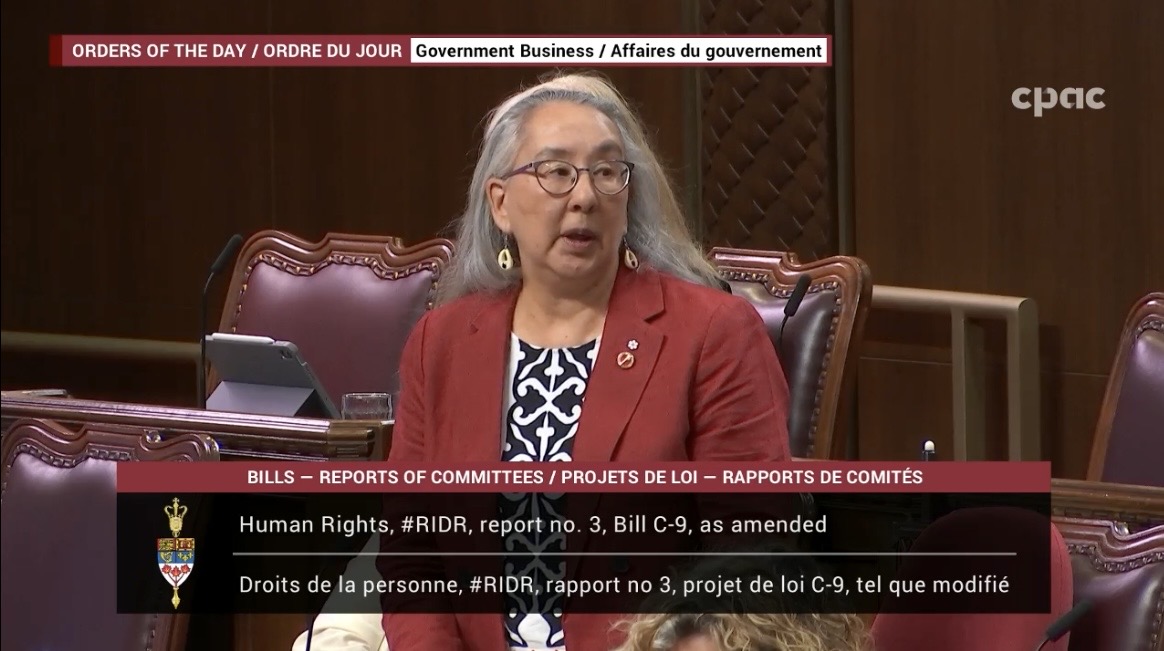
Nunavut Sen. Nancy Karetak-Lindell speaks during Wednesday’s Senate sitting, shortly before the amendment she proposed to Bill C-9, to criminalize residential school denialism, was defeated. (Photo courtesy of CPAC)

A proposal to make residential school denialism a criminal offence was defeated in the Senate on Wednesday.
The amendment, introduced by Nunavut Sen. Nancy Karetak-Lindell, would have amended Bill C-9, the Liberal government’s Combatting Hate Act, to make it a crime to “wilfully promote hatred” against Indigenous Peoples by “condoning, denying or downplaying the Indian Residential Schools System.”
It would have had people found guilty face up to two years in jail.
On Monday, during a meeting of the Senate’s human rights committee, the amendment passed a clause-by-clause study by a vote of seven to one. On Wednesday, in the Senate, the measure was defeated by a vote of 41-32.
Government representative Sen. Pierre Moreau told the chamber that no consultations had been undertaken and no legal analysis had been completed prior to its introduction.
Karetak-Lindell, a residential school survivor, had argued the amendment was needed to address what she described as a growing wave of residential school denialism and anti-Indigenous racism.
“[Residential school denialism] can involve denying, minimizing or justifying the documented abuses, deaths, forced assimilation and intergenerational harms experienced by Indigenous Peoples through the residential school system,” Karetak-Lindell said during the committee hearing on Monday.
During Wednesday’s hearing, she argued that the amendment “does not restrict historical discussions, academic inquiries or personal testimonies.”
The amendment mirrors a private member’s bill introduced by Winnipeg Centre NDP MP Leah Gazan, who tabled Bill C-413 in September 2024 to criminalize residential school denialism.
That bill got first reading in the House of Commons but has not advanced further.
Sean Carleton, an associate professor of history and Indigenous studies at the University of Manitoba, said the defeat of the amendment leaves what he described as an imbalance in Canadian law.
“You can’t downplay, minimize, twist or distort facts about the Holocaust because that’s engaging in antisemitism,” Carleton said in an interview. “But doing the same thing about residential schools, I think, teaches people that anti-Indigenous racism is fine.”
He also dismissed suggestions that the amendment would criminalize legitimate debate.

“This is not about people wanting more information or trying to learn more about residential schools,” Carleton said. “What it does target are very high-profile people who are publishing books and making money, materially benefiting from those kinds of disingenuous, bad-faith arguments.”
Bill C-9, the federal government’s Combatting Hate Act, creates new Criminal Code offences to address hate-motivated intimidation and obstruction around religious and cultural institutions. It also strengthens penalties for hate propaganda.
The bill is currently in third reading in the Senate.
As much as i respect karetek-lindell, it is a good thing for canada the motion was defeated. We don’t deny the residential schools happened. We question the rhetoric around it.
Jailing people over words is absolute insanity!!! My god develop a back bone for the love of god …
The worst result of censoring free speech is not the denial of an individual person’s ability to say what is on their mind because they are socially unpalatable.
It is much more of a problem for a society that we deny ourselves the right to hear and confront views that are different than ours.
This is especially true when what is said may have some kernel of truth; as is the case when residential school denialists point to the very real benefits received by some individuals from a western, formal education.
Or, using an other example, that few excavations of potential mass graves around residential schools have revealed human remains which detracts from the commonly held view that these schools were places of national scale systematic ethnic cleansing.
People like us that are residential school survivors certainly do not like to hear these things. However, that does not make them untrue. It also does us no real service to be unaware of the desire of some Canadians to soften our collective, national guilt.
Life is not black and white. Things are very rarely completely bad, or completely good. Censoring speech gives us a corrupted view of life by outlawing mention of the dark and medium greys. What is commonly held to be true is almost never completely and utterly true.
Not allowing the airing of these views also fails to provide the opportunity to converse with the unconvinced about why, taken as a whole, residential schools as applied by Canada was a very bad idea, destroyed our culture, and is never to be repeated.
True racism and hatred are insidious, creeping dangers to our society. We know first hand that these things create the most damage when they are left unsaid; systematically applied without open thought or acknowledgement.
Hate is a genuine human emotion. Saying we should not be hateful does not alter human nature or our need to appreciate what people in reality feel.
Europeans have been surprised and left unprepared by the resurgence of fascism, religious intolerance and nativism even in places like Germany which has had very strict anti-holocaust speech laws, and countries have otherwise suppressed these kinds of views for the generations after WWII.
People have clearly thought these same old thoughts without public expression for many years; censorship has done nothing to alter the hate that people feel.
This proves that censorship will not result in a more just society. It is just a weak bottlecap barely keeping something in.
In my view, speech should not be criminalized. It is much better for society for everyone to say what is on their mind and be able to be publicly challenged on their views. Perhaps they may even have a minor point to make.
This discourse helps those that know better to re-examine their views and articulate accurately and better why the other guy is wrong. And, this also helps for people to come to terms with the real views of their fellow citizen.
If what a person says is defamatory or otherwise egregious, there are already legal recourses for those wronged without setting up the State to be our referee in what can (and should) be said.
That was a brilliant comment Avram. Wonderfully articulated. It should be required reading for every senator that supported this bill.
People who support this notion are typically superficially “educated.” They need to read only one book to understand what residential schools were about : Shingwauk’s Vision is that book. It will answer all the doubts.
Thank you Nancy for trying to get them to understand, unfortunately this colonial system is deep rooted and it’s a very difficult situation to try and make changes that goes against the system in place, the views and denialism on residential schools will not go away, similar to people denials about the holocaust, cultural genocide and so on.
People who never gone through any of this makes it very easy for them to deny it ever happened or even question it did happen or even question how bad it was.
Still so much room for improvements and understanding.
Criminalizing ideas and speech does nothing to develop genuine understanding, that takes real work.
Criminalizing ideas you don’t like or want circulated, even if they are wrong, is short sighted and will more likely create greater resentment and more hate.
Blaming this decision on colonialism is a simplistic, reductive take. This decision was based on fundamental democratic principles that protect expression from state overreach, especially important for minority voices.
I’m happy that the Senate did the right thing. But what disturbs me is that these unelected people could have done it, they could have passed this amendment and that would be it. We need to modernize our democracy
The bill would still have to have gone through the House of Commons and be voted on by the elected through levels of readings. The senate cannot make law without the house.
Any bill introduced to silence any words spoken in a serious issue with our democracy. Hate speech is not ok, but people need to understand what is hate and what is honest discussion. We have the right to expression, and we also have the right to be heard or ignored for what we express. However you feel about any issue is your right to feel that way. But it doesnt give you the right to use it as a platform to force people to listen to lies.
This may perhaps flatly be rejected by current government! Nut sure what pub lic stunts where trying to pull here!?! Some elected LIB’s caucuses/ cabinets should be considered into mental health checks to ensure green light is part of public interests e.g. to serve public interests mandates opposed to red light right wing parties!?!
Any ideology this system can be approached or address on behalf of PUBLIC with this current LIB feds?
I think LIB’s transparent objective is to dry a point here with respect that is open and that should be transparent perhaps in some term few elected cabinets may tend to be orientated to poor judgement that misleads to unbalanced nature due in part state of mind ideology, which could (but should not) advocate to views that leads to e.g. make-up beliefs, attitudes, feelings to actions that is not part of public interests as elected member of its’ party?
What is the mockery and monkey business at your back with this current majority? who’s trying to embarrass who with respect to this current gov’t??? This is not directed to appointed respected senate!
Former Truth and Reconciliation Commission (TRC) Chair Murray Sinclair did state in a 2010 UN address that “for roughly seven generations nearly every Indigenous child in Canada was sent to a residential school.”
Sinclair’s statement was patently false. At no time during the days of Residential Schools were more than 30% of First Nations Children enrolled.
To me, this is the big issue with “Denialism”. Denialism means denying the truth. Sinclair’s statement is a wonderful example of a falsehood masquerading as truth. It’s far from the only example too.
Meanwhile, too many people would use the term Denialism to describe disagreeing with Sinclair? How many other examples just like this are there?
This was a terrible idea from the beginning.
It is hard to believe that this request has been made in 2026. Freedom of speech is fundamental. Period.
To me it shows how easily people who have never honed serious political-philosophical and ethical frameworks can succumb to the simplistic allure of authoritarian solutions that do not work.
Criminalizing speech creates a victim narrative, it deepens grievance, and quietly feeds rage. It is not a solution, it an illusion.