


Elections Nunavut needs to do better
Poor election night performance and friction with the media are signs organization needs work
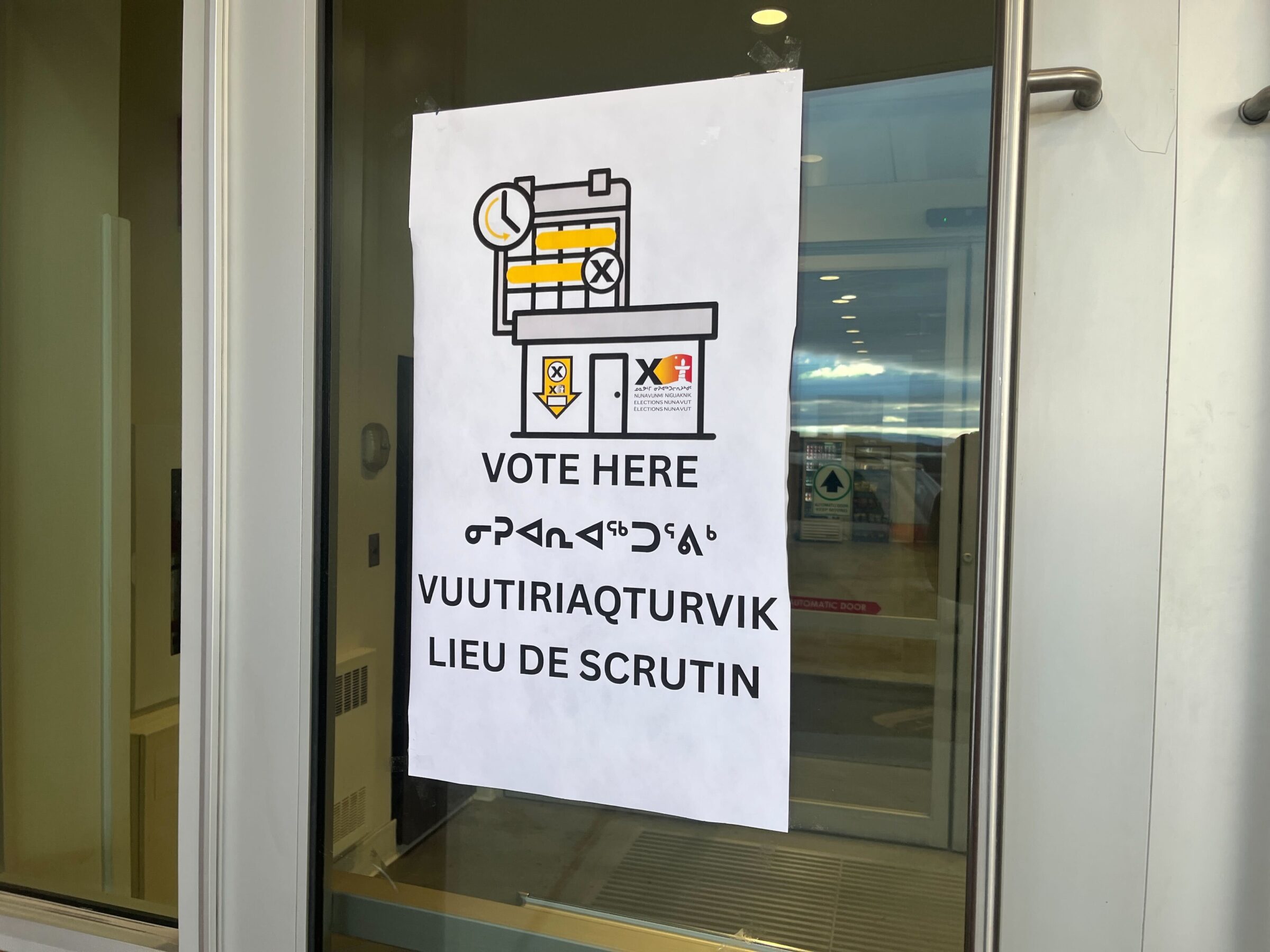
A sign in Iqaluit directs voters to a polling station at the Aqsarniit hotel on Oct. 27. Polls closed at 7 p.m. local time across the territory, but the last of the results weren’t made public until Tuesday afternoon. (Photo by Jeff Pelletier)

The only thing more excruciating than that 18-inning Blue Jays game on Monday night was waiting for Elections Nunavut to report the outcome of the territorial elections that same night.
The clearest election night result was the revelation that Elections Nunavut needs to do better.
As a journalist who has covered about 25 elections, it was uncomfortable telling reporters to pack it in at 2 a.m. because it seemed Elections Nunavut couldn’t provide complete results for all 22 ridings that night.
At 2 a.m. — nearly seven hours after polls closed in the Qikiqtaaluk Region — Elections Nunavut had posted complete results for 10 ridings, partial results for five and nothing at all for five others. Two ridings were decided by acclamation.
We weren’t the only ones to notice. Some reviews were bad on Facebook, where Clyde River photographer Niore Iqalukjuak wrote, “Elections Nunavut sucks so bad tonight.”
Reporters wondered if a power outage earlier that day in Rankin Inlet, where Elections Nunavut’s headquarters are, was responsible for the slow trickle of results and for a website that seemed to crash as often as it was up.
But chief electoral officer Kiran Situt told a reporter around 1 a.m. there weren’t any technical problems. Counting was “just taking time.”

On Tuesday afternoon, a reporter tried to get Situt to clarify why the website still appeared to show incomplete accounting for four races (Iqaluit-Manirajak, Iqaluit-Sinaa, Netsilik and Quttiktuq). In these races, all the polls had reported, yet there was a column of zeroes for specific polls. Were those zeroes for real? Were they final? Were more results from one poll still to come? It was confusing.
By early Tuesday afternoon, the results in Arviat North–Whale Cove were reported. But as of Thursday morning, the columns of zeroes were still there in three ridings’ results.
Instead of explaining the apparent discrepancy, Situt told the reporter, “You guys are bugging me so much.”
Bugging public servants to give information that people have a right to know is what we do.
It’s worth noting that the ad the Government of Nunavut ran in 2024 to hire its new chief electoral officer — a job that pays between $145,094 and $207,277 — said the successful candidate must be able to “communicate clearly and consistently” with various public groups, including “the news media.”
Situt, in his first go at running a Nunavut general election, had a testy relationship with Nunatsiaq News throughout the campaign.

It’s rare for an editorial writer to criticize a particular public servant; we save that for politicians.
But it’s also rare to encounter a churlish chief electoral officer. Usually, elections officials are eager to help the media because it helps voters become better informed.
During the campaign, when a reporter wanted to ask about the impact the postal strike might have on mail-in ballots, Situt got upset because the reporter was recording the call (entirely legal in Canada, by the way), said he couldn’t trust the reporter and brushed off his questions. “Everything has been posted on the website.”
He also complained about — of all things — this paper’s use of the word “riding” to describe the 22 geographical divisions Nunavut uses for electing members of the legislative assembly, instead of “constituency.”
It was causing confusion, he said. Gee, we sincerely hope calling them ridings isn’t to blame for Nunavut’s record-low, dismal 37 per cent voter turnout rate.

The law uses the term “constituency” but the dictionary makes this term interchangeable with the word “riding.” People, including Premier P.J. Akeeagok and cabinet ministers David Joanasie, David Akeeagok and Lorne Kusugak, have all used “riding” and “constituency” when speaking in the legislature.
After a clunky election night and stunningly confrontational encounters with reporters and dismissive responses to legitimate questions, it’s clear Nunavummiut deserve better.
I have been working in elections for many years and witnessed same. Kudos to the poll workers, they worked remarkably well considering the inadequate support. No adequate signs, voters not knowing which riding they should be going to, not enough poll workers, voters who had to wait an hour because the centralized voting system requires internet (which was poor at the voters station). And having to wait until everyone was ready to start counting (another hour), then held hostage at the polling station and not being able to communicate on who won. This points to absolute incompetence.
The voting in Iqaluit (and possibly elsewhere) needs to be redone.
Iqaluimmiut are used to voting in the center of town, at the Cadet Hall.
There was little to no publicity that the location was being changed. And the change was such that many eligible voters could not vote. The new voting location was at the new hotel, near the airport. If you did not have a vehicle, you had a long walk from most parts of Iqaluit. In particular, many of Iqaluit’s older and many of Iqaluit’s poorer residents live in the down town area. Yes, the candidates offered rides to the pole, but that should be for exceptional circumstances, not for most voters. Most eligible voters in Iqaluit did not vote.
So do the election over.
It seems the many days of recount are expensive, or do these guys word for free?
This is a clear example of training and approach to work / projects / events.
Elections Nunavut could provide media relations training to current and future chief electoral officers, to avoid future issues. Also, it is fair and reasonable to suggest that Elections Nunavut could upgrade their approach to elections events. Online voting, for example, is badly needed. There are many great ways to improve elections, and Ottawa or the other provinces would be happy to provide resources, direction, lessons learned and best practices. After all, Nunavut will be the youngest province and we will need help with a lot of things until we stabilize.
Having said that, Nunatsiaq News could benefit from facilitated Inuit Cultural orientation training because of a clear disconnect with Nunavummiut. For example, If the chief electoral officer prefers constituency, then there’s no benefit in arguing against that, as this approach creates more friction. And whose dictionary is the best one anyways, and why does that even matter when you are both referring to the same thing? Even in an editorial style, there is bias in this article.
No offense to anyone involved in this, the point is that with better training and an appreciation for the cultural context of conducting time-sensitive activities / projects in the North, those involved could do a better job in turning this situation around. With self-reflection on the part of those involved, analysis of the project delivery, a training path can be identified. Combined with cultural wrap-around supports and orientation, we would see an improvement next time around.
This only sounds like a lot of work, and it’s totally worth it. Thank you for this article and to those who are doing what they can with such little support and direction at the present time.
Another case of an available southerner willing to take a Nunavut job without the skills to fill it. I remember him from his Iqaluit days. I blame GN hiring process
Good reporting. Based on his responses to media inquiries, sounds like this “public servant” is doing everything but serving the public. Hopefully he is held to account.
The conduct of this “Chief Electoral Officer” is deplorable and unacceptable. Regardless of what one thinks about the media, this role is critical to establishing credibility and trust on the part of Nunavummiut. This position should be seen as being distinctively responsible and accountable to the people. Not to politicians but the people. This individual failed miserably. One can hope that some amongst the newly elected candidates might actually care about accountability and start to ensure it is applied across the Government and its Agencies.
I asked the local RO in Iqaluit how I could vote as I was leaving the territory for a few weeks before advance voting. I was told to check the website for special mail-in ballots or call an 800 number. I called the 800 number and was told to register on the website and they could send a mail-in ballot. I asked to come to an office as I am not comfortable with entering personal information on the website. I was told that was not an option, either website or fax it to them. I asked what I’d be sent, and how I would get it due to postal strike. They said that a ballot would come on Canadian North Cargo from Rankin. Even if I did all that fuss, I still was going to have a mail-in ballot with me in the South – no other options.
I gave up.
The Holy Grail…
elections, territorial or other used in the same sentence!
I’d like to raise another issue: how often exactly has Nunatsiaq News requested information from Elections Nunavut (or other public bodies) — and at what point do repeated media demands start interfering with public servants doing their job?
It seems there is a pattern where media expect small or under-resourced public entities to drop everything and respond on the media’s timeline. That expectation alone might slow down the process and shift the staff’s time away from the core electoral work toward urgent replies. I’m not suggesting media shouldn’t ask tough questions. By all means. But I do wonder if there’s a tipping point where the “pressing media timeline” becomes a burden, rather than a help, to the public process.
The press acts on behalf of the people. A fundamentally important part of our democracy is an election. An agency like Elections Nunavut does not get the convenience of avoiding the press during the one time every 4 years when they actually do work.
they better, better up alot of ppl had time to vote they decided to close the polls at 6:50pm when poll station supposed to close @ 7. While there were likee over 20 eligible voters as it takes less than a min to vote. They should start keeping open til all eligible voters voted. Get better
This is taking forever.
It is not good.
The court should take over the count or just make a do over for the whole election.