


Experts decry Nunavut’s ‘Band-Aid’ approach to foster care
As latest auditor general report shows GN still failing at basic duties, some call for focus on underlying issues
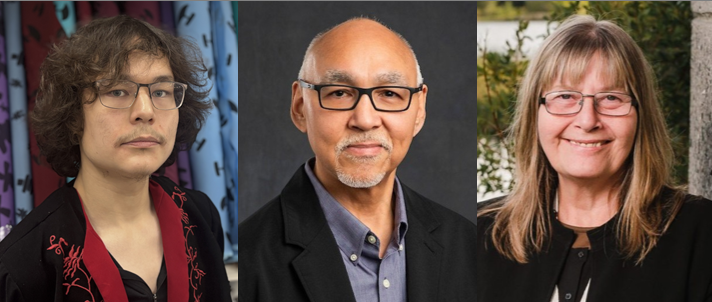
Foster care survivor Jeremy Young, left, academic and researcher Peter Williamson, and women’s advocate Arlene Hache agree that Nunavut’s child welfare system needs to be rebuilt under Inuit leadership. (File photos)

The broken child welfare system in Nunavut is rooted in the territorial government’s colonial approach to the problem, say some with years of experience with the system.
“The taking of Indigenous children never stopped at residential school,” said Jeremy Young, who was separated from his mother as a child. “It only continued with foster care.”
Young spoke to Nunatsiaq News about his experience in Nunavut’s foster care system Thursday in response to the latest report by the federal auditor general into the territorial government’s handling of youth in its care.
Tuesday’s report, the fifth over 15 years, shows little has changed. The Nunavut government is failing to account for the number of children in its care, failing to do consistent check-ins and failing in its duty to make sure every foster child is put into an appropriate home.
Young, now 26 years old, was taken from his mother as a child in Pangnirtung even though she did her best, Young said.
He blamed overcrowding and poverty for his family’s situation, saying his mother tried for 12 years to get housing for her family but ultimately could not.
“Society has failed Indigenous people,” he said. “That’s why we live in poverty. That’s why we go through the traumas we went through.”

Young believes Inuit self-government is the antidote to the problems in the foster care system.
Rankin Inlet researcher and academic Peter Williamson and Arlene Hache, an advocate with decades of experience working with Indigenous women agree.
Williamson said even if the territorial government finally heeds the auditor general’s recommendations for fixing foster care, which includes getting a handle on its own information management system, it wouldn’t solve the root causes that lead to the removal of children from their families? It would only streamline the system.
“They are identifying the Band-Aid solutions in government instead of fixing the root causes in the communities,” Williamson said.
Unstable housing, low education, unemployment and poverty are risk factors for removing children from their families, Williamson said, citing peer-reviewed studies by North American and Nordic researchers.
“Those are prevalent in Nunavut,” he said.

Mothers forced to enter emergency housing have an even greater risk of having their children taken from them, he added.
Hache agreed, calling the current system a form of “genocide” of Indigenous people.
“When [government workers] go into a family or a community, they are searching for all these problems,” she said. “Because of their colonial mindset and their racism.”
An alternative is an Inuit-led, community-based model that “supports families, recognizes their value and their ability to recover, and provides support, mentorship, and training,” she said.
“Let’s persuade people that they can grow from the place they are to a new place. That’s how elders in Inuit communities think.”
Shortly after the territory’s inception in 1999, the Nunavut government invited Hache on a territory-wide tour to share information about this approach to foster care, she said.
It wasn’t a new idea. Developed and adopted in Hawaii in 1979, it is still in use today.
“It was a well-evidenced model based on world-Indigenous understandings of families and children,” Hache said. “It wasn’t like it was radical or new. But everything in the North is radical and new if it’s not colonial.”
Nunavut rejected the model.
(0) Comments