

Families struggle after change to food voucher program
Funding ‘was so helpful for a large family,’ says Pond Inlet mother
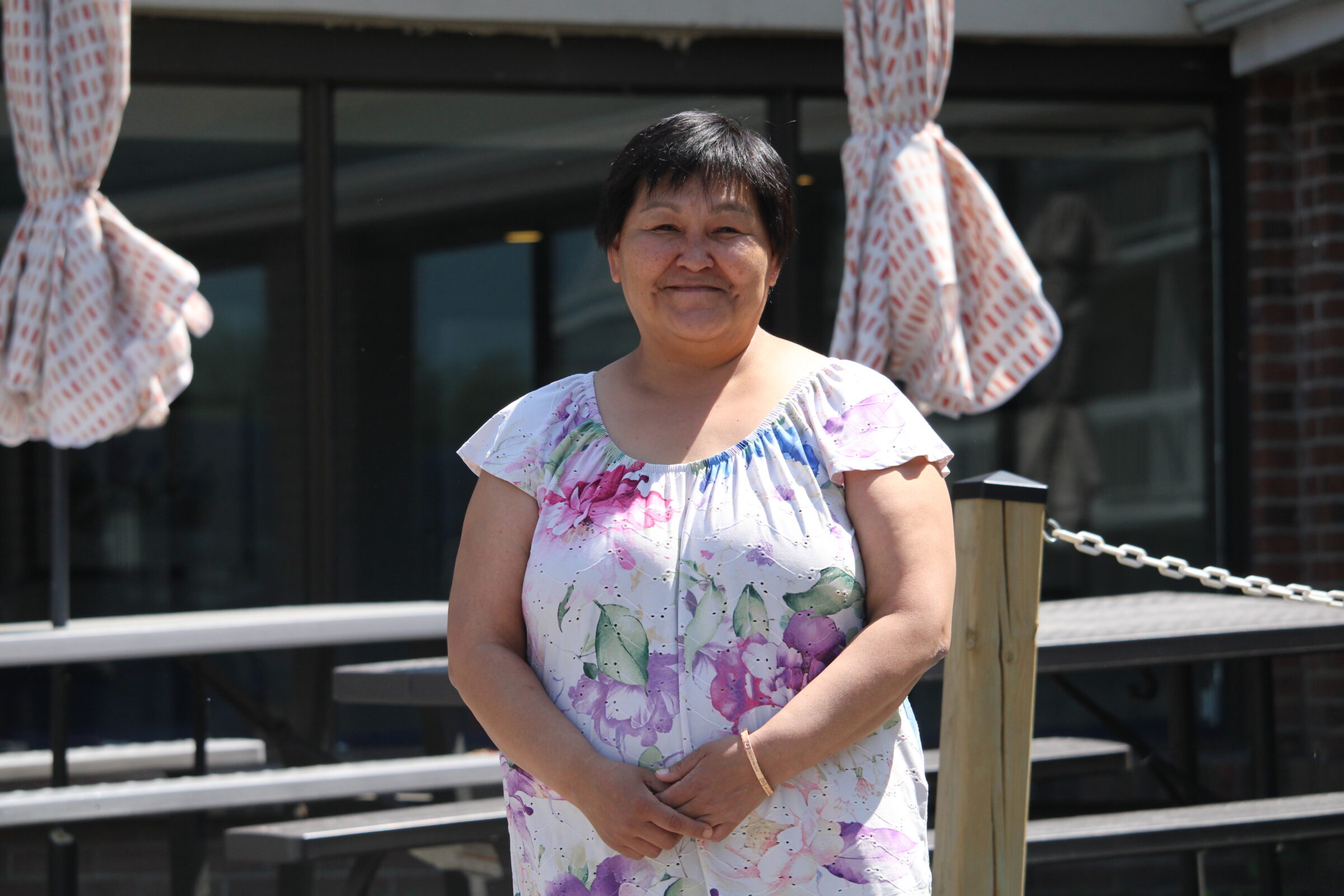
Rhoda Komangapik says the loss of the universal food voucher program has been hard on her large family. (Photo by Arty Sarkisian)
Some Inuit families in Nunavut are struggling financially, following the federal government’s cancellation of a children’s food voucher program this year.
The universal food voucher program was a part of the Inuit Child First Initiative, which provides Inuit families money to help pay for their children’s health and education needs.
The program, which started in 2024, gave $500 worth of food each month for every Inuit child under age 18, and an additional $250 for children under four to be used for things like diapers and baby formula.T
Though funding for the Inuit Child First Initiative was extended by the government for another year in March, the food voucher program was modified. Instead of being available to every Inuit family with children, it now funds children only on a case-by-case basis.
The vouchers were “so helpful for a large family,” said Rhoda Komangapik, a Pond Inlet mother, in a recent interview.
When the program was in place, she said, “I felt so much happier for [my family] that the food was on the table and we were mostly cooking now [and they] ate whatever they want to eat.”
Komangapik currently does not work in order to take care of her disabled seven-year-old daughter.
Like many Nunavut families, due to the territory’s housing shortage, Komangapik shares a home with four adults and 10 children.
All the adults are employed except her older daughter, who is on medical leave. Even so, without money coming in from the food voucher program, making ends meet has been difficult, she said.
Like Komangapik, Alurut Qaunaq shares a home in Igloolik with three generations of adults and children.
Quanaq has two children, while her brother and sister-in-law have six kids ranging in age from two to 16. Quanaq works as an assistant in NDP MP Lori Idlout’s Igloolik office, while her brother is self-employed. Her sister-in-law is a stay-at-home mom.
The household monthly income can vary from $6,000 to $10,000 before taxes, depending on her brother’s business income, but that’s a rough estimate she said.
That puts them pretty much in line with other Nunavut households. According to Statistics Canada, in 2022 the average monthly income in the territory before taxes was just over $7,800.

Even with the family’s relatively high income, Quanaq said, “it is still not enough.”
She said part of the problem is that Nutrition North — the federal program that subsidizes the price of healthy foods — doesn’t do enough to reduce the price of groceries. Its shortcoming is felt even more acutely now that the food voucher money has been taken away.
“Nutrition North is no help,” Quanaq said. “They look like they are lowering the prices, but they are way up, like triple.”
She said her family pays more than $3,500 per month for groceries.
Before the food voucher program was introduced, the family had to make sacrifices, like scrimping on clothing purchases in order to buy food. That changed when the food voucher funding started — the family no longer had to choose between putting food on the table or shoes on the kids’ feet.

“The kids were happy,” Quanaq said, and their grades in school improved.
Now that it is cancelled, they are going without again. There isn’t as much food for them.
And Quanaq noticed a difference right away.
“The kids are sleeping longer. They don’t really want to play outside,” she said.
“They ask for more food. Sometimes we can’t afford it, we have to wait to get paid.”
She said other families are reaching out to her asking for food.
Last week, Idlout called on the federal government to reinstate the food voucher program.
Speaking in the House of Commons on June 16, she recounted the story of one woman she knows: “Mosie is a single mom in Taloyoak. Her monthly income is less than $1,100. The Inuit Child First Initiative helped to feed her children, every day,” Idlout said.
She added, “At 42 per cent, Nunavut has the highest rate of child poverty in Canada. It also has the highest rate of food insecurity across the country.”
Changes the government made to the Inuit Child First Initiative “result in keeping Inuit children in poverty.”
In her response, Rebecca Chartrand, the minister for northern affairs, ignored Idlout’s request to reinstate the food voucher program and focused on Nutrition North.
Nutrition North is undergoing external and internal reviews, Chartrand said.
“We are committed to building on the positive steps already taken, like the food-harvesters program and the community kitchen program to ensure that Northern communities benefit fully from these types of initiatives.”
Give a man a fish, he will be hungry again tomorrow; teach a man to fish, he will never go hungry again.
I am torn on this issue. I understand fully why the loss of this funding is distressing. For the first family with 10 kids in the house that was between $5000 and 7500 dollars a month that they are no longer getting. Put another way that is between $60,000 and $75,000.00 no longer being received in that house. But hold on. That does seem excessive. Even with Northern prices spending $60,000 a year on food seems rich. The other issue is this was being provided across the board to 100% of Inuit families with childern. No matter if they had two working parents in government jobs earning well over $200,000 dollars a year or if a family on social assistance. I strongly believe that funding should be made available. But I also agree that it should be case by case based on need. Sorry. I am appalled at living conditions with numerous adults and 10 kids in one house. We need to do better.
All families deserve assistance. All of them.
Yes
It’s not a simple as putting a fishing rod over your shoulders and going to the lake or a river to fish. There’s a little more to it up here.
For 8 months of the year, you have to contend with the fall, winter and spring seasons. Then there’s the cost of a snowmobile, ATV, boats, a qamutik, survival gear, guns and fuel. Nothing is cheap and fishing spots aren’t simply around the corner.
My man, it’s an adage that indicates that if you teach someone to do something they will be better off in the long run than giving out handouts. The poster does not mean it in the literal sense of teach everyone to fish.
As in if NU keeps giving handouts, no one will have incentive to better their life via skills training, education and employment.
I had a good belly laugh though.
Dear Peter, what i posted is an analogy that emphasizes the importance of teaching skills and fostering self-sufficiency over providing temporary solutions. It highlights that empowering individuals with knowledge and abilities allows them to sustain themselves long-term, rather than relying on short-term aid. If you read between the lines you would understand that it has nothing to do with fish.
Honestly, as a taxpayer I feel disgusted reading this article.
That’s $5,000 a month in food vouchers if under the age of 18, possibly more if some of the kids are at the $750 a month threshold.
Also our tax money going to Nutrition North.
How much is enough. Take another pound of flesh off the working individual why don’t you.
Money is not infinite, it comes from the hard working people around you off their pay cheques.
The crazy thing is, while people like this struggle, the Inuit orgs are sitting on hundreds of millions of dollars they can’t figure out what to do with and they won’t even allow beneficiaries to know the amounts of royalties negotiated with mining companies.
Nunavut is awash in money but only the usual thin layer of Inuit at the top get a taste and Ottawa is increasingly an accomplice.
You can go to the AGM. You can also view their financial statements on line in the case of QIA and KivIA
What you’re saying is incredibley false for the Kitikmeot. What royalties. We haven’t had a producing mine in years. B2 will soon go into production and you can go to the AGM and they go through the financials line by line and know exactly how much they got.
All that’s needed is minimal effort on your own part to get this information since you can even attend online these days.
Wellp, nobody complained when the prices of everything was going up while the program was going on
“Mice die in mousetraps because they don’t understand why the cheese is free.”
My wife and I live in Nunavut. We get by on $500 per month for food. That’s for two of us. Just sayin’.
Lots of tea and bannock.
How did people manage before JP
The entitlement sense in Nunavut is just….😱”Wow”❤️🩹
We also average about $600 a month for two adults – and we eat very well! I think that people don’t realize how things like juice bring the costs of groceries up. We have eliminated juice and other heavy items from our vocabulary because it’s both expensive and unhealthy (so full of sugar). We cook everything food from scratch, and that’s really the cheapest way to eat up here – provided you have time to do so.
Perhaps it’s like for everything: when you are a bit struggling with lots of people in the house, it’s easier, faster, and sometimes necessary to get ready-made food. I think that if the $500 was only for food, that might be a little higher than the actual cost for a child, unless they eat ready-made meals every day. If it’s also for other items, then yes, it makes more sense.
The food center gives great opportunity for fresh and cheap veggies, I hope people take advantage of it!
In real poor places people are super skinny and starving. Nunavut has one of the biggest obesity problems in the world. Explain that?
Cheaper foods, often nutritionally void, are higher in sugar and carbs which cause weight gain.