


Federal government ends NunatuKavut’s bid for Indigenous rights
Nunatsiavut Government, NTI, and ITK support federal decision
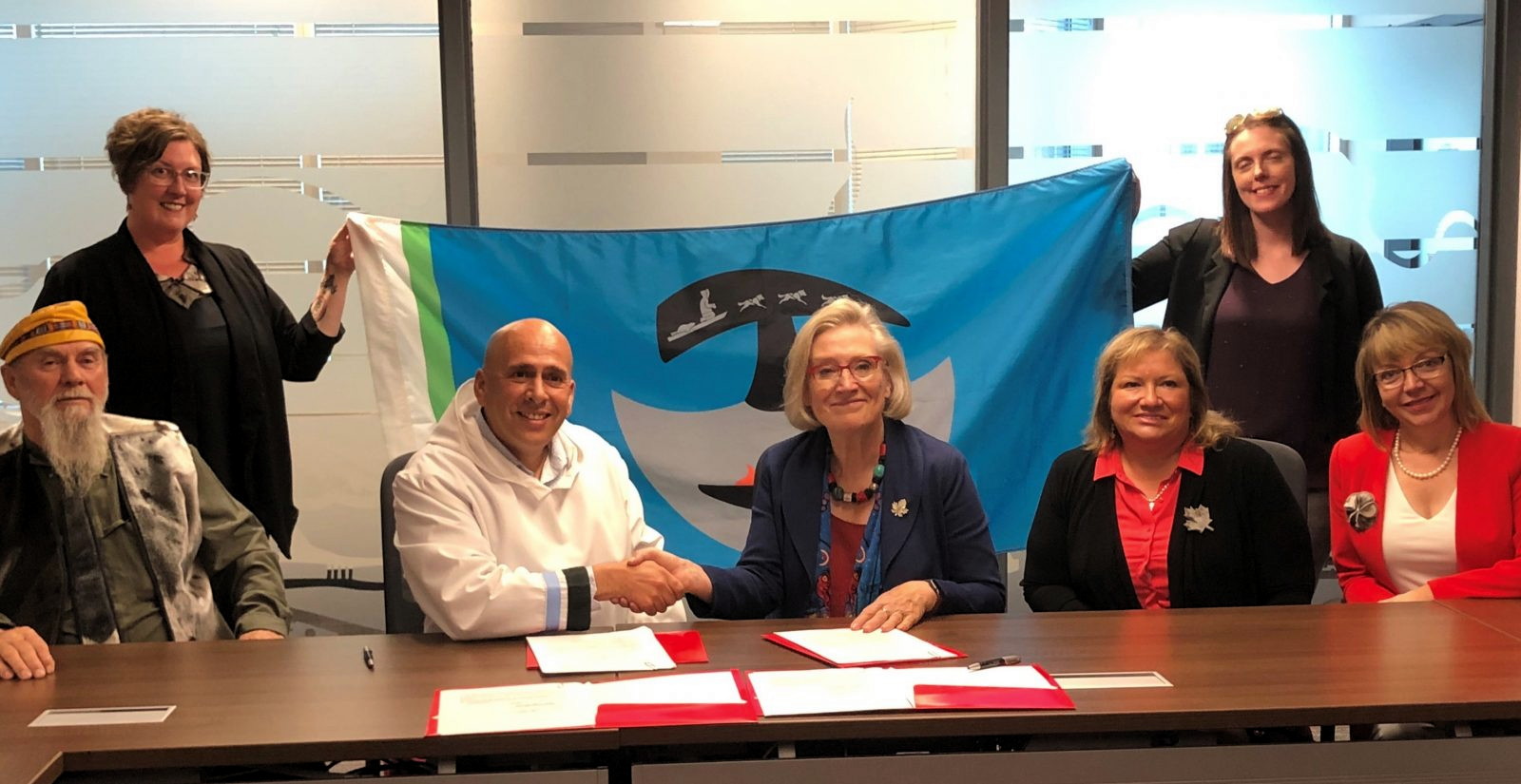
Todd Russell, the president of the NunatuKavut Community Council, and Carolyn Bennett, minister of Crown-Indigenous relations, shake hands at the signing of a memorandum of understanding between the NunatuKavut council and Canada recognizing Indigenous rights and self-determination, on Sept. 5, 2019. The federal government announced last week it is ending NunatuKavut’s bid for Inuit rights. (Photo courtesy of NunatuKavut Community Council)
The federal government has ended a years-long process to negotiate Indigenous rights and self-determination with the NunatuKavut Community Council, an organization that says it represents about 6,000 Inuit in southern and central Labrador.
According to a Tuesday statement from NunatuKavut, Crown-Indigenous Relations Minister Rebecca Alty informed the council in a letter on Sept. 4 that the federal government was terminating its Recognition of Indigenous Rights and Self-Determination negotiations.
“[NunatuKavut Community Council] is a strong and modern Inuit government that remains committed to the recognition of our rights and the advancement of our people’s well-being,” the statement read.
The council said it was not given substantive reasons for the decision.
The federal government has reviewed submissions from NunatuKavut, historical and legal analysis, expert reviews and discussions with the council, said Jennifer Cooper, a spokesperson for Crown-Indigenous Relations and Northern Affairs Canada, in an email to Nunatsiaq News.
The evidence provided by NunatuKavut did not meet “court-established tests for Indigenous rights and title,” Cooper said.
She said her department has offered to meet with NunatuKavut to discuss its findings in detail.

NunatuKavut’s leaders have said its group’s members are of mixed ancestry who primarily come from communities south of Churchill River, and are descendants of Inuit in the region.
They argue their members are the inheritors of a 1765 treaty between Inuit and the British Crown.
The group does not have a modern comprehensive land claim agreement, and the council has acknowledged that relatively few of its members speak Inuktitut.
The federal government has never recognized NunatuKavut as an Indigenous group capable of holding rights under Section 35 of the Constitution.
That changed in 2018, when Crown-Indigenous Relations Minister Carolyn Bennett began talks with the group.
In September 2019, Canada and NunatuKavut signed a memorandum of understanding that recognized the group as an “Indigenous collective capable of holding section 35 Aboriginal rights.”

Nunavut Tunngavik Inc. welcomed last week’s reversal by the federal government, adding that discussions that involve Inuit rights, self-determination and governance must be in the authority of “recognized Inuit rights holders.”
In a Sept. 8 statement on Facebook, Inuit Tapiriit Kanatami called NunatuKavut a “fraudulent collective,” adding such groups undermine Inuit and other Indigenous Peoples and can divert funding intended for Inuit.
The Labrador-based Nunatsiavut Government released a statement as well, saying NunatuKavut’s claims to Inuit identity are not recognized by Inuit or the Innu Nation.
“Inuit identity is not something that can be self-declared — it is affirmed by Inuit, grounded in our culture and history,” Nunatsiavut president Johannes Lampe said in the statement.
NunatuKavut maintains that it is “appalling that the minster of Crown-Indigenous relations would bend to pressure from other Indigenous groups on the denial of our claim.”
“We are Inuit. We come from Inuit. That will never change,” reads NunatuKavut’s Tuesday statement.
Finally the federal government has made a sensible decision in the face of the fraudulent claims of the NunatuKavut group, claims which were allowed to go on unchecked for far too long. This decision was long overdue.
There is no denying that a number of people in southern Labrador have some Inuit ancestry, but certainly not 6,000 people. But one Inuk ancestor a number of generations back cannot make one an Inuk. The concept of the “root ancestor,” as it is called by some indigenous groups in North America, is a bogus concept which holds that all descendants of the indigenous “root ancestor” are bona-fide members of the ethnic group to which that ancestor belonged. By that logic, I would be German (because of a great-great-grandfather who was German); for me to identify as German would be ridiculous and laughable. This was the logic used by the so-called “Southern Inuit” to justify their claims of being Inuit.
It is one thing for people with Inuit ancestry to claim to have an Inuit ancestor, and to be proud of that fact. But it is quite another thing to say that that fact makes them Inuit. It doesn’t.
Claims by the NunatuKavut group over territory legitimately claimed by the Innu Nation did much damage to the Innu Nation’s progress toward an eventual land claim.
My Inuit ancestors have always lived on the Labrador coast, we are legitimate Inuit descendants as are many on the north Labrador coast. My DNA proves we are related. Inuit were not restricted the north coast, they were free to travel and yes some decided to make their home on the south coast. We did lose the language when the European ancestors forbade their Inuit wives to stop using it, some words did stay though. I am a proud member of the NunatuKavut Community Council. I am 77 years old.
How can we all learn from this and hopefully make every culture in the world to have international cultural status card… to claim what culture they are…. culture protection will be needed in the future…
Hi Ken,
I have been working on the historic past of southern Labrador for about 25 years now and have the peer reviewed literature to back it up. To the best of my knowledge, you have never had a single ‘field day’ in southern Labrador and are basing your comments on bogus literature and spiteful sound bites from detractors of NunatuKavut; ostensibly, competing for Federal funds. The separation of north/south Inuit in Labrador is a sad state of affairs brought on by divisive colonialism very early in the contact period. I suggest you read Lisa Rankin’s recent chapter in an Allan Greer edited book, ‘Before Canada’ for the at-contact period. To gain some notion of how the concept of ‘root ancestor’ does not apply to Labrador, because they are all root ancestors with extensive kin-groups, I can refer you to the work of both Roger MacDonnell and Neil Reddekopp from the 1990’s. More recently, I was asked by the Federales at the RIRSD table, being one of NunatuKavut’s four negotiators, to expand a concept, unkown to NunatuKavut elders, that of ‘core ancestors”. That is perhaps the same idea as the urban concept of ‘root ancestor’? I can provide a rather large excel spread sheet showing the web of southern Inuit kin-groups which I provided the Federal negotiators, to illustrate my point. In that same vein, I can refer you to “Unveiling NunatuKavut: Describing the Lands and People of South/Central Labrador”, authored by myself and D. Bruce Clarke from Halifax. It is unfortunate that the ‘on reserve’ Inuit in northern Labrador (today’s Nunatsiavut Government) have bought into the Great Colonial Project; brought to the Atlantic shores of Labrador in the sixteenth century and which has persisted to the present day.
Cheers
Greg Mitchell
Hi Greg,
I’m not sure what “field day” refers to. I have never lived in southern Labrador or anywhere else in Labrador. In 2015, as the NunatuKavut claims were more and more in the news, I was sufficiently curious about it that I flew to Blanc Sablon, rented a car, and spent about two weeks driving up the highway to Cartright and back, spending time in Red Bay, Battle Harbour, Cartright, and many small communities along the highway. In particular, I met and talked with a number of people in St. Lewis, formerly Fox Harbour. Why? Because I wanted to know what was going on. There was no government or institutional grant paying for this trip; I did it on my own. And there was no report to anyone or any organization about what I learned.
And I have read extensively on the topic of NunatuKavut. I have read “Unveiling NunatuKavut,” all 392 pages of it, and much more.
I also remember well an interesting and lengthy conversation we had in Montreal at an Inuit Studies Conference, I think in 2019, at a time when I was more sympathetic to the NunatuKavut cause than I am today, so I am well aware of your passion for the cause and your dedication to advancing it.
I agree that the separation of people in north and south Labrador is a sad state of affairs. I also believe that there are many inequities in the Labrador claim which led to the creation of the Nunatsiavut Government. Many of these inequities are attributable to the unfortunate blood quantum requirement for Inuit, a requirement unique to Nunatsiavut among the four settled Inuit land claims. The inclusion of “settlers” (Kabunângajuit) in the Nunatsiavut claim is also unique to Labrador and, in my opinion, probably acted as an incentive to people with some Inuit ancestry in southern Labrador to pursue the NunatuKavut agenda.
I would like to learn how your concept of “core ancestor” differs from the concept of “root ancestor as promoted by the Algonquins of Ontario, for example. I do not deny that many people in southern Labrador have Inuit ancestry. But I cannot accept that one Inuk ancestor no matter how far back in time gives one the right to call oneself Inuit. That is the logic which the Qalipu used successfully in Newfoundland and, again in my opinion, it is unfortunate that that travesty was ever allowed to happen.
I have a German great-great-grandfather. I don’t consider myself German or call myself German. To do so would be to court ridicule. I believe that the same logic applies to many of the people of southern Labrador. I accept that there are inequities in the Nunatsiavut claim and that there should have been some provision to include some people in southern Labrador, but certainly nowhere near the number that claimed membership in NCC.
Ken, I appreciate that you took the time to travel through southern Labrador in 2015 and speak with people, including people in Fox Harbour/St. Lewis, and that you have read extensively about NunatuKavut. I don’t question that you have made a genuine effort to understand the history.
Where I disagree with you is in the way you frame Inuit identity in southern Labrador.
I am from Fox Harbour. My Inuit identity is not based on finding one distant Inuit ancestor and deciding that I am therefore Inuit. It comes from my family, my community, our history, our relationships, and the way Inuit life has been carried forward in southern Labrador. Those things cannot be reduced to a blood-quantum calculation or to the number of generations separating someone from an ancestor.
Your comparison between having a German great-great-grandfather and being Inuit is therefore not convincing to me. Being German and being Inuit are not necessarily comparable concepts of identity, and Indigenous identity has to be understood within the particular history of the people and communities involved. Would you identify as German if you grew up in Germany and spent your entire life there following the ways of your great-great grandfather, great grandfather, grandfather?
I also think the comparison to Qalipu risks oversimplifying what people in southern Labrador are actually saying. The question isn’t simply whether someone can point to an Inuit ancestor. The much larger historical question is whether there has been a continuing Inuit population in southern and central Labrador, with family, community, cultural and territorial connections extending through generations. These are mandatory for NCCs membership process – despite what you think you know.
You say that you accept that many people in southern Labrador have Inuit ancestry, but that you cannot accept that they are Inuit. I would ask you to consider what evidence you believe should distinguish those two things, and why the historical experiences of Inuit families in southern Labrador should be measured against an analogy involving your own German ancestry.
You also say that you became less sympathetic to NunatuKavut after your research. I respect that your position changed. But I would be interested in knowing specifically which evidence changed your mind, particularly evidence concerning families from places such as Fox Harbour/St. Lewis.
For people whose families come from these communities, this isn’t simply an academic argument. We are talking about our ancestors, our families, our communities, and our understanding of who we are.
You spent two weeks travelling through southern Labrador because you wanted to understand what was going on. I think that same curiosity requires listening seriously to the people who have lived that history, not only asking whether their ancestry meets a particular threshold, but asking what kind of Inuit community existed here and how that identity was carried forward.
Hi Ken,
One final comment. Just to say that I don’t work for a cause, I work for a people. To see how these people were treated in the violent colonial environment of the eighteenth century, I can suggest that you read a recent paper by myself and a colleague and published by Acadiensis at UNB, re – Mitchell, G., & Crompton, A. (2026). Slavery in New France: Resistance and Enslavement of Southern Labrador Inuit. Acadiensis (Fredericton), 54(2), 8–39. https://doi.org/10.63489/acad.2025.35808
For much of my life, my search for identity was a quiet one. It began when I was a teenager, with a feeling that something was missing.
In my community, for whatever reason colonialism, adapting to life in a changing world, or simply the need to get on with life our Indigenous connection had been suppressed. The stories, the knowledge, and perhaps even the language of who we were had become less visible from one generation to the next.
For me, there was always a void.
My faith is strong. My connection to home and family is strong. My work ethic is strong. I am proud of where I came from and the people who raised me. But there was a part of me I could not explain.
When I went to college in Ontario, people would ask me, “What Aboriginality do you belong to?”
I didn’t have an answer.
That question stayed with me. It helped me recognize that the piece I was searching for wasn’t something outside of me it was something within me that I needed to understand.
When I returned home, I became involved with what was then the Labrador Métis Association. I wanted to learn. I wanted to understand our history, our families, and the Indigenous connections that had been obscured over generations.
And the more I learned, the more fulfilled I became.
As we researched our ancestors and followed our family trees, something became undeniable to me: my Indigenous lineage was Inuit.
This was not a strategic decision. It was not about choosing an identity because it was convenient or beneficial. It was a realization that came through research, family histories, genealogy, and a deeper understanding of the people who came before us.
Today, I know who I am.
I know where I belong.
And I no longer need others to define me.
My connection to the Inuit people and to the history of our families is something I carry with pride. My relationship with the NunatuKavut Community Council is part of that journey and part of my continuing effort to understand, protect, and give voice to the identity and rights of our people.
A government letter cannot tell me who I am.
It cannot erase my ancestors.
It cannot erase the family trees, the stories, the research, or the journey that brought me here.
My identity was not given to me by a government.
I found it.
I learned it.
I came home to it.
And I know who I am.
#ourrights #NunatuKavut