


Federal government will fast-track Iqaluit hydroelectric plant, Carney says
Proposal to build a hydroelectricity generator among 6 ‘nation-building’ projects announced
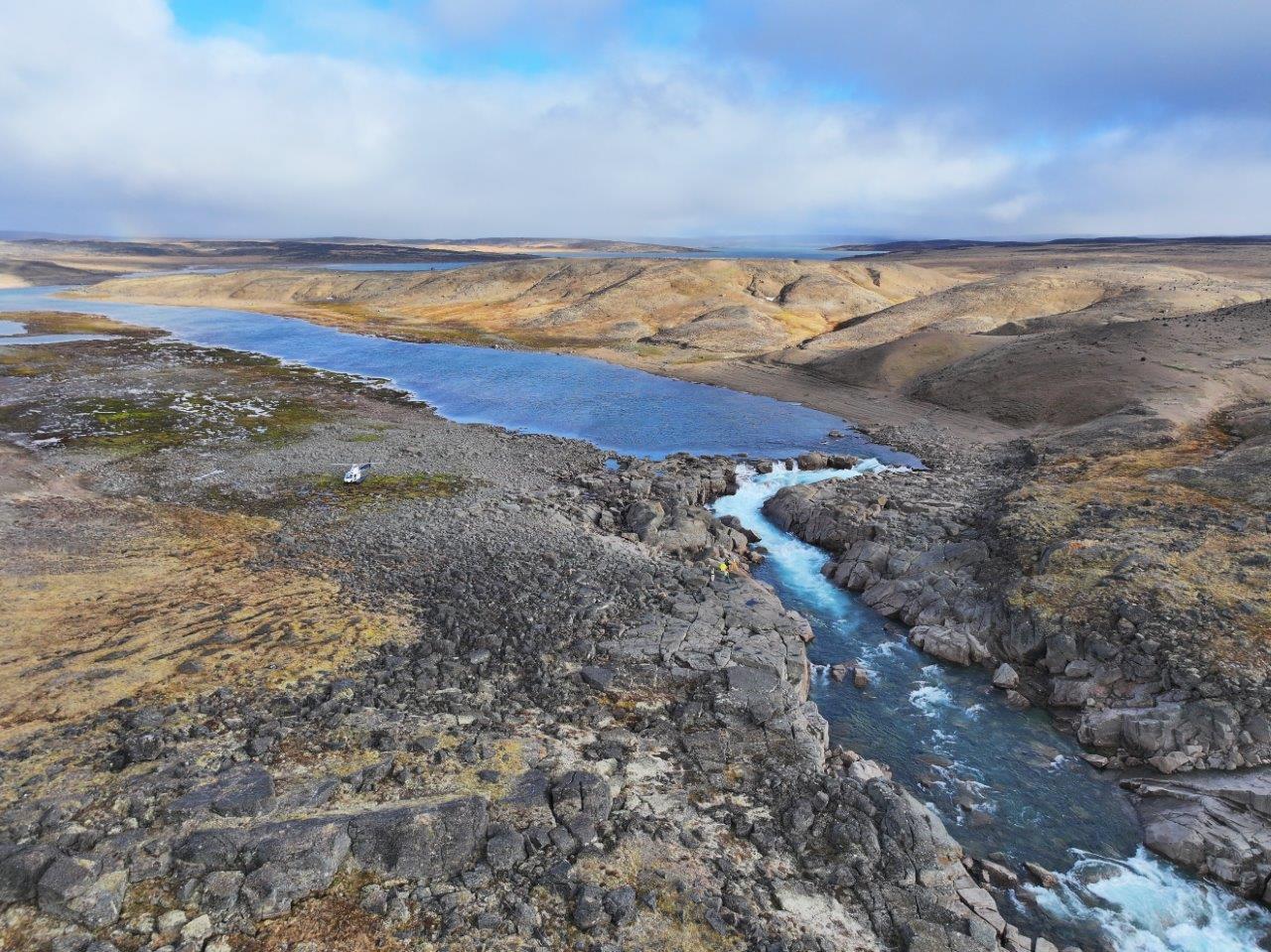
A proposed hydroelectric project with a 50-metre-high dam and powerhouse would be built along the Kuugaluk River, about 60 kilometres northeast of Iqaluit. (Photo courtesy of Nunavut Nukkiksautiit Corp.)
The Iqaluit Nukkiksautiit Hydro Project is one of six new “nation-building” projects the federal government wants to fast-track for approval, Prime Minister Mark Carney said at news conference Thursday in Terrace, B.C.
The proposal would see a hydroelectric power plant built along the Kuugaluk River, about 60 kilometres northeast of Iqaluit.
It would generate enough power to replace Iqaluit’s diesel-burning electricity generator.
Projects that Carney announced will be referred to the government’s Major Projects Office, which was created to streamline the regulatory process for big infrastructure projects deemed to be in the national interest.
The Major Projects Office, announced in August, enables the government to prioritize infrastructure work that normally would take years before shovels were put in the ground, Carney said.
The five other projects announced Thursday were the North Coast Transmission Line in northwest British Columbia; the Ksi Lisims LNG project on Pearse Island, B.C.; Canada Nickel’s Crawford Project in Timmins, Ont.; Nouveau Monde Graphite’s Matawinie Mine in Saint‑Michel‑des‑Saints, Que.; and the Northcliff Resources’ Sisson Mine in Sisson Brook, N.B.
Rebecca Alty, the federal minister of Crown-Indigenous Relations, was scheduled to make an announcement at Qulliq Energy Corp.’s Iqaluit power plant Thursday at 4 p.m., about two hours after Carney announced the latest round of nation-building projects.
Nunatsiaq News will have full coverage of Alty’s announcement and more news about the hydro project later Thursday.
Nunavut should seriously look at SMRs for Iqaluit and other communities . A modern SMR is the size of a couple sea cans, can power the whole city, its the CLEANEST and the SAFEST option, and costs a fraction of a massive hydro project. Hydro is great, but we should at least compare it to the newest nuclear tech. And of course, this project is being fast-tracked by the time it’s done, other places around the world will be running SMRs and we’ll be looking at them thinking wow what a great idea….always playing catch up
SMRs are an untested technology that generate significant amounts of nuclear waste — a hazard and security risk for 100,000+ years, with no current operating permanent storage site in Canada or the US. In addition, uranium mining creates highly toxic tailings. That’s hardly “the CLEANEST and the SAFEST option.”
Actually you are both incorrect. SMRs have promise but are still unproven commercially. In other words none are actually in production right now for electrical generation purposes. The actual permitting process for new nuclear generation is over 10 years. Who is going to invest time and effort and waste 10 years waiting for approvals (or rejection) for minimal profit. Nobody.
The north is not the place to R&D unproven solutions due to its remote nature. Someday , if socially acceptable, it will be a perfect solution. Right now nuclear has an image problem to solve along with proving the technology in commercial operation. Many Inuit communities would hesitate to approve such technology right now.
SMRs do not produce the same waste as large nuclear power plants, neither in quantity (although actual nuclear waste quantity produced in Canada over the last 50 years is roughly equivalent to 50 gal oil drums covering a football field) or in terms of radioactive output. In fact the spent fuel from SMRs is barely radioactive. The North has plenty of abandoned mines to accommodate this waste. It should also consider storing highly radioactive waste from large nukes in one of these abandoned mines. Buried, encased in concrete, and charge the owners an ongoing storage fee. Easy , safe, good for everyone.
Good points, but just to clarify, I’m not talking about the big 300 MW reactors like Ontario is building. I mean the micro-SMRs that are actually designed for remote communities. Those ones are already proven in other parts of the world, including by the US military and Arctic research stations. They’re basically sealed nuclear batteries, low-pressure, can’t melt down, and only need a small amount of fuel every decade.
I agree the licensing process in Canada is slow. That’s kind of my point though. If we never start looking at them, we’ll still be spending close to a billion dollars for 15 MW in 2035 while other places are running 20–50 MW units the size of a sea can.
We wouldn’t be “R&D-ing” anything here. These are manufactured elsewhere and shipped in, just like our diesel generators. It’s just strange that we didn’t at least do a feasibility study before choosing the most expensive and slowest option.
Micro modular reactors are not tested enough for a whole town to rely on for energy. I think that’s the point, it’s great they are powering a couple buildings already, but for a whole town to be a testing ground would be unfair.
I do think that eventually MMRs will have to be integrated in the Arctic, and are very promising for both electricity and heating output.
Hydro is reliable and even when the city’s energy demands go up, integrating wind and solar to a dam would be a simple solution.
Sorry yes MMR not SMR, same technology but on a smaller scale. The scale in this case being 5MW for an MMR, as opposed to 100-300MW for an SMR.
There are no MMR in commercial operation anywhere in the world. Period. They have been used for military and scientific purposes for the past 70 years and extremely safe and reliable. The fuel is minimal (replaced every 10 years) and the waste is also minimal, barely radioactive, and not a threat to the community. MMR are also relatively small. Westinghouse has a 5MW unit that comes in 5 seacans for assembly. It is also considered “walk away safe” as it can never have a melt down according to the manufacturer.
The problem is not it is not proven for electrical generation in a commercial setting and the time required to begin the process of R&D is unreasonable. Various SMR proponents have been trying to develop an R&D project SMR/MMR for nearly a decade now on existing nuclear sites such as Chalk River and Point Lepreau. Still no luck. Nunavut is not the place to R&D this technology without some kind of backup.
A community such as Iqaluit would need 3 of these to make up the 15MW equivalent of the hydro plant. Each unit costs about $400M so $1.2B and would have a life on 20-30 years maximum. The hydro project would cost far less than that, would have a lifecycle of 100 years, and is easily expandable to 30MW for future growth. It is also proven technology, green energy, and no waste fuel to consider. Seems like an easy decision.
MMR would be a good alternative to consider for communities which do not have a hydro resource, with a diesel plant as a backup. After a decade of proven reliability and a cycle of refueling after 10 years it will have proven itself and may be socially acceptable to some communities, however should never be forced on a community that does not want or fears the technology.
Nuclear energy fear mongering is so 1970s.
So does any fish go up that river?
Like any river probably, the great news here is Canada actually supporting major infrastructure in the north, Canada’s north has been neglected for so long, in one of the richest countries in the world, other circumpolar countries are light years ahead of Canada, small countries like Denmark has invested so much more infrastructure in Greenland and the Faroe Islands, Norway in their arctic, even Russia in their arctic regions.
Places like Greenland has 4 of these hydro dams, powering 70% of their communities.
We’ve been left behind and playing catch up, it’s great to see the commitment from our government.
The river is not going to be impacted and in fact a hydro development can ensure constant flows to the river to avoid the summer dry up. The reservoir up above the river will grow slightly and in keeping with current geology and past reservoir size. The fish in the reservoir are landlocked and the fish in the river do not migrate to the reservoir, although a new development could include fish ladders (not complicated) if it is deemed necessary.
Greenland has many hydro electric dams. They also have year-round open waters. I think it be best to study the impact of the dams on the Inuit in Greenland. Has it always been open water conditions? If not did it happen after the dams came? Are Nunavut Inuit open to losing sea ice? Are Nunavut Inuit going to benefit from this financially if this is going to change the way of life?
The current diesel power plant is many times safer and cleaner than the construction and operation of a dam, reservoir and hydroelectric power plant. That doesn’t include the total waste of money to build the new facility and decommission and turf the old one. Shameful. When it comes to a health society the Liberals always get it wrong.
How is burning diesel cleaner? Actually asking.
Are you serious?
Diesel is cleaner? Your last name Irving per chance?
I hope that is not a lie. I mean we pay homeowners pay and try to pay. And I hope they get it back from the communities. Just giving our pockets away. No more lies
Wake up people, without infrastructure investments in Nunavut, Nunavut will never grow and prosper. Currently we are stuck in the old days because of too much negativity on technology advancements, infrastructure upgrades, etc. We need projects for training, employment and long term growth. Certain groups and people within Nunavut are holding us back from being prosperous with good growth and economic benefits for our Inuit people and Nunavut as a whole. Going to good clean energy is a PLUS for our climate for future generations. Don’t be short sited, look long term for good growth within ourselves and our communities.
Oscarey, anytime any development in Nunavut, a very few vocal groups Oceans North, and a few other NGOs get all the press from NN, this is a Nation building project that should be planned even bigger and run transmission lines to all of the Baffin communitiys, along with upgrading all airstrips, but we will see with this new group of MLAs, and their input if any.
The Hydro-Electric project is both good for Iqaluit and good use of federal funds, but is a strange choice for a “nation-building” list. The river being dammed is too small to generate power beyond the present requirements of Iqaluit, itself only a town of <10,000, with limited economic growth potential. While ending reliance on diesel is laudable, the project is not scalable, cannot serve additional communities, will not be a catalyst for new industry, brings relatively few new jobs, and introduces no new technologies for "export" (domestic or foreign). A "nation-building" list should be reserved for projects that promote future growth, investment, development, resilience (e.g. mapping, roads, communications, etc.). Replicable energy projects such as modular nuclear for industry sites, community migration to natural gas, and regional power transmission lines would be better Arctic choices for the "nation-building" list.