


Future of Inuktitut cause for concern, high school speakers say
Iqaluit school hosts discussion exploring struggles, significance of language preservation
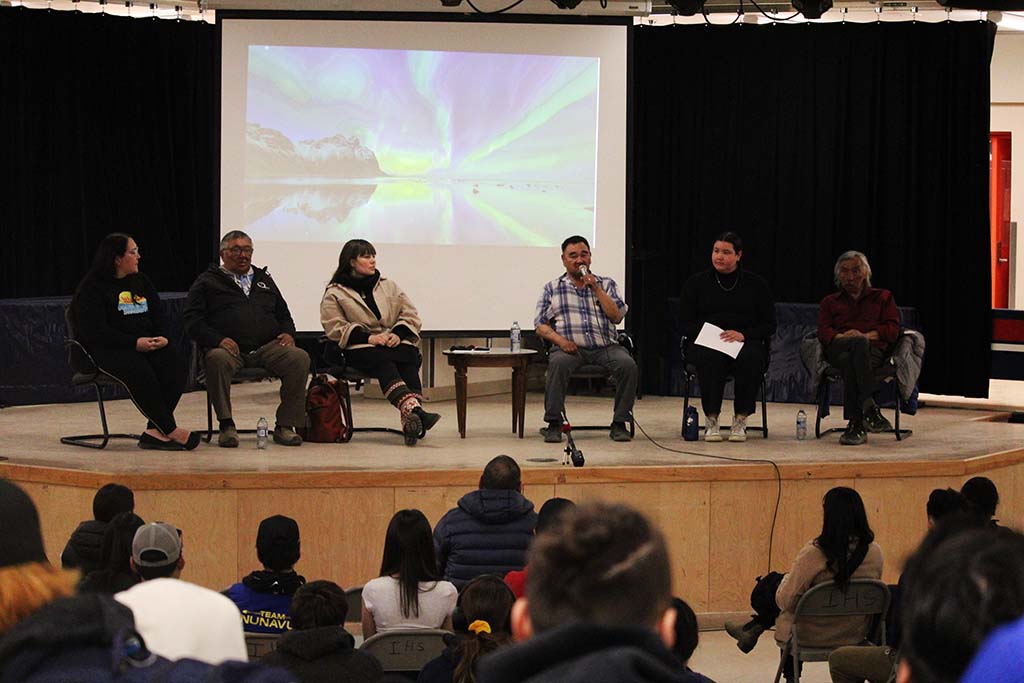
From left, panellists Aluki Kotierk, Methusalah Kunuk, Celina Kalluk, Pits Alainga, Ella Estey and Jack Anawak discuss the state of Inuktitut during a session at Inuksuk High School in Iqaluit on Wednesday. (Photo by Arty Sarkisian)

“I wish I could present in Inuktitut, but I am just going to present in English,” said Ella Estey, a 17-year-old student at Inuksuk High School in Iqaluit, during a discussion on the state of Inuktitut at the school Wednesday.
Despite living in Nunavut all her life, she said she hasn’t been taught to speak Inuktitut. She said that’s important — young adults like her aren’t given the chance to learn their own language and culture.
Estey was one of six panellists who took part in the discussion, organized by the school’s social studies department as part of its attempt to implement more Inuktitut in the curriculum.
It was attended by students from grades 9 to 12.
Estey — who in August 2023 told the House of Commons Indigenous affairs committee that Inuktitut classes should be mandatory in Nunavut schools, not just optional — was joined on the panel by other prominent members of the community.
Speakers included Jack Anawak, an elder and former Nunavut MP; Celina Kalluk, a teacher and author; Methusalah Kunuk, Iqaluit city councillor; Pits Alainga, cultural curator at Inuksuk High School; and Aluki Kotierk, president of Nunavut Tunngavik Inc.
While Estey spoke English during the discussion, the other panellists mostly spoke Inuktitut. All the panellists agreed the future of Inuktitut is worrying.

Estey, whose family is originally from Igloolik but lived in Iqaluit for most of her life, said she was never taught Inuktitut in school. All her academic classes were in English.
When her generation grows up ready to become teachers and government employees, she said, they won’t have the Inuktitut language skills to pass on to future generations.
“Young people in Nunavut who speak Inuktitut should strive to do big things for the territory to help the presence of Inuktitut,” she said in an interview after the discussion.
Anawak, a residential school survivor, said it’s important to preserve the language to help overcome the trauma of the past. At the residential school, he said, he and the other students were not allowed to speak Inuktitut.
“We lost to white people. Our parents lost to white people. But we have to go beyond that,” Anawak said in Inuktitut.
Trauma stays with people at all times, he said after the discussion. The important thing is how they deal with it.
“Everyone needs to understand that we are in Nunavut, and the reason Nunavut came to be is because of Inuit,” he said.
“There would be no Nunavut if there was no Inuit.”
This was the first time the school held a panel discussion on the state of Inuktitut, said teacher Patrick McDermott, the head of the school’s social studies department who moderated the panel.
“It was quite a wide-ranging number of people that provided their perspective, which is really important,” he said afterward.
“I really like that it was a school event where Inuktitut was predominant.”

He said he hopes the school can organize similar events in the future to help his students understand the importance of their heritage.
“My piece of advice to you as a teacher is to pick one thing to help improve Inuktitut,” McDermott told the audience at the end of the discussion.
“Whether it’s writing a small poem or sitting down with an elder and asking some questions about the translations, if everybody picks one thing, Inuktitut will improve in our community.”
Young people are not taught Inuktitut because their Inuktitut teachers rarely ever show up. Daycare workers recruited from the South because local hires don’t apply or stay employed there steadily. Lots of people flying around whining about cultural loss but unwilling to work with the common people or even teach it to their own kids.
What does “lost to white people” mean? The residential schools were orchestrated by the same governing arrogance that still exists today; and we saw evidence of that during the pandemic where “science” seemed to be replaced with authoritarianism. I know of many people, dating back to the seventies when I was a child, who were disgusted with residential schools. They were very white.
I think it’s a valid observation that refers to the complete hegemony of western culture, in this case specifically, its language. You don’t need to take it personally. It can be obvious and a fact without being an indictment of you as a person.
The Territory has much bigger problems than a language that’s barely used anymore. You have fourth grade material being used to teach grade 8s because the kids are so far behind everywhere but Iqaluit.
Schools lack basic staffing resulting in basic courses not being offered except online. Attendance rates are absolutely abysmal and parents seem to care less.
Often kids that do make it to school use it as a refuge from their violent homes and just end up sleeping most of the class.
Education is abysmal and it’s not teachers faults. Lack of parenting and very very poor judgement.
“barely used anymore”…. I would be more open to your thoughts of you had a basic understanding of our territory.
Stats Can’s 2016 Nunavjt Language Report shows Inuktituk is the MOST COMMON LANANGUAGE spoken in the home in Nunavut.
You’re conflating the statistics of whom speak and what language is used routinely. There’s a reason kids don’t know it obviously and it’s because it’s not used routinely anymore by the majority nor is it used by any large employers in Nunavut as the main operating day to day language. Not even NTI, daily business is done in English there.
Not only that were in an interconnected world now, sorry but no one is learning a language barely used to do business with those in Nunavut.
I have a basic understanding, it’s those living In Lala land that don’t. Evidence speaks for itself though. You wouldn’t have all these articles or organizations to try to preserve language if it was not dieing out rapidly. Kids would know it if it was the most common language but they don’t.
It’s not because it’s going down that the fight is lost. Yes, English has become very prevalent in Nunavut, but it’s very possible to turn the tide. Inuktitut speakers, don’t listen to that guy. Look at Quebec and use their tools to make Inuktitut vibrant again. I would totally have learnt Inuktitut if it was mandatory to live/work here and there were programs to do so. Instead, I am using English, which is not my first language either. I would much rather use Inuktitut and send my kids to Inuktitut daycare.
This comment in itself a basic lack of understanding of our territory. No businesses for the majority do anything in Inuktitut. Schools are not in Inuktitut. Daily life, at the grocery store, or elsewhere is in English. The majority of USED language is English.
The report a statistic you cited is a statistic that is based on if the respondent believes they had the ability if necessary to carry a conversation. Not what language they use and even that noted a downward trend. Where do you think we are 8 years later?
If you’re grounded in reality you know the language will eventually die out, Nunavut does not self sustain, it relies heavily on outside investment and isn’t its own silo. Even after federal devolution the entire Territory is supported and only operable due to transfer payments from a federal government and outside investment from private companies. The Territory has no ability to act on its own, and certainly will not prior to the language being completely erased.
That’s just reality, clearly the trend suggests that reality is coming sooner than later. To stick your head in the sand and say otherwise is just playing dumb in the mean time.
Boy, Lack of understanding, am I ever glad I don’t have you around for when it’s time to be miserable and perpetuate it. There’s a difference between being real and having a vision to solving problems. To say the language will die out is laughable.
“Barely used anymore…” Is right.
“InuktituK ” is dying fast in our little sik-sik hole in Nunavut.
Travelling to a certain region and people (Inuit) laugh and make fun of the dialect.
Good incentive to learn “InuktituK”?
How ’bout students learn the 3 R’s,
(Reading, ‘riting & ‘rithmetic) first. At least the basics.
Seems to be passing the buck a bit, isn’t it? Children learn language long before they first attend school.
Learning and understanding Inuktitut is the parents’ job. Not the Dept. of Education.
“Yeah…but…”🥱
Blame your parents if you can’t speak Inuktitut. Language begins at home. In the communities, Inuktitut is widely spoken. Perhaps, Ella you can go to Igloolik for the holidays to spend time with your family there and you can surely pick up Inuktitut? Barring that, Pirurvik in Iqaluit offers Inuktitut class, have you enrolled? Talk is cheap, need more action.
Inuit can learn from any 10-12 year old in igloolik or arviat that speaks inuktitut. Any one willing to learn, im 100% sure of that. I can see language is well preserved in these two communities. Igloolik and arviat.
Are there not enough qualified and reliable inuktitut teachers because there is no university in iqaluit yet? Or is it’s use declining because of the advancement of internet, tv and technology, where the English speaking world is no longer the outside world, as it was 50-100 years ago?
Yeah, keep an look out for the newly Deputy Minister of Education committed to hire Teacher’s without any QUALIFICATION’s just to fulfill vacant positions in the schools across Nunavut. What do you think of this nomadic proposed plan? It best to become stone age!
About 1973 Sedluk ( Bryan Pearson) proposed dismissing all southern teachers in favor of hiring local individuals as teachers.
In 1973, that would have been easier to do. Dick and Jane were still all the rage and students had a Math workbook as thick as today’s textbooks that you worked on all year. The same existed for all courses….. a giant workbook.
The job has gotten a lot more complex today.
And how many locals do Nunavut have, “Sedluk”? I read in NN the majority of Nunavut can’t pass a basic entrance exams to get to college or university.
Besides qualified teachers do NOT want to live in the most violent place to live in Canada.
On language, Québec ‘résistance’ is something that should inspire Nunavut. Bill 101 for Inuktitut? Why not? There is a lot to learn on the east side too. Greenland has made tremendous progress over the last years on that matter. Unfortunately, it will not put competent teachers in those classrooms. Maybe it’s just the finger in the hole that prevent the dam to collapse, but it’s a start. For now, we seem to have no plan whatsoever…
When we enrolled our 9-year-old son in a school in Nunavut, he informed us that his Inuktitut teacher was from Romania. I inquired whether she spoke Inuktitut, and he responded that she didn’t. Upon further questioning, he explained that the teaching approach primarily involved reading about Inuit history.
I am aware that the acquisition of Inuktitut proficiency predominantly occurs within the home environment, and thus, I do not anticipate the school to be the sole provider of Inuktitut language instruction for my children. In my experience, a couple of Inuktitut teachers often engage students through storytelling, and when I say storytelling, it is not about the history of Inuit culture, but about the teacher and their childhood, etc, or a student will be asked to raise their hand if they would agree to pull grey hair from the teacher to kill time.
On a separate note, an individual once critiqued my Inuktitut proficiency, acknowledging my fluency but pointing out imperfections in certain words. This critique was attributed to the increasing prevalence of modern Inuktitut, which frequently incorporates English. The individual implied that Inuit people are veering towards assimilation by predominantly using English or excessively blending it with Inuktitut, consequently leading to a decline in the retention of pure Inuktitut vocabulary.
What kind of Inuktitut teaching we got in our school? Is it as bad as people think or say? (just coloring books, singing the alphabet and learning few words that everybody already know) Eventually, my kids are going to go through the system. If I don’t speak Inuktitut myself, can I expect my kids to learn it at school? What kind of level they got after high school? Poor? Fair? Good? Bilingual? Feel like it’s the elephant in the room and nobody want to talk about this…
Estey, whose family is originally from Igloolik but lived in Iqaluit for most of her life, said she was never taught Inuktitut in school. All her academic classes were in English.
So basically she is blaming her Inuktitut teachers for not teaching her. There are inuktitut classes at the high school in Iqaluit. And the students cannot graduate if they don’t take Aula/Inuktitut. And yes of course all her academic classes are in English, does she know anyone who can translate the entire syllabus in Inuktitut? Maybe in the distant future? She is trying to grasp air here.
Children learn their first language(s) at home before they are school aged. You can also teach young children two languages at the same time, if one parent speaks one and the other speaks another and being consistent about it. A young child ‘s brain is very geared to learn languages. It is a small window of opportunity. Parents teach your young children the languages you want them to learn. It is your responsibility, Not the Governments. Read to them as well when they are children.
Aren’t schools in the Territory required to teach students in the official languages of the Territory? Surely you can’t expect the schools to only teach in English. The GN is required to have Inuktut available to be used as a language tool throughout the entirety of their schooling done in Nunavut.
One comment above noted to have Mrs. Estey (which I should add is still a high school student) to have her enroll with Pirurvik to have Inuktitut language instruction to her, why should a current high school student have to enroll at another institution to have Inuktitut taught to her when it should be up to the high school to have some instruction provided to their own students.
Wake up. Do you see a flood of qualified teachers who know the language? I sure don’t and the GN can’t magically make them appear so would you prefer no teachers? Look at all the vacancies across the territory, we can’t even get fly in teachers anymore let alone local individuals that know the language.
Go across to the Western Arctic and the problem is even worse. There’s almost zero local high school teachers and there’s so many vacancies every single year.
You can’t make people get teaching degrees and then also make them subsequently stay in Nunavut to teach.
You have to work with what you have and right now that’s mostly fly in teachers who won’t know the language.
It is easier to find an honest politician than an Inuktitut teacher in Nunavut.
Every school that I have ever been in is dying for Inuktitut teachers, but there aren’t any.
But statistically it is dieing out… Doesn’t exactly take a genius to see the trajectory of something based on where it’s going.
You might not like that and it might hurt your feeling but that’s simply truth. Things change over time and it’s been on a continuous decline. The same thing has happened for many First Nations in the south and look at Inuvialuktun in the Western Arctic. It’s almost completely gone. Nunavut is such a tiny population and its a small fraction of that, that even care about preservation of the language, hence why kids don’t know it. Parents don’t care to teach it.
If we, the parents,make a rule to speak only in Inuktun at home, it is doable to keep our language.
When we moved to Western Nunavun,I made this rule, today after 19 years in Cambridge Bay, they are still fluent in Inuktun.
Maybe she’s friends with the Nunavut MP and wanting to be Joan of Arc.
It’s the people who vote and hire these idiots to teach, who has no criminal record and no experience,, everything is red tape to stall everything until most Inuit are gone..than they can take over resources,,you are dying while living… they are after resources… they don’t care about your language…
Have you polished your tinfoil hat lately?
It is very, very difficult to find credibility or truth in this editorial. There are repeated examples of unsubstantiated and unsupported claims in the comments made by those who attended the conference and in the assumptions made by the author of the article.
Presenting such gatherings and musings as truth without rigorously considering disputing evidence and engaging in open debate and reasoning is at best callous and more accurately, deceptive. In general, the term used to describe that kind of preaching and promotion is indoctrination.
“Inuktitut classes should be mandatory in Nunavut schools, not just optional”
Why not let people choose? If it’s important to them, they’ll take inuktitut classes. Let those that would prefer to take other classes do so. Not everyone wants to learn inuktitut, and that’s ok.
I agree it should be mandatory. Without it, it’s too easy for non-Inuktitut speakers to take the easy way. Anglophones generally have to be forced to learn another language. Don’t fall for that trap if you want to keep Inuktitut!
It would have to be taught in schools also.