


Gjoa Haven journalism student wants more Inuit telling their own stories
Emerald Hatkaittuq working to earn Carleton University Indigenous journalism certificate
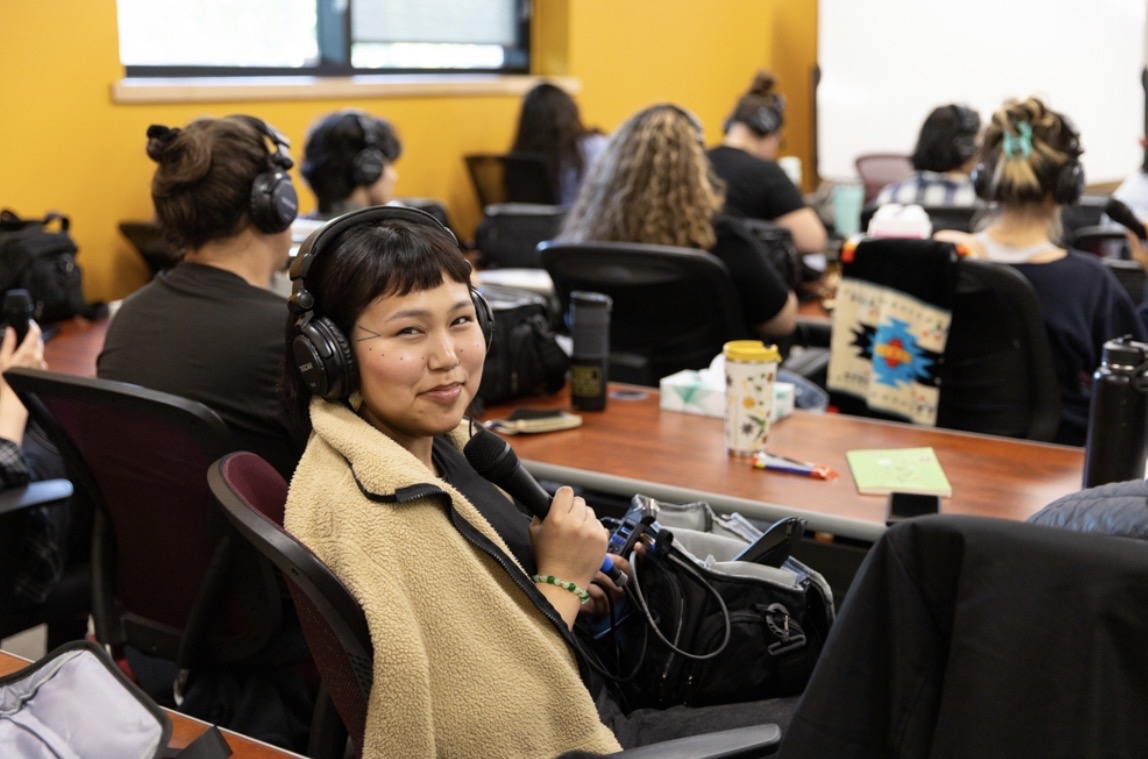
Emerald Hatkaittuq wears audio recording equipment while studying for Carleton University’s Certificate in Journalism in Indigenous Communities on Manitoulin Island, Ont., in September. Hatkaittuq, who is from Gjoa Haven, is one of the first two Inuit students enrolled in the nine-month program. (Photo by Cedar Grace Photography)

Gjoa Haven resident Emerald Hatkaittuq is pursuing a career she has thought about since high school.
The 23-year-old is one of the first two Inuit students enrolled in Carleton University’s Certificate in Journalism in Indigenous Communities. The nine-month program, designed to train Indigenous journalists to tell stories from their own communities, is in its second year.
“Representation is so important. When applications opened for this year, I shared it with people I know because I want to see more Inuit pursuing journalism,” said Hatkaittuq.
Hatkaittuq had considered studying journalism after high school but instead enrolled in science and technology foundations at Algonquin College, hoping to enter the medical field.
She eventually realized science was not for her, she said, and joined Tigulavut’s media-training program in Ottawa this year. The hands-on program, launched by the Inuit Broadcasting Corporation, helps Inuit aged 18 to 30 develop skills in film, television and digital media.
During the program, Hatkaittuq met Duncan McCue, director of Carleton’s journalism certificate program, who visited as a guest speaker. He encouraged her to apply.
“The goal of this program is for them to imagine being a media maker in their own community, and imagine our own narrative sovereignty that doesn’t necessarily include legacy media and could instead be Indigenous media,” said McCue in an interview.
Hatkaittuq was accepted into the program alongside 18-year-old Alanna Dean, whose family is from Iqaluit, and 18 others.

Alanna Dean, left, interviews fellow student Emerald Hatkaittuq while testing audio recording equipment. The two are in Carleton University’s Certificate in Journalism in Indigenous Communities on Manitoulin Island, Ont., in September. (Photo by Cedar Grace Photography)
The curriculum is delivered primarily online, allowing students to study from their home communities, with three in-person intensives for hands-on training and cultural learning.
The first intensive took place during the week of Sept. 13 at Kenjgewin Teg, an Indigenous learning institution on Manitoulin Island, Ont.
For Hatkaittuq, getting there meant flying from Gjoa Haven to Yellowknife and then to Ottawa, before driving about seven hours to Manitoulin Island.
Due to weather, she also got stranded in Yellowknife for a week on her way home.
“She travelled further than any of our learners just to get there. That’s not cheap, but we’re happy to support our northern learners in that way,” said McCue.
Travel, accommodation and meals for students attending the intensives, as well as travel for a two-week internship, are covered through a three-year, $3.2-million partnership between Carleton University and the Mastercard Foundation’s EleV program.
During the intensive, Hatkaittuq said classmates who introduced themselves in their Indigenous languages inspired her to do the same in Inuktitut.
“I was happy that we were able to share Anishinaabe culture and other First Nations cultures with Emerald and Alanna because I think that cross-cultural sharing between First Nations and Inuit can be very productive,” McCue said.
Back in Gjoa Haven, Hatkaittuq has returned to studying remotely.

“The only issue I’ve had so far is that we’ve been having power outages in Gjoa Haven quite often and it happened in one of my classes,” she said.
After completing the certificate, Hatkaittuq hopes to pursue further education in journalism.
“I remember Duncan saying to non-Indigenous people, ‘Don’t be story takers, be story tellers.’ I feel like having Inuit tell their own stories in our communities can create much bigger and better change,” she said.
(0) Comments