


Grays Bay impact assessment predicts project could boost Nunavut GDP by 20%
West Kitikmeot Resources Corp. says construction on $1B road and port could start by 2029
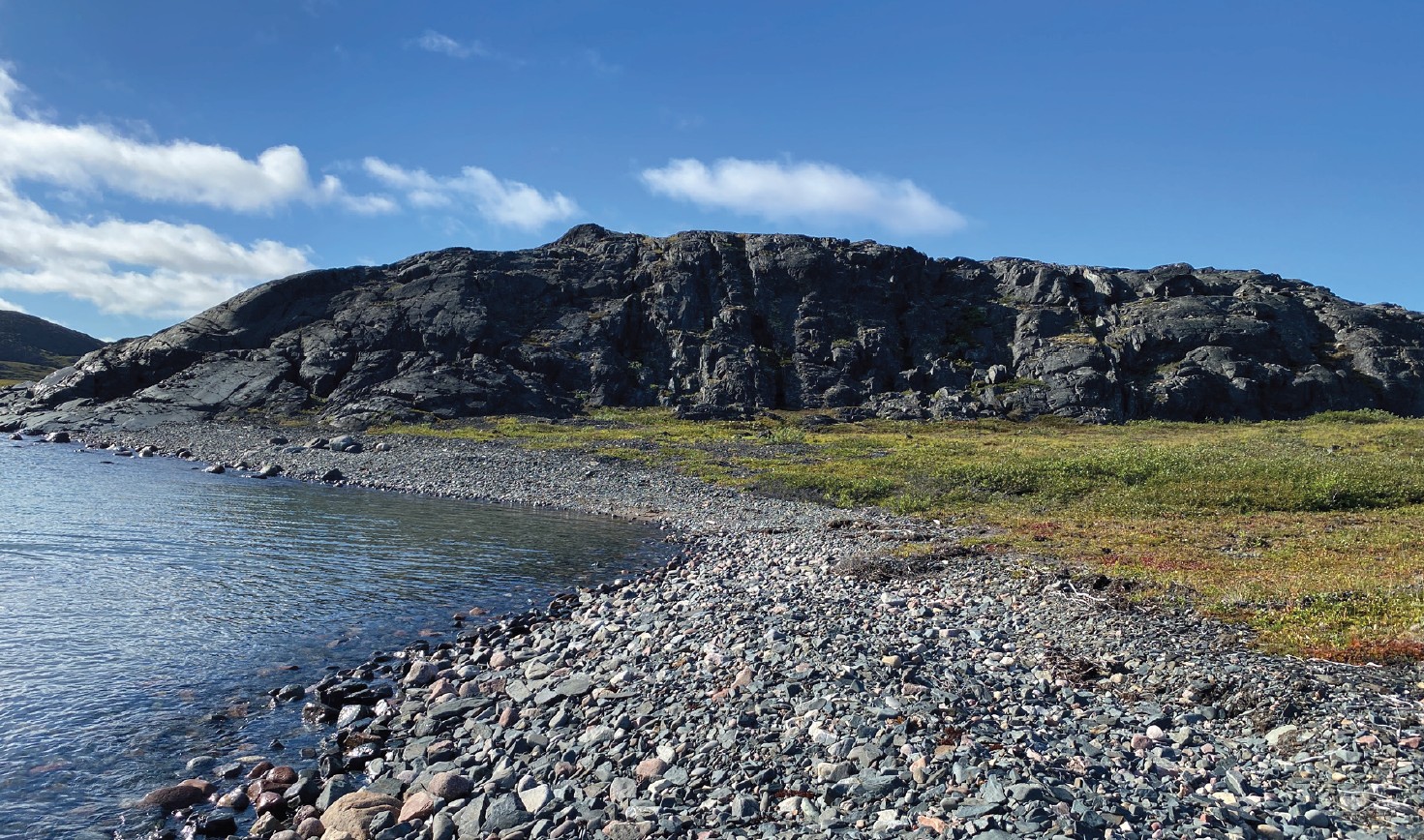
West Kitikmeot Resources Corp.’s Grays Bay road and port project impact assessment is now before the Nunavut Impact Review Board. The site of the proposed port is pictured here, in warmer temperatures. (Photo courtesy of West Kitikmeot Resources Corp.)

The Grays Bay road and port project could unlock a 20 per cent increase in Nunavut’s gross domestic product, its proponent says.
Brendan Bell, CEO of West Kitikmeot Resources Corp., points to that figure as one of the key takeaways from his company’s impact statement for the project, which it submitted to the Nunavut Impact Review Board earlier this week.

A map depicts the location of the proposed Grays Bay road and port project. (Screenshot courtesy of West Kitikmeot Resources Corp.)
“This project and the induced developments that come with it over the next number of years will have an almost potentially 20 per cent uplift on the GDP of Nunavut,” Bell said in an interview.
“I can’t think of another project across the country that would result in a 20 per cent increase in the GDP of any territory or province.”
Gross domestic product is the total value of all goods and services produced in a certain area within a certain time.
West Kitikmeot Resources Corp. took the project under its wing in 2023.
The submission is 7,723 pages long, presented in four languages — English, French, Inuktitut and Inuinnaqtun. It outlines ways the proposed 230-kilometre road and deepsea port, as well as the proposed surrounding mining developments made accessible by the project, could impact the territory’s economy as well as the region’s communities and environment.
On the territory’s economy, West Kitikmeot predicts construction of “reasonably foreseeable” mining projects in the area around Grays Bay would contribute $1 billion to the GDP for the years spanning 2031 to 2035 and 2037 to 2040.
Also, the operations of those projects from 2040 onward would contribute $750 million to the GDP annually, the company estimates.
For reference, Nunavut’s total GDP was listed at $4.1 billion. The road and port project itself has an estimated cost of $1 billion.
The assessment’s environment section covers how construction and operation of the road may impact air quality, water, vegetation and animals based on decades’ of research.
Concerns about caribou were at “the top of the pile,” Bell said.
West Kitikmeot’s assessment commits to developing a mitigation strategy that could include restricting use of the road during “sensitive” periods such as calving season.
“Any development in the North really seeks to strike a balance and understand the hopes and the aspirations of communities who want economic benefits and jobs,” Bell said.
“But also, respecting and understanding just how important protection of the environment and wildlife is the chief concern.”
Submitting the impact statement was “decades in the making,” Bell said. Using a baseball analogy, he described the project as only being in the “third inning” of development.
“We imagine that it will take a year of NIRB process, and that we would have a project certificate probably before the end of calendar 2027, but I’ll defer to NIRB on what that looks like,” he said.

In a letter posted to the NIRB website, impact assessment manager Kelli Gillard acknowledged receipt of West Kitikmeot’s submission and that an internal review would be completed by March 16.
If accepted, a public review process would follow.
In the meantime, Bell and his team are working to secure funding for the project through private investors and the federal government.
The hope is to begin construction by 2029, Bell said.
“We still have an immense amount of work to do, but we’re proud of the way this is unfolding,” he said.
GDP is a measure of economic activity and it can be useful, but it also cannot be considered the one and only measure of success.
Nunavut has a GDP of $4 billion. OK, that means $4 billion changed hands in Nunavut in a year. Most of it was government spending. Let’s say another $1 billion gets spent in Nunavut on the road and port project. Great, Nunavut’s GDP is $5 billion. But what does that actually mean FOR Nunavut?
Of that $1 billion that the road costs, let’s say $200 million goes to salaries and wages. If all the workers are flown in from Alberta, Quebec, and Newfoundland, they get paid $200 million to work in Nunavut (goes to Nunavut GDP), then they take all their money back to their home provinces. Sure, Nunavut gets $4 million in payroll taxes which is nice, but it’s a small fraction and they don’t collect income taxes from these workers.
Speaking of flying people in, how much goes to Canadian North and/or Summit Air and/or some other airline? They’ll get paid in “Nunavut GDP” dollars, but their profits will go to Manitoba and NWT where they’re headquartered.
How about sealift? That will be “Nunavut GDP” dollars, but that money will go to NWT or Quebec.
It’s the same situation when mines become operational along Gray’s Bay. Most of the money heads south. KIA will collect its royalties which is a positive, even though they don’t seem to do a whole lot with them. Some people from Kitikmeot will go work for the mine, which is good, but some of those people will move south because they’ll get paid the same to live somewhere cheaper, and the mine companies love it because it’s actually cheaper for them to fly employees in from Edmonton than it is to fly them in from Kitikmeot Communities.
Nunavut collects its little pieces here and there along the way, but it’s really just a fraction of what we refer to as “Nunavut’s GDP”.
GDP per capita to go way up, net income per capita to go way down. Progress is what we’re told this is.
In my mind one of the largest problems with the money in Nunavut is there’s nowhere to put all that money back into Nunavut. There’s no property to invest in. And the means to build it and maintain it are astronomical. There’s no businesses to pour the money into for most communities. At most you can hope for a Co-Op, a local carver and a seamstress.
There needs to be more places to put the money back into the community and therefore the economy of Nunavut, rather than taking it all back south.
While I agree on your assessment of GDP, as a Kitikmeot Resident I do see this as building the next 50-100 years.
The Kitikmeot isn’t going to become a commerce or tech or tourist driven economy , or is unlikely to anyways, and so Gov’t remains really the primary source of wages, or Gov’t funded organizations.
You are correct in your assessment as well that we do not currently have the workforce capacity to actually take advantage of economic development. There’s already an excess of vacant positions at Hope Bay and B2’s sites that cant be filled via Kitikmeot workforce. Continued no-shows to work, wanting to leave site early from rotation among many other issues continues to plague that workforce as well as most applicants being entry level work.
With that said I think we should try to picture 50 years down the road, and hope that town infrastructure in the meantime also gets developed to the point where graduation rates exceed 35% , and those that graduate, actually graduate with some type of meaningful education and were not just pushed through to pump DEA’s statistics.
And I think you need to do both hand it hand, keep developing economically so the opportunity exists, and develop infrastructure that aids in development of kids, recreation centers for programing, etc. Kids need to see the opportunity while also being stimulated in a positive way by good facilitators. I really think you need both.
The road is the opens the oppertunity of course for spur roads, and KIA can determine how mines are deceloped along it. Perhaps its just 1 at a time, and when reclaimed properly they give the thumbs up for the next. I think there’s a balancing act here where its possible to have the best of both worlds.
We cant turn our heads and say, hey southern Canada keep paying us all these transfer payments we don’t want mining / the only economic opportunity available to us, keep paying for our housing and social assistance, and health care though.
That isn’t fair nor will it break the poverty cycle.
That’s just my opinion as a Kitikmeot Resident.
Hey My Thoughts,
I agree with all of your points as well. I’m not anti-mine or anti-road and port exactly, but I would like to think that West Kit Resources (which is owned by KIA) would more explicitly try to address benefits to Nunavummiut rather than just tout GDP figures.
Personally, I think that if this road and port is to go ahead, I would like to see it at least have a road connection to Kugluktuk.
There is a short answer to your question. The amount of money that Grays Bay could contribute to the GDP FOR Nunavut is directly proportional to the interest and effort made by Nunavummuit to participate in this project and the other developments that it will induce.
We can compare and contrast the road and port to another Nunavut activity – commercial fishing. In the case of fishing, people from our territory wanted to participate, wanted to own and operate the fishery, and organized and worked towards this goal.
This included training local people for over a decade and counting at the marine training facility in Iqaluit, setting up a HTO lead fishing consortium, gathering equity to own vessels by investing revenues from quotas and otherwise growing Nunavut involvement over time. These years of effort have born fruit, and it would be safe to say today that a good portion of what fishing contributes to Nunavut’s GDP is FOR Nunavut.
If, 20 or 30 years ago, Nunavut had thrown up its hands and conceded that fishing in Davis Strait and Baffin Bay would always be in the hands of the Newfoundlanders, or Maritimers, or Faroese, we would be exactly at the stage we are at now with the extractive industries.
So I would pose my own question, why do we in Nunavut consistently bemoan low benefits from resource extraction without doing anything about it, when we clearly will not tolerate the same thing for other sectors of the economy?
Wow. They will let it happen ? It will completley change all animal migration and behaviour …. so much more emissions to drive the caribou away and blasting in particular carries it sound for miles all around which…caribou do not like. Make paved runways instead in the nunavut kitikmeot region.
Yk to wekweeti to lupin then on ….
Wekweeti is halfway to Lupin from Yellowknife . will benefit as well if considered