


Group plans trek along family’s traditional migration route
Approximately 200-kilometre journey will end at winter caribou hunting grounds

Gayle Uyagaqi Kabloona says learning about her family’s traditional migration from her father has been an “amazing experience.” (Photo courtesy of Gayle Uyagaqi Kabloona)
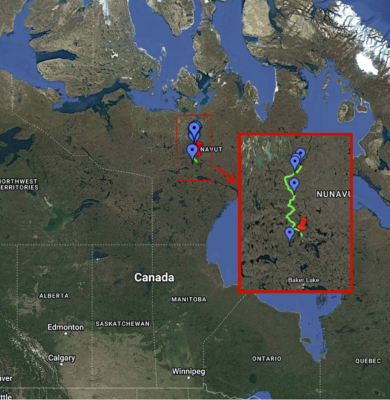
This map shows the approximate route the group plans to take. (Image courtesy of Google Maps)
A woman with roots in Baker Lake is planning to trek along a traditional migration route to winter caribou hunting grounds — one her family took for generations before colonization.
“I’ve always loved my dad’s stories,” said Gayle Uyagaqi Kabloona, who is planning to make the journey with her partner Erik Reid, sister Kilikvak Kabloona and friends Victoria Perron and Tess Girard starting Aug. 29.
“I love being on the land. I love hunting and fishing, I love camping. I love Nunavut.”
Uyagaqi Kabloona is an artist and writer born in Baker Lake. She has spent time in Iqaluit, but now calls Ottawa home.
In an interview, she described learning about her heritage while spending summers in Baker Lake with her father, Thomas Kabloona.
The pair recently spent time poring over maps and discussing seasonal camps where the family used to fish and hunt caribou, and the seasonal migrations her ancestors took.
The journey is about 200 kilometres. The group will fly into Baker Lake, then take a chartered plane to a place called Kittikat. From there, they plan to hike in a roughly southerly direction for three weeks until they reach Amarulik, which Uyagaqi Kabloona said means “the place where there are wolves.”
Amarulik is near Agnico Eagle Mines Ltd.’s Meadowbank Complex. Thomas Kabloona, with the help of Agnico Eagle, plans to pick the group up and return them to Baker Lake once they are finished.
Historical migrations were well planned, Uyagaqi Kabloona said.
“I’m not shooting myself into the middle of nowhere,” she said, describing glacial eskers that will take the group more than halfway along the route.
Eskers are “glacier-made highways” of sediment ridges left behind by the polar ice caps when they retreated after the last Ice Age.
The group has deposited a cache of food and fuel about halfway along the route. Uyagaqi Kabloona said she picked an arbitrary spot “in the middle” of the journey for the cache, but when her family members went to drop it off they discovered there were already inuksuks almost exactly in that area.

“It’s really important to Gayle to do this trip,” said her partner, Erik Reid. “If it’s important to her, it’s important to me. It’s something that no one has really done for like 60 years.”
Reid said he has never embarked on such a long hike but looks forward to the challenge.
Uyagaqi Kabloona’s father, 75, was born on the land. He’s provided the co-ordinates of his birthplace to the group, and they will hike to that spot along the way.
Once finished, Uyagaqi Kabloona plans to write a book about the trip and the history of her family’s migrations.
It will involve “telling stories about what people’s lives used to be like,” she said.

Tess Girard, a filmmaker friend of Uyagaqi Kabloona, is making the trip to document the journey.
Uyagaqi Kabloona said that initially the trip was going to be a small thing she was doing just for herself, but Girard convinced her it could be something more to make “Inuit history more accessible.”
The movie won’t strictly be a documentary, Uyagaqi Kabloona said, adding, “in Inuit time, it is cyclical. [The film] will be as non-linear as possible and very family focused.
“I had to do a lot of research with my dad and going through maps and, like, really put a lot of work behind this.”
For the most part, she said, she will document the journey through drawings, photographs and journals she intends to share with family members only.
Speaking with her father has been “incredible,” Uyagaqi Kabloona said. “He is a really good storyteller. He is very strong. The breadth of his knowledge is incredible.”
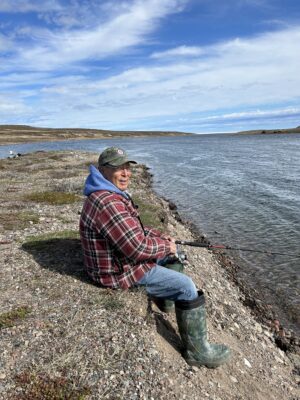
Thomas Kabloona, 75, Gayle Uyagaqi Kabloona’s father, was born on the land. As part of their journey Gayle will visit the place where he was born. (Photo courtesy of Gayle Uyagaqi Kabloona)
She said she is looking forward to putting what she has learned from him into practice on this journey.
Looking forward to the documentary.
Good luck on your amazing journey, such an important step back into history and tradition for you. I hope you and Erik stay safe and enjoy your adventure.
Love Aunt Hilary
Cool idea for an adventure, Gayle.
The book, “Being Caribou”, by husband and wife Karsten Heuer and Leanne Allison who followed the migration of the Porcupine caribou herd on foot for five months over 1500 kilometers should interest anyone who has a passion for humanity and nature
From 1986 to1989 inclusive my father would charter plane to fly our family down to
Echimnagruq at the last rapid of the Back River. A traditional summer location for the Utku
people.
We would stay there for about 4 weeks and it was awesome to be there, fishing, hunting,
and the scenery was beautiful
My dad and mum, Rick and Martha, would walk for miles into the land. So many remains
of old Inuit culture. Great memories.