

Housing, schools and food vouchers: Qikiqtarjuaq leaders discuss hamlet issues
Future port offers hope for more employment, infrastructure

Qikiqtarjuaq is one of Nunavut’s most picturesque communities and a tourism hub, but locals still face issues such as hunger and a lack of housing. (Photo by Arty Sarkisian)

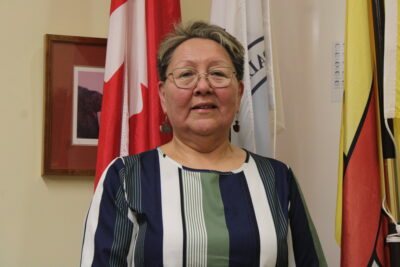
Former MLA and mayor Mary Killiktee says lack of housing remains an issue for people in Qikiqtarjuaq. (Photos by Arty Sarkisian)
Qikiqtarjuaq is one of Nunavut’s most photogenic communities.
Photographers and hikers (including movie star Leonardo DiCaprio, who reportedly visited in 2015) have travelled to the community to take photos of the surrounding mountains and many polar bears known to inhabit the area.
Destination Nunavut describes Qikiqtarjuaq as “picturesque” and “cheerful.”
But the community of 600 people still has generational issues that affect residents’ daily lives.
‘Housing is always an issue’
In terms of housing, Qikiqtarjuaq is in slightly better shape than most Nunavut communities.

Nunavut Housing Corp. classifies the hamlet’s need for public housing as “high” compared to 19 communities that are in “critical” need, according to the corporation’s 2023-24 annual report.
The public housing stock in the community would need to increase by nearly 40 per cent to house all the people on the housing waiting list. In Kinngait, where the state of housing is the worst of all 25 communities, the number of public housing units needs to almost double.
“But housing is always an issue,” said Qikiqtarjuaq’s senior administrative officer Geela Kooneeliusie.
There are three-bedroom houses in the hamlet with 11 people living in them, she said.
“I can’t even imagine to put myself in their shoes,” said outgoing MLA and former two-term mayor Mary Killiktee.
“No wonder today there are family issues in our homes.”

‘There is hunger’
While hamlets were administering a food voucher program last year through the Inuit Child First Initiative, Kooneeliusie said she felt her relationship with the community slightly changed.
The program offered families an extra $500 per month per child under 18 for food, plus an extra $250 per month for children under four to cover infant and toddler necessities such as formula and diapers.
With the program in place, fewer people were asking her for food or to borrow money.
But as soon as the funding for the program ceased earlier this year, everything went back to what it was before.

“There is hunger,” Kooneeliusie said. “Everybody was very disappointed.”
People have changed since the funding was discontinued, she said.
A lack of food, paired with overcrowding, leads to other issues.
“We have a wellness centre here, and kids were vandalizing and breaking in looking for food,” Kooneeliusie said.
The new federal budget doesn’t extend funding for the Inuit Child First Initiative beyond March 2026, but Indigenous Services Minister Mandy Gull-Masty indicated the program will be redefined and made permanent.
There has been no word on any possible reinstatement of the community-wide food voucher program.

Qikiqtarjuaq’s senior administrative officer Geena Kooneeliusie says the community is excited about construction starting on a new deepsea port.
School drop out rates
Every year, Qikiqtarjuaq has about 25 school students, but not every year will there be graduates.
“Every second or third year, we have two to four graduates,” said Kooneeliusie, who herself didn’t finish high school.
The high cost of living plays into the reasons for this, she explained, saying, “I had to start working to earn income.”
Qikiqtarjuaq port – something to be ‘ecstatic’ about
A $500-million deepsea port for the hamlet has been on the to-do list for a long time, and now construction could begin in summer with operations kicking off in 2030.
Construction is led by Qikiqtaaluk Corp., the business arm of Qikiqtani Inuit Association, and the project was designated as “nation-building” by the Nunavut Tunngavik Inc. and the Nunavut government.
“I’m actually ecstatic about it,” Kooneeliusie said. “The fact that it’s going to create job opportunities, that’s the part I’m really excited about.”
The new port is expected to bring businesses and jobs to the community where a majority of the population is unemployed, she said.
“We really love that they are coming here,” Kooneeliusie said.
We still say this is only a short term bandaid fix and waste of funds on a underestimated cost for this project ,
Focus on housing first, the Feds/Nu Government has to help,
start your training for heavy equipment operations right away unless 99% will be employed external as no shortage of employment this will be ,
Carney project Libs’
The Inuit in Baffin Region have developed a very rich fishery in Davis Straits.
Those fishery products presently can be landed in Pangnirtung about 250 kms from the fishing grounds.
With this new deep water port the boats will be only travelling a small fraction of the present distance to land their catch..
That is a great reason for this great construction project.
There’s more than $2 billion of dead money in the land settlement trust fund. How many shares in Agnico Eagle does the fund hold? Not many, for sure, and why’s that? Why not tap that fund for immediate needs? Why not apportion the money into individual family trusts with a power of advancement?
And what are the schools doing to enable next generations for rewarding job opportunities in the professions and management and not just for unskilled and semi-skilled work, and welfare? There are far more well paid jobs in Nunavut than there are Inuit of employment age. People in well-paid jobs can get their own housing.
The more that hand outs are given, the more they are needed. I see hungry people everyday getting government money while their children starve and the parents smoke a pack a day or drink the money away in Pepsi and liquor.
I think our communities would be better if people had to work or go to school to get government handouts. In school learn about money management, interest rates, healthy food preparation, computer skills – actual life skills. Why should you finish school when the government gives you housing and money for food and money for kids and everything else. No wonder no one wants to work anymore.
My mother taught me the best place to find a helping hand is at the end of your own arm.