


‘That’s our vision:’ Qikiqtarjuaq prepares for its long-promised deepsea port
Project idea that has been around since the 1950s might finally come to fruition

The site of the future Qikiqtarjuaq deepsea port is roughly a kilometre south of the community’s airport. It awaits the start of construction expected in 2026. (Photo by Arty Sarkisian)


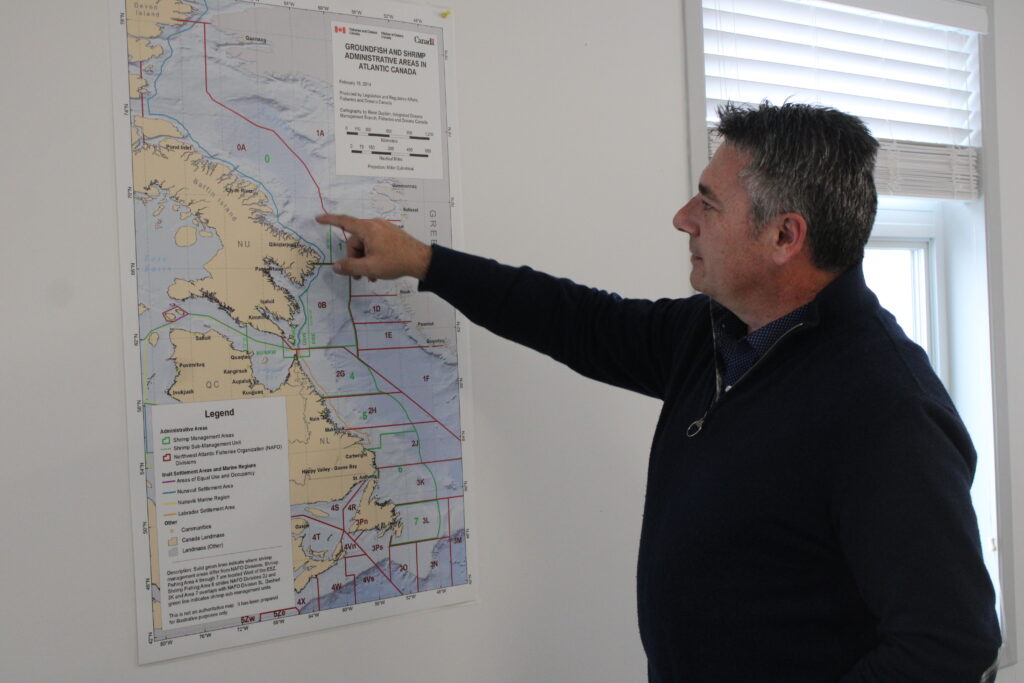
A poster shows a map of the planned Qikiqtarjuaq port, greeting everybody arriving at the community’s airport. (Photo by Arty Sarkisian)
One of the first things a visitor to Qikiqtarjuaq sees when they land at the hamlet’s tiny airport is a map of the deepsea port.
It’s like the long-promised facility is already there to welcome sealift ships, fishing boats and cruises.
“That’s our vision,” said Mary Killiktee, the two-term mayor and out-going MLA for the community who has been a supporter of the port project for many years.
The area, located about one kilometre south of the airport along the western shoreline of Broughton Island, currently sits empty. Occasionally, small motorboats pass by.
Port construction is expected to begin in summer 2026 and finish by 2029, with operations starting in 2030, said Michael McNair, CEO of Arctic Economic Development Corp., one of the companies working on the project.
The $200-million plan includes a 75-metre wharf, a crane for offloading cargo, security and operations offices and a 275-metre-long access road.

So far the federal government and GN have contributed $53.4 million, with $13.3 million coming from the territorial government and $40.1 million from Ottawa.
The rest of the funding could be “coming together,” McNair said, with the $1-billion Arctic Infrastructure Fund announced in Tuesday’s federal budget, plus “positive” conversations with the Canada Infrastructure Bank.
The Qikiqtarjuaq port recently made the list of “nation-building” projects compiled by Nunavut Tunngavik Inc. and the Nunavut government to tap into the federal government’s plan to assert Arctic sovereignty and security.
Other projects include the Iqaluit hydroelectric project, Kivalliq hydro-fibre link and Grays Bay road and port.
The Qikiqtarjuaq port was the only one of those projects that didn’t have a private sector proponent until September, when Qikiqtaaluk Corp., the business arm of Qikiqtani Inuit Association, took over the lead on it.
McNair said the port will be the first project from the nation-building list to be completed and could be a “quick win” for the territory and Canada.

It’s expected to make Qikiqtarjuaq one of the Eastern Arctic’s main sealift and refuelling hubs and will likely be used by Canadian Coast Guard and Royal Canadian Navy ships, he said.
The port will boost fishing and bring jobs to the community where the majority of the population of about 600 people is unemployed, said Geela Kooneeliusie, the hamlet’s senior administrative officer.
She said Qikiqtarjuaq is centrally located in Nunavut’s best fishing areas, is close to Greenland, and has water as deep as 400 metres close to the shoreline, allowing large ships to dock.
Unlike the Grays Bay road that has seen opposition from Kugluktuk’s Hunters and Trappers Organization over potential environmental hazards, the Qikiqtarjuaq port has support from both the hamlet and local hunters and trappers group, according to a letter submitted by both entities to the Nunavut Impact Review Board.
Also, the community recently became host to the Arctic’s latest research station, operated by Laval University.

“We will be able to support the project through our research,” said Gabrièle Deslongchamps, the station’s marine biologist.
Baffin Fisheries interim CEO Glenn Grandy says Qikiqtarjuaq will need a lot of infrastructure in addition to the port. (Photo by Arty Sarkisian)
For fishing companies, the port is a promising but uncertain prospect, said Glenn Grandy, interim CEO of Baffin Fisheries, which employs about 200 people.
A lot of infrastructure, such as freezers and containers, will be needed in the community “for anybody to land any significant amount of fish,” he said.
The community will also need trained personnel able to support the docking of big and technically complex vessels like the ones Baffin Fisheries uses.
The port will be located above the Arctic Circle and won’t be available year-round. Even in more southern areas of Baffin Bay and Davis Strait, the fishing season lasts from late July to mid-December, when ice starts to push out the ships.
“It’s an expensive project, but you have to have the infrastructure there in order to attract the industry,” said Grandy, adding his company will likely use the port once it opens.
For people in Qikiqtarjuaq, the conversation about the port predates the recent sovereignty push. It even predates Nunavut.

Former Qikiqtarjuaq mayor and out-going MLA Mary Killiktee, left, and hamlet SAO Geela Kooneeliusie both say the port will bring great economic benefit to the community. (Photos by Arty Sarkisian)
The idea first came up in the mid-1950s during the Cold War when the community’s Distant Early Warning station was built.
“We have been advocating for decades,” Killiktee said, adding that this time around she’s sure it will go through.
“This is our vision for the community, so it has to happen.”
This is just a dream and happy the port will be dealt with and will surely cost and the issues will arise after without ture consulting the fishing industry who Glenn mentions and everything should be mentioned well if this is even better for Nunavutmuit at all ,
The fuel tanks cost , runway for jets , man power who can show up , storage components for 1000 tons of fish products just from one ship , how fast would this be dealt with not to spoil 🤔 ,
Think this over and have discussed this more to public how this would work in short season and think how many ships Nunavutmuit have to offload each month as AFA/ BFC/ QC total ships 6 that is totally impossible for a small community,
We’re talking about a billion dollars in infrastructure and mother nature in this area will not stay nice weather that cost $$$ and time always,
We say Iqaluit already has this area and the Government should rethink build the fish plant and help all the fishing companies working together,
Wish the dream becomes a reality as we see wasted good amount of funds.
Eyes & ears
At Nanisivik there was both a good runway and a port, as well as a lot of good buildings when the mine closed. And of course all that was built and supported by the real wealth-generating lead-zinc mine. Same as what Baffinland did at Milne Inlet to access the iron ore. This port sure looks like yet another boondoggle, with no economic reason for the expenditure of taxpayers’ money.
Mentioning Nanivistik, Stephen Harper initiated building it as a refueling base. It seemed strategically located. A report released about a year ago said it wasn’t completed because there was no political will. The Liberals didn’t follow through because it was a Conservative project. Now the Liberals are trying to look good building a port that is not that far north nor that far inside the Arctic.
$200 millions holy… Here we didn’t get $100 million worth of housing in Clyde and Qik…so much for housing shortage in “Nunavut”
The GN and NTI have already received 300 million in new funding for housing, this port funds is also new funding, Nunavut is swimming in new hundreds of millions in funding, it’s not a money issue but a capacity issue, also a HR issue at the GN with their gong show housing 3000,
$200 million port
Crazy invest the money better one something Nunavut really needs
Iqaluit already has most of what is need for this fish plant
Iqaluit got a $100 million dollar port it ain’t much might as well put it to some use
With deep water port they will have to upgrade the runway for the jets able to land so as taxpayer to make feasible Canada might as well have proposed military base otherwise they will have to do a major upgrade on the runway.
This “nation building” project is such a blatant grab at tax payer’s money by QC. Isn’t about time for Harry Flaherty to answer some questions and explain how this boondoggle is magically going to achieve everything being breathlessly promised?
And where did these Arctic Economic Development Corp guys crawl out from?
Why? Would you rather QC gives this project back to the GN? The GN is way too incompetent to manage this project and why they decided to hand it over to QC.
Who do you think should take this project instead?
I think by removing as much from the GN is better as they continually show us how incompetent they are and why we can’t have nice things in Nunavut.
Housing being one of them with the hundreds of millions the GN has received to build new housing. What a gong show.
The $89M+ Iqaluit port did not create new jobs or even contribute to more economy in Iqaluit. Exactly how is $200M port in Qikiqtarjuaq going to help create jobs without the extra infrastructure let alone a tiny population who hasn’t gotten educated and ensured that every job in their own community is filled by Inuit or moved to places where jobs are more available or taken jobs with the mines? There’s no plan or money or space for a fish processing plant especially since most ships now process fish on board. The cost of flying out fish is more expensive than simply taking the ships to Nuuk or St. Johns and then to market.
The only ones going to make money off of this scheme is the southern contractors trying to get free government money. The GN pulled out because they have no money to spend on crazy projects with no real prospect of economic return. The GN over leveraged themselves with the Iqaluit airport. No real business case except for the scammers.
Yes, Qikiqtarjuaq has long wanted a port as have almost every other coastal community but it doesn’t mean that they wanted or need such a big port. They could have community floating docks like Pangnirtung.
Try and be a little more optimistic here, we have enough nay sayers up here with anything and everything, new major infrastructure always have positive imps up here, spin offs and new opportunities.
Take some of the major infrastructure away in Newfoundland or Greenland and see how it is, this is a right step in the right direction for Nunavut, a start.