



Fifty years after the signing of the James Bay and Northern Quebec Agreement, Inuit artists in Nunavik are determined to tell their own stories. Clockwise from top left are singer-songwriter Elisapie, graphic designer Thomassie Mangiok, printmaker Maggie Napartuk, and fashion designer Victoria Okpik. (Submitted photos)
How Nunavik Inuit artists are creating their own stories
Spotlight on Nunavik’s creative Inuit artists
It has been 50 years since the James Bay Northern and Quebec Agreement empowered Inuit artists, creators, and storytellers of Nunavik to determine the course of their own stories.
“Fifty years went by so quick,” says linocut print artist and instructor Maggie Napartuk.
“Looking over the decades, from when they started to how the region is today has incited a lot of growth for Inuit, and more education.”
Educator and graphic designer Thomassie Mangiok added, “it’s a great achievement for that time.”
“I’m incredibly proud of the Inuit who were able to work on JBNQA,” Mangiok said.
Here’s a spotlight on some Inuit artists from Nunavik who are making their mark creatively.

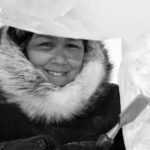
Maggie Napartuk (submitted photo)
Maggie Napartuk —Kuujjuaq’s Maggie Napartuk was introduced to linocut through a weekly printmaking workshop in 2015.
“I was hesitant in the beginning … because I was not educated enough, or not really interested in the significance of linocut printmaking,” she said.
“The first minute I started carving, I got hooked … It will always be with me.”
Napartuk credits her elders and their storytelling on the land as the inspiration behind her designs.
“Listening to [elders], I can picture and imagine and know exactly what they are talking about … our ancestors who worked so hard to … live on a day-to-day basis. The endurance and resilience that they had saved our identity. I want to show the world that this is how our ancestors survived, and we’re still here. Each print I’ve had is all based on our traditional activities.”
Napartuk believes in the importance of passing on this knowledge to young people through her own travelling printmaking workshops.

“It shows how each coast is a little bit different, but everybody is all connected as Inuit.”

Victoria Okpik (submitted photo)
Victoria Okpik — “Since the signing of the JBNQA, there have been many positive developments in our region, including in the arts,” says Okpik Designs creator Victoria Okpik.
Today, there are many wonderful programs available to support artists throughout Nunavik. I myself have benefitted from these programs for my business.”

After completing a three-year fashion design program in 1999, the Quaqtaq designer struck out on her own, working with Nunavik Creations (a subsidiary company of the Makivvik Corp.), until it closed. After a few years, she started offering online orders for parkas and accessories.
“My biggest influences are the traditional styles from our region. I’ve always loved our parka designs — they are not only practical and built to endure the harsh winter, but they’re also vibrant and unique compared to other types of outerwear.”

Elisapie (Photo courtesy of Spotify)
Elisapie — Singer and performer Elisapie has a ferocious attachment to Nunavik and its language, which influences her by embodying the starkness of the landscape as well as the beauty of the Inuit region, central to her journey as a creator.
From Salluit, where she grew up as an adopted child in the small community, watching her cousins suffer and die from the legacy of colonialism, she lived out her early life in the isolated village while learning to express her pain through dance during nights at the local community centre.
She began performing with her uncles as a teenager, making up the band Sugluk, while also working at the local radio station.
After moving to Montreal to study and pursue a musical career, she has become one of the most influential Canadian-Inuk singer-songwriters, and has performed in over 70 countries, constantly integrating her culture into her work by mixing modernity and tradition.

Thomassie Mangiok (submitted photo)
Thomassie Mangiok — After attending design school, Thomassie Mangiok, who lives in Ivujivik, describes himself as having been “drawn into education for a long while…I create products, resources that are culture-related and language-related, to promote our way of living.”
Some of his successes include printing four children’s books, a trilingual strategy game called Nunami, and an app to promote communication in Inuktitut called Inuit unikkausiliurusingit, which loosely translates to “how Inuit create their stories.”
“My knowledge in education and my skills in design, allowed me to create an intuitive [syllabics] keyboard.”
Mangiok says his creativity is driven by “the sense of inspiration and curiosity [of] being out on the tundra.… With the season, or year after year, it changes.”
“For a long time, we’re absorbing experiences from other cultures…not too many options in Inuktitut…what I wanted to do was show other Inuit, ‘If I can do it, you can do this as well.’”
“If we compare how we live to how our parents lived just one generation ago, or to how our grandparents lived just two generations ago,” says Mangiok, “it is evolving, it is changing…we’ll choose how they evolve.”
This article is part of Nunatsiaq News’ commemoration of the 50th anniversary of the signing of the James Bay and Northern Quebec Agreement in 1975.

This project has been made possible in part by the Government of Canada.
(0) Comments