


‘Huge movement’ to connect North reflected in Ottawa exhibition
More than 80 works from circumpolar regions on display at National Gallery of Canada
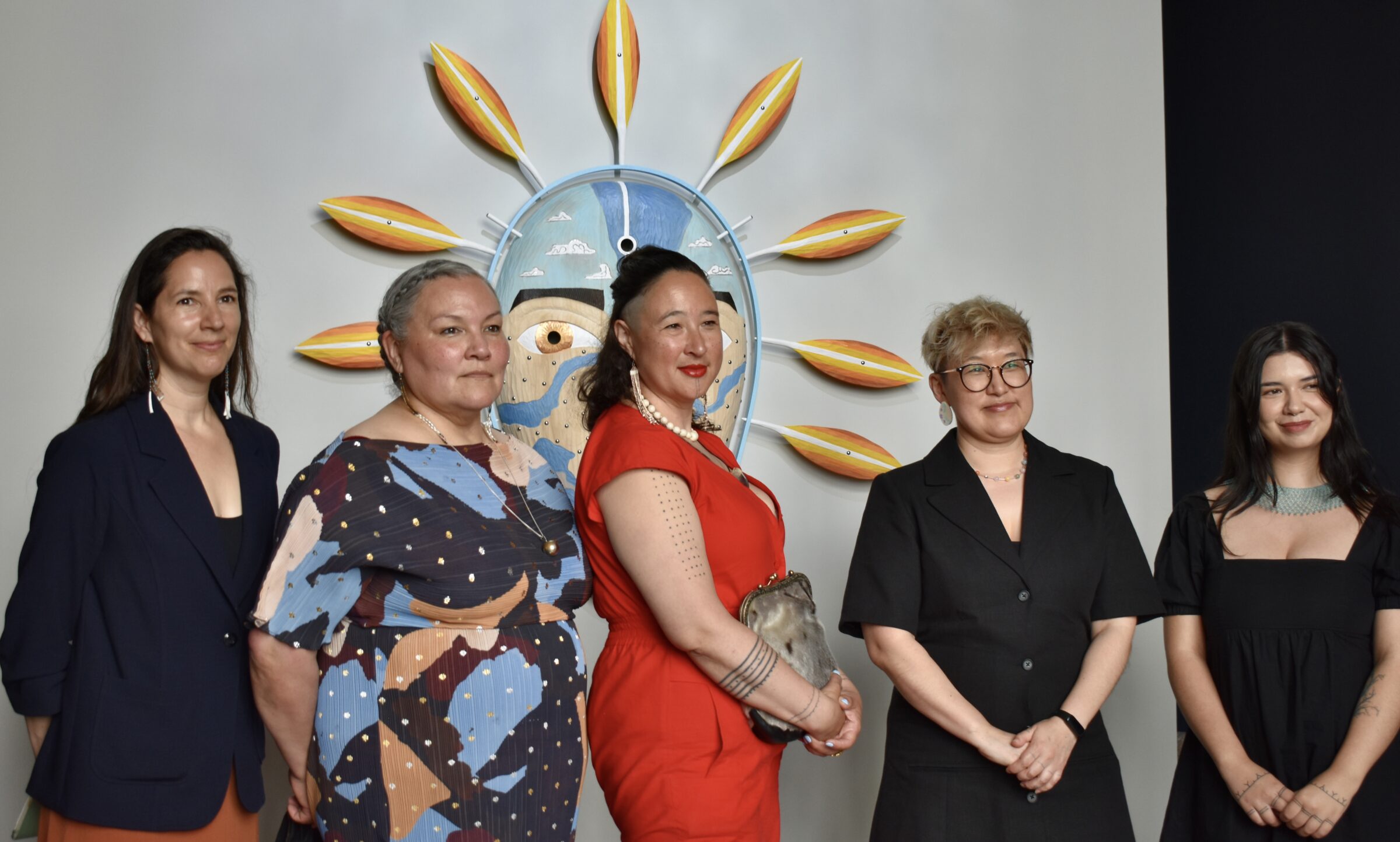
Indigenous art curators Nadia Jackinsky-Sethi, left, Taqralik Partridge, Laakkuluk Williamson, Jocelyn Piirainen and Ooleepeeka Eegeesiak pose Wednesday during a media preview for Qillaniq, at the National Gallery of Canada. (Photo by Nehaa Bimal)

Visitors entering the National Gallery of Canada’s newest exhibition in Ottawa will be able to sit inside a large qaggiq — or igloo used for community gatherings — reimagined as a woven grass basket.
It was designed by Inuk artist asinnajaq and created by Métis architect Tiffany Shaw.
Inspired by the baskets that asinnajaq’s grandmother and great-grandmother have made, the structure is a part of Qillaniq, touted by the National Gallery of Canada as the largest circumpolar Indigenous art exhibition ever, bringing together more than 80 works by nearly 70 artists from across the Arctic.
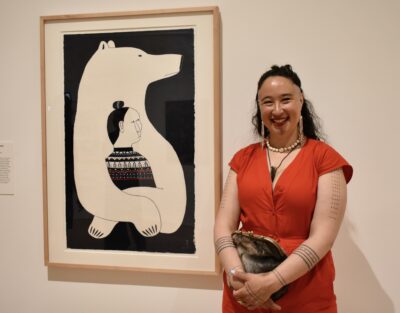
During the media preview of Qillaniq at the National Gallery of Canada, Laakkuluk Williamson stands beside a 2024 print by Kinngait artist Ningiukulu Teevee, Strong Thoughts. (Photo by Nehaa Bimal)
Curated entirely by an Indigenous team from the North, the exhibition features artists from Alaska, Inuit Nunangat, Greenland, and Sápmi, which covers the northern parts of Norway, Sweden, Finland, and the Kola Peninsula, an Arctic region of Russia just west of Finland.
“This is our community that we are bringing to the National Gallery of Canada,” said guest curator Laakkuluk Williamson. “It is our people.”
Qillaniq is an Inuktitut word describing the shimmering light reflected on water by the sun or moon.
Planning for the exhibition began in 2024, with the curators gathering in Iqaluit for a weeklong brainstorming session in November.

Among the works on display are contemporary jewellery by Iqaluit artist Barbara Akoak, a recreation of a 19th-century amauti by Pangnirtung artist Rose Tina Alivaktuk, and a papier-mâché sculpture by Inuit artists Jesse Tungilik and Jason Sikoak.
“There’s a huge movement right now to have the North better connected,” said Jocelyn Piirainen, associate curator in the gallery’s Indigenous Ways and Decolonization department, during a media preview of the exhibition on Wednesday.
“We’re incredibly lucky that we get to work together in this way.”
The exhibit brings together artists who “not only challenge colonial institutions and infrastructure,” Williamson added, but challenge their communities “to create spaces that are more exploratory, more inclusive, more safe.”

A qaggiq reimagined as a woven grass basket by Inuk artist asinnajaq and Métis architect Tiffany Shaw is one installation featured at the Qillaniq exhibition at the National Gallery of Canada in Ottawa. (Photo by Nehaa Bimal)
Williamson highlighted one of Kinngait artist Ningiukulu Teevee’s recent works, which depicts a polar bear embracing a Greenlandic woman, created after United States President Donald Trump made threats that the U.S. should acquire Greenland.
“It’s such a clear statement from her as a person from Nunavut, saying we are all Inuit and we are all protecting Greenland,” she said.
Qillaniq opens June 12 and runs through Sept. 20 at the National Gallery of Canada.

The North has so many talented artists but it’s always the same few who take up all the space.