


Indigenous knowledge key to protecting Arctic, says Governor General
Mary Simon, Natan Obed deliver opening remarks at 3-day Hudson Bay Summit in Ottawa
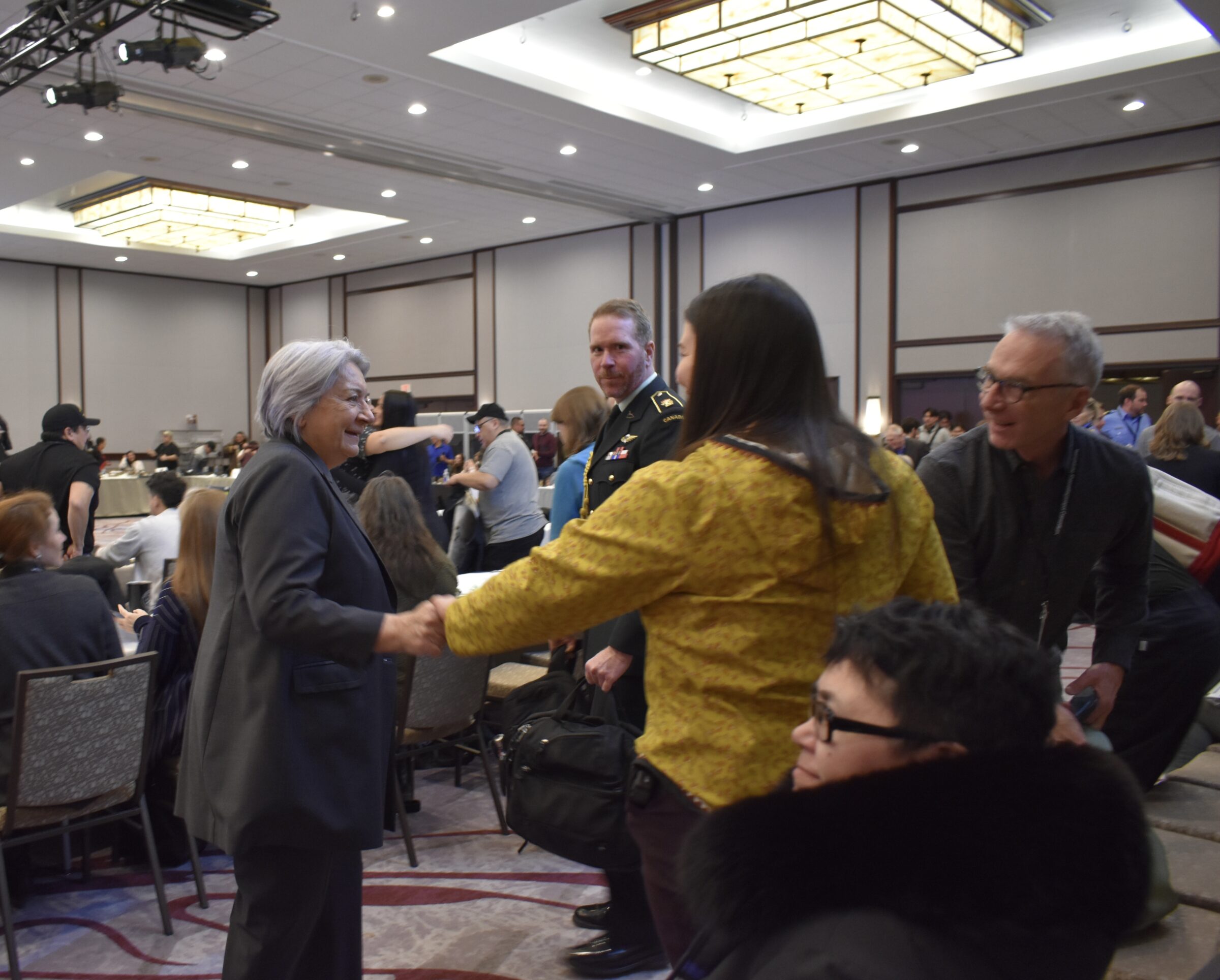
Gov. Gen. Mary Simon greets attendees Tuesday at the 2026 Hudson Bay Summit hosted by the Tasiujarjuaq Sheewetaganapoi Consortium in Ottawa after delivering her opening remarks. Communities around Hudson Bay and James Bay will get to discuss regional priorities during the three-day summit. (Photo by Nehaa Bimal)

Gov. Gen. Mary Simon urged Canadians to recognize Indigenous knowledge as essential to protecting northern ecosystems as she opened the 2026 Hudson Bay Summit in Ottawa on Tuesday.
“Indigenous knowledge is vital to understanding and protecting the Arctic,” Simon said, recalling testimony by elders in the 1990s against Hydro-Québec’s proposed 3,000-megawatt project on the Great Whale River in northern Quebec.
The project was suspended in 1994 after a group of Inuit and Cree from the area canoed from northern Quebec to New York City to convince leaders in the state to back out of an agreement to buy electricity from the dam, once built.
Simon said Indigenous traditional knowledge can reveal things that short-term scientific data cannot capture and stressed that work in the Arctic must be guided by community leadership.
“National attention on the Arctic brings resources and visibility that — when paired with strong community leadership and regional co-operation — can translate into lasting benefits for Hudson and James Bay communities,” she said.
The three-day summit, running until Thursday downtown at the Westin Hotel, is hosted by the Tasiujarjuaq Sheewetaganapoi Consortium, a network that co-ordinates environmental stewardship for Hudson Bay region.
Simon and Inuit Tapiriit Kanatami president Natan Obed both delivered opening remarks.

About 250 delegates from Inuit and Cree coastal communities, regional organizations and other institutions were registered to attend.
Held every four years, the summit focuses on Indigenous-led stewardship of Hudson Bay and James Bay, with presentations and discussions on shipping, security, environmental and emergency response, and strengthening regional connections in research and monitoring.
Respectfully disagree with the gg.
We indigenous have ideas to protect the environment in a modern sense that we learned from qallunaat. Included is development and proper education for Inuit.
People don’t take indigenous knowledge as serious as someone like Simon would hope for probably because it’s a nebulous concept that appears to lack transparency and rigor.
Philosophers figured out long ago that without precise definitions, without the ability to scrutinize, what is called knowledge becomes susceptible to manipulation or bias. If you are serious about using traditional indigenous knowledge alongside science start sharing and allow others to pick it apart without getting defensive or hiding behind mysticism or contrived reverence.
It’s the non indigenous gate keepers who use IQ and traditional knowledge this way – to perpetuate their own agendas and maintain control. Just talk to the RWOs’ biologist.
I definitely believe you
Now they are working hard. They say there will be a university in Arviat. And Arviat don’t have many workplaces and houses to worked on it. That is how they are working and they use laws and regulations to Inuit. And they forget they have laws and regulations too in their work places. I have been trying to let investigate Arviat mental health and Arviat RCMP. Hope their will be karma hit back so hard.