


Inuit mobility, family ties drive Canada–Greenland relationship, ambassador says
New consulate in temporary location but fully-functioning

Canada’s ambassador to Denmark, Carolyn Bennett, left, and Canada’s new Arctic ambassador, Virginia Mearns, attend the opening of Canada’s first permanent consulate in Nuuk, Greenland, on Feb. 6. (Photo courtesy of Global Affairs Canada)

Canada’s new consulate in Greenland is as much about helping Inuit travel throughout their traditional homeland and nurturing relationships as it is about diplomacy and security, says Carolyn Bennett, Canada’s ambassador to Denmark
The consulate, which is temporarily located on the second floor of a building shared with Iceland’s consulate general in Nuuk — Greenland’s capital — was formally opened Feb. 6 by Foreign Affairs Minister Anita Anand and Gov. Gen. Mary Simon.
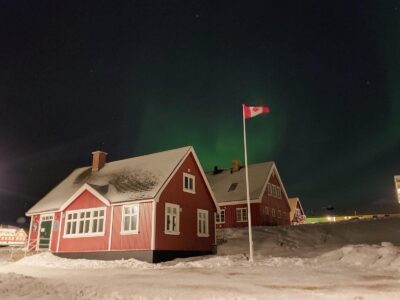
Canada’s new consulate in Nuuk, Greenland, is located in a building shared with Iceland’s consulate general. (Photo courtesy of Global Affairs Canada)
Bennett attended the opening ceremony with Virginia Mearns, Canada’s new Arctic ambassador. The opening marks Canada’s first permanent diplomatic presence in Greenland.
“It was a real celebration of family,” Bennett said in a video call from Copenhagen, the Danish capital.
The consulate provides services to Canadians visiting or living in Greenland, according to the Global Affairs Canada website. That includes passport applications and replacements, citizenship documentation and notary certifications.
Canada’s presence in the region has long been welcomed, Bennett said.

In 2024, Greenland came up with a foreign, security and defence strategy that encouraged the establishment of a Canadian consulate in Nuuk, as well as Greenlandic representation in Ottawa.
By the end of 2024, the move was incorporated into Canada’s Arctic foreign policy.
“All of this is coming to fruition in a way that I think Inuit are unbelievably happy about,” Bennett said.
“The first thing is to get [the consulate] up and running,” she said.
“Then it becomes about building relationships with the Greenlandic government, identifying areas of collaboration — whether that’s Inuit mobility, transportation, tourism, or opportunities in health and education.”
Bennett also said Canada is working closely with the Greenlandic government, the Joint Arctic Command, and Canada’s Defence Department and military.

Canada already has a presence at Pituffik Space Base, the northernmost U.S. defence installation. Two Canadians are stationed at the base’s satellite-monitoring facility.
Bennett said discussions are underway about potentially assigning a Canadian Armed Forces liaison officer either in Copenhagen or in Nuuk.
“There’s also real interest in doing joint exercises together and learning from one another,” Bennett said, pointing to Greenlandic interest in the Canadian Rangers program.
U.S. President Donald Trump has recently threatened to acquire Greenland, saying the U.S. needs it for national security reasons, but backed down from that talk in late January.
Bennett said Greenland has indicated it would welcome an additional U.S. security presence, but any expansion would be guided by Greenlandic priorities.
She added that Greenland has been clear about maintaining control over domestic priorities such as tourism and fisheries, while remaining open to outside investment in areas like critical mineral extraction.
Looking ahead, she said the consulate’s success will be measured at the community level.
“Our job internationally is to reinforce what Prime Minister Mette Frederiksen has said: Greenland speaks for Greenland,” Bennett said.
Since 1942, the Danish Navy using its elite members, has continuously maintained the Sirius Dog Sled Patrol (Slædepatruljen Sirius) along the northeast coast of Greenland.
The unit consists of 14 soldiers working in 2 man teams along with a dozen sled dogs per patrol.
Slædepatruljen Sirius uses a system of 50 remote huts along their patrol route.
The patrol is based at Daneborg in the Northeast Greenland National Park, which is the world’s largest national park.
Individual patrols can be as long as 4 months in duration, and are part of a 26 month deployment to Greenland.
Although Trump has recently made fun of this unit, the Danish on the ground presence in Greenland actually dwarves Canada’s military presence in our Queen Elizabeth Island archipelago.
There is no permanently stationed Canadian regular ground force unit within Nunavut. Canadian military exercises in Nunavut are of short duration. Ranger patrols to places like North Warning System sites are similarly brief and infrequent.
Alert is down to 8 CAF Signals personnel, on 6 month rotations. All of these efforts come with complete and utter reliance on direct and continuous logistic support from southern Canada.
Denmark may be interested in our Canadian Ranger program, but Canadians should not be complacent in thinking the learning between our countries would only go one way.
Instead of dropping southern military capabilities into Nunavut for a little while and then withdrawing them, or hiving off Arctic operations to a unit that can barely be considered a Militia, Denmark actually has troops that live and travel in the Arctic, fully adopting Inuit modes of travel and surviving.
Someone in Ottawa who does not think wintertime is the time to take the family to the Caribbean for a break should be siriusly considering whether or not we need a sled dog patrol of our own.
Don’t worry, you can still visit when it becomes part of the USA. Trump is the greatest president the US has ever had!
He is a Nazi always have been, your breath confirmed you comment.