

Iqaluit city council asked to declare Moose Hide Campaign Day
Indigenous-led campaign aims to get young men, boys to oppose violence against all women and kids
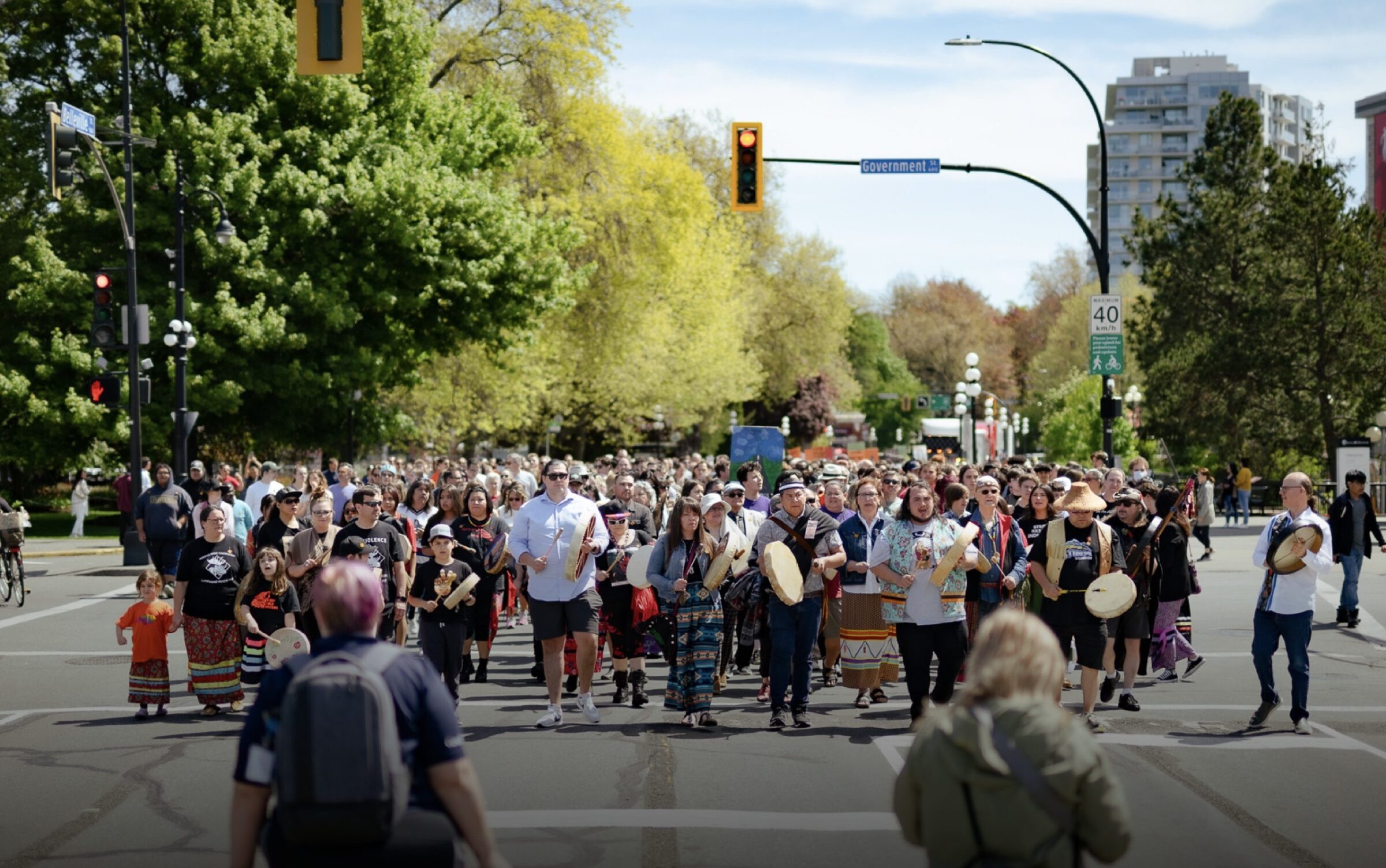
A Moose Hide Campaign Day walk in Victoria in May 2023. Iqaluit city council is being asked to declare May 16 Moose Hide Campaign Day in the city. (Photo courtesy of the Moose Hide Campaign)
Thursday could be declared Moose Hide Campaign Day in Iqaluit, if city council chooses to vote for it Tuesday night.
The Moose Hide Campaign is a Canada-wide movement aimed at engaging young men and boys in the fight to end violence against all women and children.
Describing their effort as an “Indigenous-led, grassroots movement,” campaign organizers sent a letter to Iqaluit city council asking it to vote to declare May 16 as Moose Hide Campaign Day in the city.
The correspondence is included in the May 14 council agenda. Council could choose to hold a vote.
Campaign organizers have reached out to nearly all municipalities across Canada proposing the same motion, CEO David Stevenson said in a phone interview from Victoria, B.C.
The campaign is represented by small, yellow moose-hide pins that can be worn on a shirt or coat.
The campaign has distributed more than six million of the pins since its creation.
Each year, RCMP employees are allowed to wear a Moose Hide pin on their uniform to support the anti-violence message, a break from protocol similar to the way they’re allowed to wear poppies around Remembrance Day.
“It’s not a badge of honour or virtue signalling,” Stevenson said of the pins. “It’s an acknowledgment that there is an epidemic of intimate partner violence and domestic violence.”

The Moose Hide Campaign has distributed more than six million of its pins. Campaign CEO David Stevenson calls it “an acknowledgment that there is an epidemic of intimate partner violence and domestic violence.” (Photo graphic courtesy of the Moose Hide Campaign)
The Moose Hide Campaign began in 2011 when its founders, Raven Lacerte and her father Paul Lacerte, were hunting moose along Highway 16 in northern British Columbia.
The roadway is also known as the Highway of Tears, named for the women, mostly Indigenous, who have gone missing there or who were killed and their bodies were found along the 724-kilometre road.
Inspired by their surroundings, after the Lacertes caught their first moose they planned out the campaign and decided its symbol could be part of the repurposed moose hide.

On May 16, an in-person event featuring speakers including Raven and Paul Lacerte is planned in Victoria, B.C., that will be livestreamed.
As well, local workshops will be held across Canada.
Stevenson called it the “day of ceremonies,” during which all men and boys are invited to fast from sunrise to sunset to demonstrate their commitment to opposing violence against women and children.
“Let’s fast together during the day and think, ‘Wait a second, I have a daughter, she is going to a post-secondary school, post-secondary institutions are actually risky places for young girls in this country. That’s not OK,’” Stevenson said.
The Moose Hide Campaign has fasting guidelines on its website, urging people to be careful to not undermine their own well-being.
“Our goal to have every municipality stopping for a day and going, ‘Of all the things we have got to do, one thing we have got to do as a city is to acknowledge that this city where women are at risk, because they are at risk everywhere,’” Stevenson said.
This is a great cause, and all communities in Nunavut should participate! It all starts at home, and partner violence has no place in Nunavut!
During a conversation with an Inuk lady about relationships, I asked, “I notice that there are some..(repeat Some) Inuit women who will not “go out ” with Inuit. Why is that? (Just asking)
She replied…”Cause you guys (Inuit) don’t know how to treat women. You only know how to beat us up and abuse us.” 😥
“Women in Nunavut are the victims of violent crime at a rate more than 13 times higher than the rate for women in Canada as a whole. The risk of a woman being sexually assaulted in Nunavut in 12 times greater than the provincial/territorial average. In 2016, Nunavut had the highest rate of female victims of police-reported family violence in Canada.”
I don’t blame them for looking elsewhere for a partner.
More men than women are are assault victims in Nunavut. I’m sure the City Council will grandstand.
Please supply court records and homicide statistics to support your comment.
Hi Good Grief,
The information is available online on StatsCan. Title is, “More than half of people living in the territories reported physical or sexual assault since the age of 15”.
Quote is,
“In the Northwest Territories, 52% of women and 55% of men reported having been sexually or physically assaulted since the age of 15. Nunavut had the lowest prevalence of violent victimization: 42% of women and 46% of men in that territory reported having been sexually or physically assaulted since age 15.
In Nunavut, the prevalence of assault was relatively low in the smallest communities. In the largest communities such as Iqaluit (58%) or Rankin Inlet (56%), the prevalence of violent victimization was relatively similar to what was observed for the territories as a whole. In contrast, in the other smaller communities, just over one-third (37%) reported having been sexually or physically assaulted at least once since age 15.”
Does that work for you?
According to Statistics Canada in 2018 (a wee bit dated I agree), women in Nunavut experience violence at a rate of 10,325 per 100,00. While males, by contrast, experience violence at a rate of 5,205 (2018).
If true, women experience nearly twice as much violence as men
https://www.gov.nu.ca/sites/default/files/documents/2022-11/police_reported_victims_of_violent_crime_by_sex_of_victim_and_by_province_territory_2018.pdf
Hi Not Even,
I’m aware of those statistics. There are 2 data issues with your argument:
1. There are police reported statistics, as opposed to self-reporting as I listed. It is well-known that men usually do not report instances where they are victims. A study titled, “Homicides, Firearm Offences and Intimate Violence” found that “whilst 27% of women who experienced intimate partner violence reported it to the police, only 10% of men did so, and whilst 44% of women reported to some professional organization, only 19% of men did so”. Using these reporting numbers, the police-reported statistics you’ve referenced would still put men ahead.
2. The police-reported statistics do not exclude repeat-victims. Therefore, if one woman calls the police on the same culprit 5 times in a year, then that will be reported 5 times. We know this occurs regularly. We know that women often return to abusive relationships. The information I provided was based on the overall percentage who have been victimized, which was also my argument, “[m]ore men than women are are assault victims in Nunavut”.
Would be more appropriate for the Inuit organizations to be participants. Their boards are chock full of known wife beaters and child abusers.
Of course, blame the child, the boy. Have a day off for walks to swirl the child’s and young man’s thinking mind that everything is his fault. Teach him not… or give opportunities to be strong, work hard, hunt with strength and skill, clearly talk, have morals, be spiritual, be leaders and have fun. Instead, feminization of boys, young men to be weak and seen as no good because everything is their fault. Repeated 24/7 direct to their growing mind. Where is the trust boys and young men can and will figure things out? They are our brilliant future. Where is the hope and support they hear? Why the twisted control over boys, young men who do love but money flows to believe are nothings?