


ITK divvies up $27M to fight tuberculosis
Funds are part of federal government’s goal to eradicate disease in Inuit Nunangat by 2030
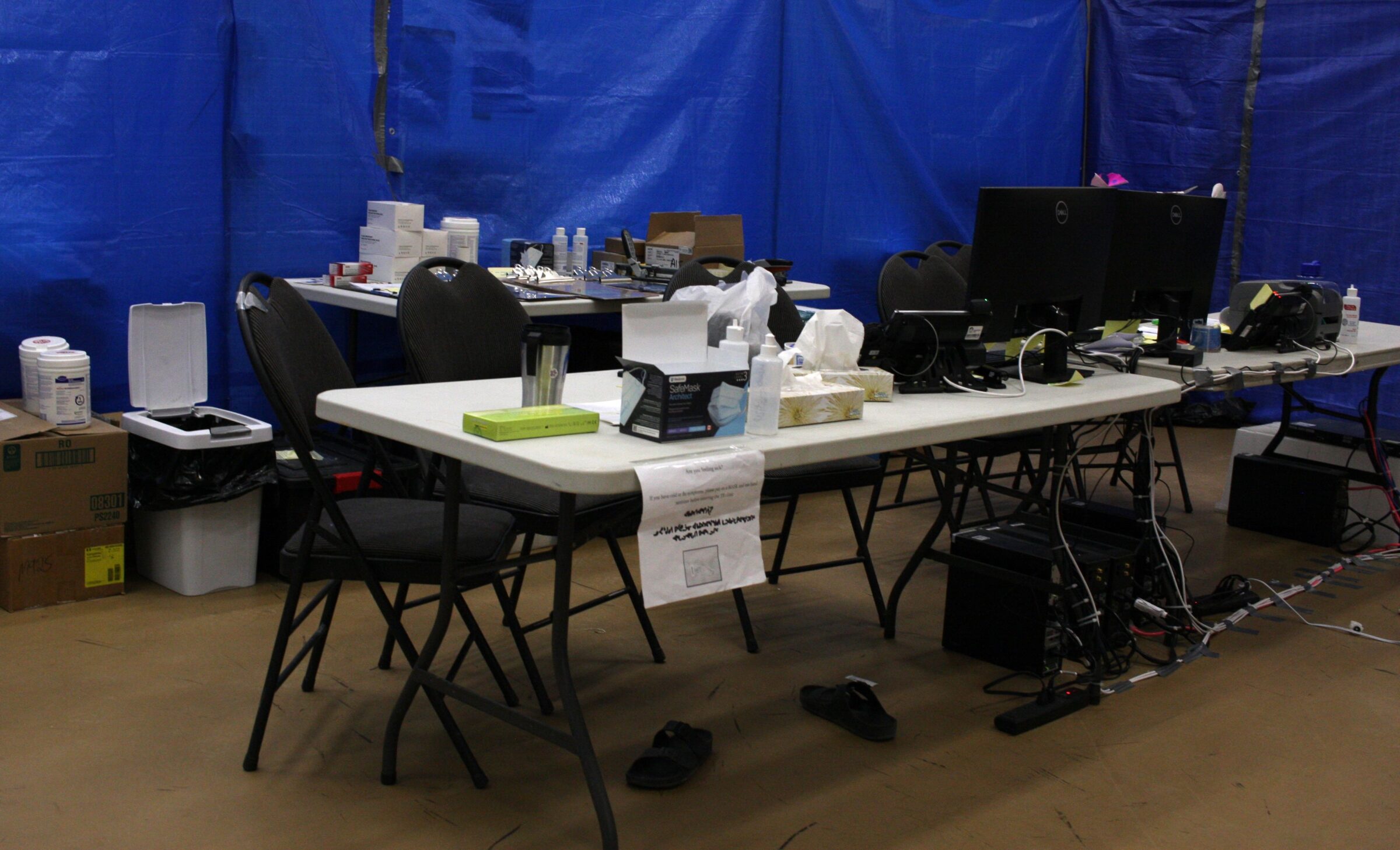
ITK announced in late May how it plans to distribute $27 million to fight Tuberculosis among Inuit in Canada. The money will go towards supporting screening clinics such as the one held in Pangnirtung in 2023, seen here. (File photo by Corey Larocque)
Inuit Tapiriit Kanatami has decided how it will allocate $27 million earmarked for tuberculosis eradication across Inuit Nunangat.
The money, originally announced in February, is meant to help fulfill the federal government’s promise to eradicate tuberculosis by 2030.
Inuit in Canada see disproportionately high rates of tuberculosis. While rates in Canada are some of the lowest in the world, at 6.1 cases per 100,000 people, the rates of the disease among Inuit in Canada is 186.9 cases per 100,000, according to statistics from the federal government from 2024.
Tuberculosis is treatable with medication, but left unchecked, it can be deadly.
Inuit groups across Canada have been lobbying for $131 million in funding and “co-ordinated action” to address the underlying issues that increase tuberculosis spread in the North, ITK said in a May 27 news release about the funding allocation.
This money does “not meet that need but will sustain momentum for strengthening TB programs,” the news release said.
Of the $27 million, Nunavut Tunngavik Inc. gets the biggest share, with $11.6 million. Nunavik Regional Board of Health and Social Services will receive $9 million, Inuvialuit Regional Corporation will get $1.8 million and Nunatsiavut Government gets $1.3 million.
“The current funding will be used to keep TB program momentum going,” said Raymond Obed, senior policy adviser with ITK, in an email to Nunatsiaq News. “Inuit are still hopeful TB can be eliminated by 2030 with adequate federal resources.”
The money will go towards diagnostics and treatment, training, awareness, and other supports for Inuit. Obed also emphasized the importance of tackling other social determinants of health. Overcrowded housing across Inuit Nunangat is one of the main contributors of spread, for example.
“Eliminating TB will also require substantial investments in housing, infrastructure, and food security,” Obed said. “Tuberculosis care is resource-intensive and places an immense burden on fragile health systems in Inuit regions.”
Nunavik has seen a sharp increase in TB rates in recent years.
The region serves about 20 per cent of Canada’s Inuit population, but the Nunavik Regional Board of Health and Social Services received nearly 35 per cent of the $27 million.
Other Inuit regions are showing a downward trend, said Obed, citing statistics from the Public Health Agency published in 2024.

Since I didn’t vote for nti elections, I sure hope my 100 voucher went to this instead.
27million can go to much needed housing across Inuit nunanga & some much needed food vochers in my wildest inumari dreams
How much are they keeping for themselves as an admin fee?
If you add up the four regional allocations it comes to $23.7M, leaving an amount of $3.3M going somewhere.
@ forever amazed
The typical “kick-back” is 15% for each group that touches it. For example 15% of $27,000,000.00 is $4,050,000.00.
But this is not where it stops as the article indicates: NTI will get $11,600,000.00 , NRBHSS will get 9,000,000.00, IRC will get $1,800,000.00 and NG will get $1,300,000.00 making each of their “cream” at $1,740,000.00: $1,350,000.00: $ 270,000.00 and $195,000.00.
This totals the various 15%’s to $3,555,000.00
This (3.555 mill) amount removed from the 27 mill = $23,445,000.00 for TB.
Call it the Liberal way. Wasting taxpayers dollars in the name of reconciliation.
@ TP
PEOPLE ARE DYING FROM TB in the regions mentioned.
This is not a matter for “reconciliation” or in your case, trying a “drive-by” hit on the Liberal Federal government.
Sorry, my comment was not at all clear in its intent. In no way am I suggesting that this money, and perhaps much more, should not be invested in eradicating TB from Inuit communities. It absolutely should. It is 2026 and TB should not be present anywhere in Canada.
My issue is with choosing ITK as the funnel through which the funding flows. The inefficiency of this process will mean that somewhere in the range of 50% of this money will actually be used for the intended purpose. The rest will go to admin charges, hiring staff to manage the file, contracts to well positioned consultants…
Meanwhile there are public governments for each of the jurisdictions which already have health departments working on this. Also, ITK has already made up its mind that the result of this funding is that more funding is needed for more social housing, publicly funded grocery store models and any other number of things that will not make a difference in addressing the causes of poverty, which is the main determinant in the TB outbreak. Why not focus on education (the public system, not the elitist Inuit University), financial literacy and management, causes of substance abuse, family planning so that teens are not having babies that their parents or grandparents have to support. Instead the symptom (TB) will be treated, instead of the root causes (all of the above and many more).
ITK knows the community more than federal government officials, they understand how process work in the communities. Nothing to do with Liberal government, political parties don’t administer programs, government departments are separate from political party in government. Parliament members government in control set policies but do not interfere in operations. I hope that make sense to you.
The Government of Nunavut, specifically the Department of Health, should be handling TB, not the Federal government and definitely not ITK, who have ZERO expertise in health.
I hope that makes sense to you, oh ima
Average is 10% to 15% for administration for any organization, I hope that answers your question.
I have no understanding why ITK would have any role whatsoever in distributing Federal health related funding.
The four Inuit ITOs have signalled to the Feds for many years this is how they prefer to receive funding for their regions. ITK does political work for sure, but they do admin for the ITOs as well and provide general coordination and guidance on these types of things.
.
If you’re asking with Ottawa gives these groups money in the first place, that is another question altogether – maybe you’re asking why are they not just provided to Territorial governments? I am 99% sure the reason is politics on that one. In some regions, not NTI, the ITOs are actually delivering health services and are aiming to replace their respective PT gov’s role in that field under self-gov initiatives.
Well they do need millions to print out paper and pamphlets to print out that will never be seen by majority of Inuit at waiting rooms.
I swear every time they announce TB funding thats all what we ever see and the issue is never worked on. Nothing will ever change with majority of Inuit smoking daily so butt pickers get TB and spread it around.
if the total Inuit population in Inuit Nunangat is 65,000 the break down comes to $360.70/person if the funding is until 2030. or is this old funding that is revamped?
Do all 65,000 of those people have TB?
@ re-do yer maths
Correct answer: All 65,000 are very much at risk of catching it.