


John Amagoalik squares off with GN in court over home-care funding
‘Father of Nunavut’ seeks funding for in-home medical care in Iqaluit; GN says health-care spending is up to the legislature, not a judge
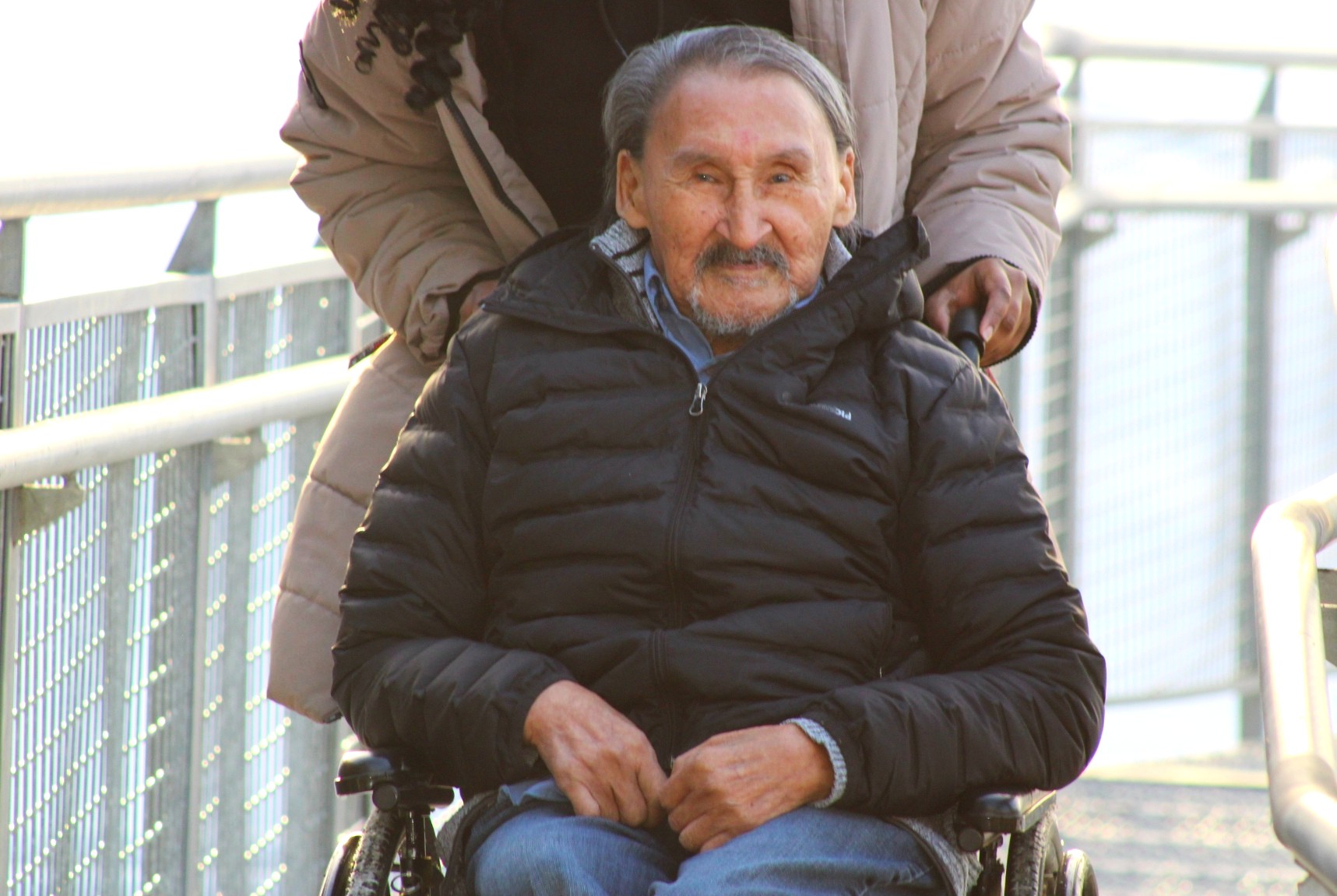
John Amagoalik arrives at the Iqaluit Courthouse on Friday. (Photo by Daron Letts)
Nunavut Chief Justice Susan Cooper reserved her decision after hearing lawyers for John Amagoalik argue the territorial government should pay for his private medical care in Iqaluit while government lawyers argued it shouldn’t.
Lawyers for the man many consider the “Father of Nunavut” were in civil court Friday, trying to secure emergency funding to allow him to receive medical care in Iqaluit while a lawsuit he brought against the Nunavut government proceeds.
At issue is the retired politician’s request for approximately $16,000 a month to pay for private support care workers and housing.
Amagoalik says he needs that money so he can live with his wife and family in Iqaluit instead of at a long-term care facility in Ottawa, where he had been living for a year and a half until he returned North in August.
Nunavut’s Health Department has declined the request, saying it’s outside the government’s legislative authority to provide the amount of in-home care Amagoalik needs to stay in Nunavut.
Last month, Amagoalik, 79, filed an application for a judicial review of the Health Department’s decision, which the court will consider at a later date.
The department has so far offered to cover two hours a week of private support care for Amagoalik, which his lawyer Dougald E. Brown said is unacceptable. He currently receives up to 10 hours of care a day.

“This is for an individual who is described in the plan of care as medically fragile,” Brown told Cooper in an Iqaluit courtroom Friday morning. “That is not a scenario that ends well. Mr. Amagoalik would be left vulnerable, and at risk of serious, adverse medical consequences – and I say this candidly – death.”
Brown cited sections of the territory’s Hospital Insurance and Health and Social Services Administration Act and its Boards of Management Dissolution Amendment Act, which he said appear to give the department the authority to fund his care and housing.
Brown told the judge “it is clear” the Health Department does have the legislative authority to grant Amagoalik’s request.
The way the Government of Nunavut has chosen to handle Amagoalik’s pleas for help infringe upon his Charter of Rights and Freedoms rights, Brown said.
Since the 1970s, Amagoalik had lived in Iqaluit with his family, until a surgery resulted in him being sent to the care home in February 2025.
Amagoalik has described his life at Embassy West as lonely and says he was unsatisfied with the care he was receiving.

He cannot and will not return to Embassy West in Ottawa, Brown told the judge.
“A return to Embassy West is not a Charter-compliant option,” he said. “John Amagoalik already experienced life at Embassy West to be psychologically distressing and painful.”
In the afternoon, lawyers for the government took their turn.
“How public dollars are spent and the delivery of public health care is for the legislative assembly” to decide, not the courts, said Craig Boyer, a lawyer for the GN.
Exercising discretion in a way that goes against values in the Charter is not the same as infringing upon someone’s Charter rights, he also said.

“[The Charter] does not provide an unqualified right to healthcare,” he said.
Using that logic, Iqaluit’s hospital would not be considered Charter-compliant, because some higher levels of care, such as certain kinds of cancer treatments, aren’t available there, Boyer said.
Brown, Amagoalik’s lawyer, said however they are “not asking for a restructuring” of the government’s home-care program delivery. Rather, they want the court to assess the reasonableness of the Health Department’s decision not to fund Amagoalik’s home care.
Cooper did not say when she will give a decision on Amagoalik’s application.
(0) Comments