


Like giant ‘Lego set’: Arviat modular homes factory eyes April opening
$70-million project expected to produce about 40 new homes per year

A modular homes factory in Arviat remains under construction. It’s set to start operations next April. (Photo courtesy of Sakku Innovative Building Solutions)

Arviat’s modular homes factory is substantially completed and expected to start manufacturing houses in April.
“We’re really excited. This year on the sealift, we’re already bringing the raw material up to Arviat to start the production,” said Guillaume Guida, Sakku Investments Corp. vice-president of business development.
Modular construction is a process where components for houses are built off-site in a factory, shipped out to where the home will be located and assembled there.
The roughly 64,000-square-foot factory – nearly the area of four hockey rinks – with a 21,500-square-foot warehouse, situated in Nunavut’s third-largest community of roughly 2,900 residents, is expected to produce about 40 homes a year.
The project is led by Sakku Investments Corp., the business arm of the Kivalliq Inuit Association. Construction started in September 2023.
The expected April 2026 startup comes slightly later than originally planned because of construction delays, Guida said.
At this point, the factory’s foundations and most of the walls are up. Now work crews are focusing on connecting mechanical, electric and plumbing systems and building the warehouse, said Caroline Nault, CEO of Sakku Innovative Building Solutions, the factory’s operator.

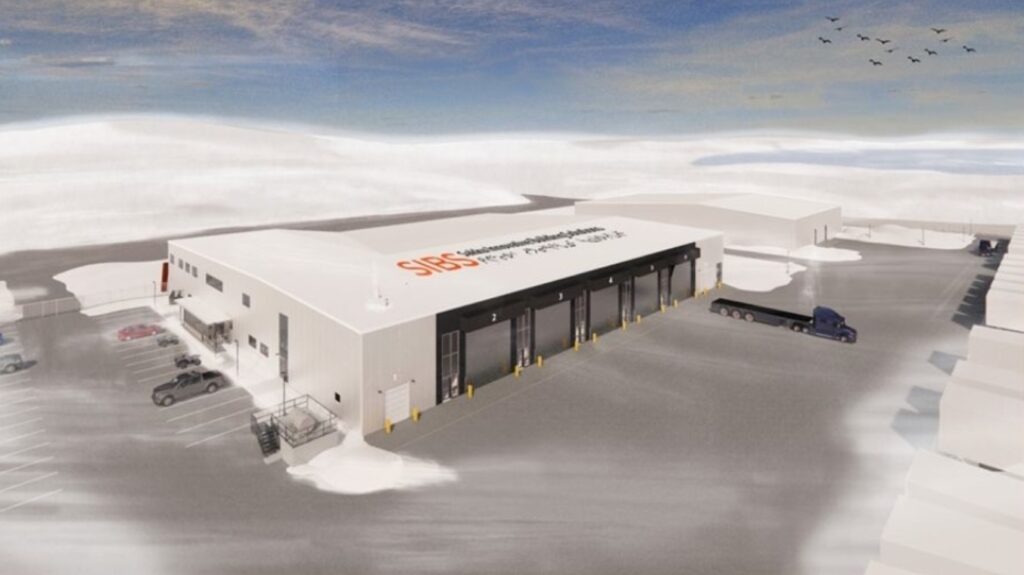
Construction will soon be completed on a modular homes factory in Arviat that is expected to be operational in April 2026. (Photo courtesy of Sakku Investments Corp.)
The project will also go over budget, she said, with an estimated price tag of $70 million instead of the $50 million originally planned.
That change, Nault said, is due to a post-COVID-19 hike in construction costs.
Sakku, the Government of Nunavut and the federal government all pitched in to fund the factory startup.
The idea of creating a modular homes factory in Arviat dates back to 2015 when the Kivalliq Inuit Association, which is mandated to protect the rights of Kivalliq Inuit, directed Sakku to find a way to employ more Inuit in the construction industry, Guida said.
To do that, companies need to provide training, which is difficult in the context of on-site construction where typically “you try to build as fast as you can while the weather is good,” Guida said.

But with modular home building, construction can go on all year round in a factory.
So Sakku decided to give it a go at a time when modulars were “frowned upon,” Guida said.
“It was not like today when modulars are the flavour of the week,” he said.
For a long time, modular housing was unreliable because most of it was fabricated in the south and unable to withstand the Arctic climate, he added.
So, in 2018, Sakku formed a partnership with RG Solution, a Quebec firm that specializes in building modular homes.


Minister John Main, in the middle, is one of the officials touring the nearly-complete modular homes factory in Arviat in June. (Photo Courtesy of Ron Elliott)
The difference with the modulars that will be built in Arviat is that from insulation to roofs and windows, they are built specifically for the Arctic, Guida said.
“It’s not something taken from the south with a cute bow on top, trying to fit Nunavut.”
Nault described a standard module the Arviat factory will produce as a “Lego set” approximately 12 metres long, 4.3 metres wide and 3.7 metres high with electrical wiring, insulation, windows and doors.
Two modules would normally make up a two- or three-bedroom apartment.
A module should take about three weeks to build. After that, it’s wrapped in protective plastic and the “huge marshmallows” will be shipped to one of the Kivalliq communities for installation, which should take roughly two months.
Along with 40 full-time factory employees, the enterprise is estimated to create about another 100 jobs that will support construction, Guida said.
For now, he said, the project is set to only focus on Kivalliq.
“But it’s a model that we believe would work for all of Nunavut,” Guida said.
Would be very interested to see the business case presented to the Feds and Territory to support funding.
Factory needs to import and store all materials used for construction on sealift.
Factory will pay some of the highest costs in Canada for electricity, other utilities. (unless it is subsidized… the best business model of all!).
Will struggle to operate with local labour, leading to high operating costs using southern labour to fill the gap.
Completed modular units will need to be put on sealift backhaul to deploy to other communities. Material and product will be handled three times through sealifts without port access.
Is there client NHC? What is the estimate sq ft cost supplied and installed?
Always so negative, just worry how much a jug of milk is costing you….
Those are valid concerns / questions. We face these issues in every NU community, we use outside labour for almost all building because the skills do not exist, we use sealift to move everything so moving things effectively twice is very expensive obviously and honestly makes no logistical sense. Large spaces are incredibly expensive to heat here due to the only option being diesel.
Everything they said is valid, so what is the business case compared to a modular plant being put right in Quebec by NSSI or NEAS docks? On paper it seems it would make vastly more sense to do that. Maybe once NU has the capacity / skilled labour in-house it becomes different but that’s not remotely a current reality and could be decades out.
Pretty sure criticism are valid, especially if NHC is the ultimate customer which means unnecessary spending of tax dollars just to support this high cost venture.
If you want training, this is the way to do it. As the article indicated, the main issue with training in construction now is that you can use a project to train, you can get it done on time, or you can do it cheaper. Pick two. Having a place where you can do it year round, so there’s not the rush to finish and get the unit enclosed before the weather turns bad, allows time to train and gain the experience. Then you’ve got a cadre of workers who are trained and qualified to do the work so they can be employed in more traditional construction. Will it work? Who knows. But it is an innovative step.
Maybe.
There was a very similar outfit in my home town that made “executive” trailers for Fort Mac. I toured it a few times as it was a cool operation. It ran as an assembly line, very similar to a car plant. However, like car plants, workers had very specific jobs. One worker did nothing but screw down plywood sub floors all day long. I remember thinking how boring that would be. Others installed windows and doors all day… you get the picture.
If this plant works the same (and it would have to in the beginning) it’s not really prepping workers with practical job skills. Workers in a car plants, aren’t mechanics and workers in this plant won’t be carpenters. That said, there are lots of good jobs in a plant like this. I would do a job like that quickly.
It’ll be very tough to balance “overall” job training vs speed of building units.
Training?!!!
Go to SKOOL.
It’s FREE. Get a real certificate on your own. There are trade schools all over Canada.
Get in for real. As someone said….”I had a dream. That my children and grandchildren will be judged by their character….”
Something like that…🤘♥️
Most people won’t work because they don’t want their welfare affected because they live a simple life
13 downvotes from people unwilling to admit they know people that have turned down jobs because “it will affect my rent.”
Sincerely hope that this is a successful venture.
It’s so difficult to be positive. Because there hads been so many failures.
It costs more to ship prefab, fully assembled buildings.cargo is charged by the greater odds weight or volume, the building would have cu ft calculated vs weight. Then charged. So you would be paying for shipping air space from the south. Great idea.
You’re still shipping it to communities from Arviat…
So you’re shipping raw materials then shipping buildings after assembly in NU. So you’re still shipping air.
Everybody needs to understand that with this factory, you are at the mercy of not one but two sets of timelines that you cannot control. The arrival of ships into Arviat and the schedule of connecting sailings of the other communities. Anybody knowledgeable of those issues will tell you that they would not bet a silver dollar on acheiving the right target date especially a year and a half ahead of time.
How can you assure the customers that their dream home will come on time ?
After all this is the essence of doing BUSINESS anto not MAKE WORK PROJECTS.
On the other hand we all know contractors that would give their right arm to be given for a dollar such a facility. Nothing to pay back. Let;s not kid ourselves the various government agencies will never see another cent of their so called INVESTMENTS. On top of that they have only the foundations and the shell of this building and are already $20mm over budget . Let`s see what the price of their units will be
Thank you
You’re right, not even finished and watch 100 million of KIA. Money, and maybe GN money, these Quebec. Company’s have hit more than 2 gold mines, Kia money, not one of those houses will make it out of Arviat, they will all stay there and be public housing,
And GN housing,good for Arviat they need housing always.
There are no locals working on ships which equipment brought up from south. Only outsiders. Only white men and non arviatmiut. Kind of useless