


Meet MNRL — Nunavut’s new Department of Mines, Natural Resources and Land
Premier announces addition as part of devolution process
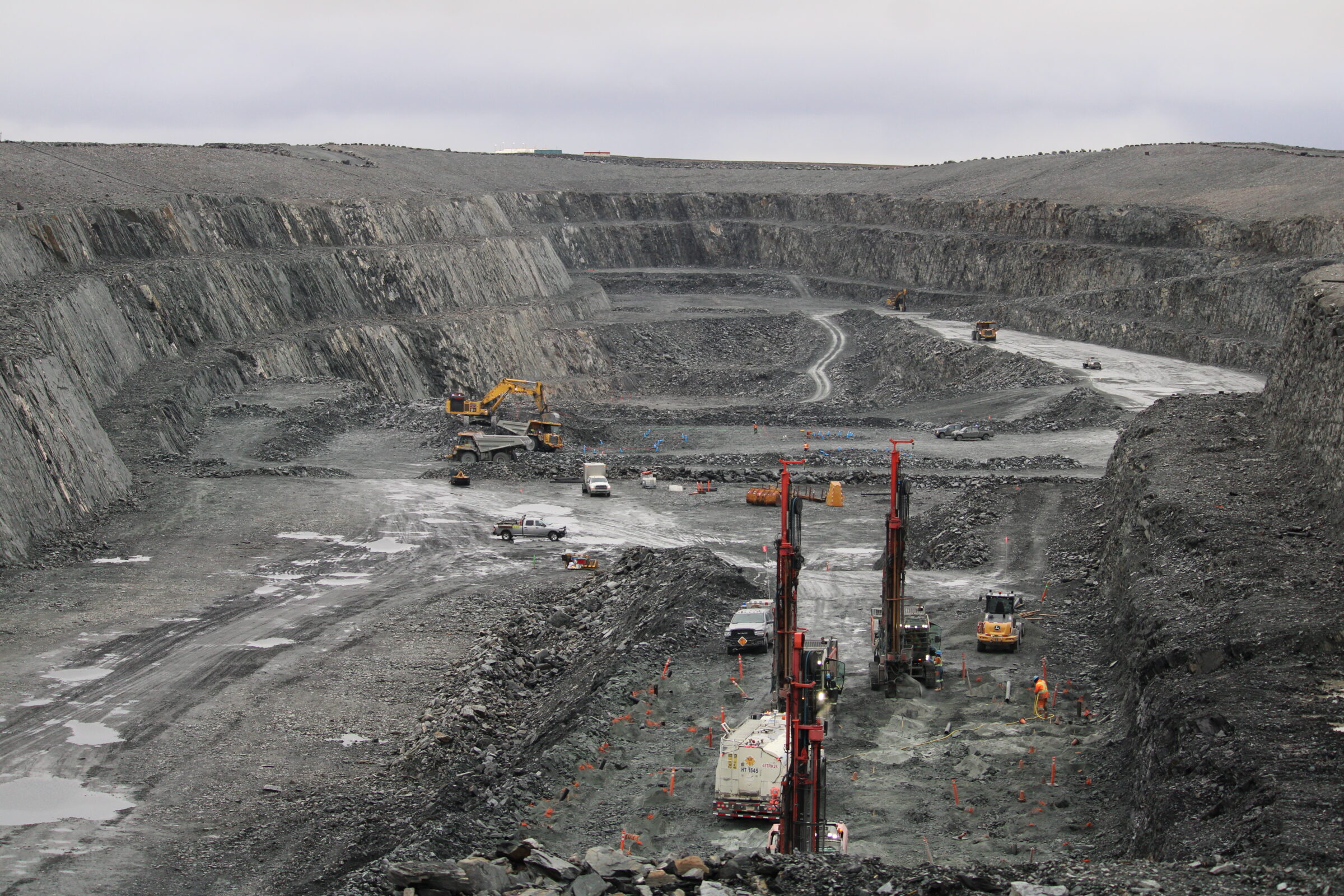
The open pit of Agnico Eagle’s Meliadine Mine near Rankin Inlet is seen in this file photo. Nunavut Premier John Main announced Tuesday that the GN will form a new Department of Mines, Natural Resources and Land as part of the devolution process. (File photo by Arty Sarkisian)
The Nunavut government is preparing to roll out a new department to manage its post-devolution responsibilities.
Premier John Main announced the Department of Mines, Natural Resources and Land — or MNRL — Tuesday in the legislative assembly. It will serve as a “single point of access for land and resource development matters,” he said.
The department will be responsible for the administration, regulation, and sustainable development of natural resources on land that the GN will acquire from the federal government.
“This includes public lands and fresh-water management, oversight of mineral and oil and gas development, and promotion of geoscience and mineral exploration through a Nunavut Geological Survey,” Main said.
The territory signed a devolution agreement with Ottawa in January 2024.
Touted as the largest land transfer in Canadian history, it is scheduled to take effect on April 1, 2027. The new department will also launch on that day.
Whoever championed this name internally deserves kudos.
Yes it’s been touted as the largest land transfer in Canadian history, but you shouldn’t trust touts. Here’s what the agreements says:
3.1 As of the Transfer Date the Commissioner shall have administration and control of Public Lands and rights in respect of Waters.
3.2 Notwithstanding the transfer under section 3.1, Public Lands and rights in respect of Waters belonging to His Majesty the King in right of Canada at the Transfer Date shall continue to belong to His Majesty the King in right of Canada.
What’s being transferred is the administration of land and resources, which is very important, but the federal government will still own the land.
Legally, the King in Right of Canada nominally owns the land and water in Canada, including Nunavut, on behalf of the people of Canada.
Since we live in a constitutional monarchy, the rights and interests of all the people (the public interest), is conferred on and embodied within our reigning Monarch.
That is why when criminal charges are laid on a person in Canada, charges are made by the Crown, not the police or by a government official. Crimes are committed against the people, not the government.
In Nunavut, CIRNAC for the Government of Canada has administered and controlled these public resources on behalf of the King.
The Government of Canada is relinquishing its duties, and transferring them to the Government of Nunavut.
The Government of Nunavut will now have these responsibilities – administration and control, on behalf of the Crown.
The Federal government never owned the land and water in Nunavut. Nunavut cannot receive from the Government of Canada something the Government of Canada did not have in the first place.
That is what the Devolution agreement acknowledges.
Fair enough to say the federal government didn’t own the land prior to 1993. However, in the NCLA Inuit agreed to give up (“cede, release and surrender” — Article 2.7.1) the land to the Queen in right of Canada, that is, the federal government (but take back ownership of certain parcels of land).
One aspect that worries me is that this new DMNRL entity will be in charge of a large gamut of realms, where the concern of intrinsic conflict could arise.
Consider that DMNRL will be in charge of “public lands and fresh-water management, oversight of mineral and oil and gas development, and promotion of geoscience and mineral exploration”.
This means that a single group will effectively be promoting mining (since mineral exploration is essentially the first step of mining, and it is also known as prospecting, with everything afterwards being seen as development) as well as (presumably) doing the enforcement of mining-related regulations.
Looking more closely at what DMNRL will be doing, I see that its mandate will include the “management” of public lands and freshwater, in addition to “oversight” of oil, gas, and metal mining. These task descriptions imply to me a certain amount of enforcement of rules. (All laws and rules need some enforcement bodies behind them, or else they mean nothing.)
So, unless the Nunavut Department of Environment will be tasked with policing mines and enforcing regulations and compliance orders regarding mines, we will have problems. For example, what happens if the tailings (waste rock) start leaching acidic mine drainage [AMD], a serious problem well-documented at metal mines in Ontario and in Minnesota, as well as in many other places where sulphide mineralizations are present in the rock? Unless there is a “firewall” between the mining promoters and the mine inspectors, I see a serious danger here of a conflict-of-interest situation arising.
In other words, if the same regulatory body is in charge of both promoting mining and policing it, then we are putting the fox in charge of the henhouse.
Also, in looking at the GN-DOE website, I see that “the Department of Environment, in partnership with others, protects the environment (land, air, water), parks and wildlife in Nunavut by promoting the sustainable use of these renewable resources.” Although such a statement sounds nice on paper, I already see another problem here: mined resources are by definition nonrenewable (so a one-shot deal), as is land (e.g. once a mine has made a huge hole, such as the Agnico-Eagle Meliadine Mine near Rankin Inlet, the land is permanently off-limits to all other uses; also keep in mind that, due to the aforementioned AMD concerns, the environmental footprint of a mine extends beyond the direct footprint of the open pit; also remember that underground mines also bring impacts too; also note that no tailings impoundment technology has proven itself reliable over the timeframe, which is literally forever!).
Furthermore, I was hoping to hear tangible insight about proper, meaningful royalties being drawn from future mining companies. Nunavut (and/or Inuit organizations) would do well to learn from the example of Norway, which has a two-trillion-dollar Sovereign Wealth Fund, as obtained simply by investing the profits (as obtained via its government-owned oil firm Statoil, today known as Equinor) wisely and with discipline. Contrast that to Alberta, which has a mess of massive oil sands sites and abandoned (orphan) conventional oil wells that collectively need hundreds of billions of dollars in cleanup, and no sovereign wealth fund to speak of. So, literally, the profits went to private investors, thereby leaving the taxpayer to pay for the cleanup! How fair is this?
Granted, the mining companies are very good at promoting how they offer apprenticeships and jobs. While those perks are appreciated, the endless emphasis and advertising on these topics tend to drown out the elephant in the room, which is simply that we need to insist on serious royalties (not royalties being set by the mining lobbyists via their capture of regulatory bodies, as happened in Alberta).
Looking ahead to the future, will Nunavut go “the Norway route” with its one-time windfall of mining wealth? Or, will we let the vast majority of mining profits flee the territory (and Canada too)? A royalty rate of 10-15% is nowhere near enough. I strongly feel that we should be insisting on the public purse (and/or Inuit organizations) receiving at least 50% royalties, accompanied by a firm promise that the executives of the mining firms do not take home any more than 5 times as much total compensation (including stock options and bonuses and benefits) as the lowest-paid employee.
I note that Nunavut is currently at a “Peter Lougheed moment”. Lougheed was the former Premier of Alberta, back in the 1970s and 1980s. He foresightfully created the province’s Heritage Fund (HF), and the oil-industry royalties were at that time high enough to grow the fund seriously. (Sadly, subsequent premiers reduced the royalties down to nothing, and then they spent the HF on things which normal provincial taxation would have easily paid for, thereby leaving this sovereign wealth fund withered. Today the fund remains a tiny fraction of Norway’s, even though Alberta and Norway have roughly similar populations. Granted, Alberta is a subset of Canada whereas Norway is its own country, but even then, if Alberta would have kept its oil royalties high enough to both continue serious contributions to the HF and also pay the routine annual transfers to Ottawa, then the public purse would have been in much better shape today than it is now.)
I hope the starkly contrasting lessons from Norway and Alberta are taken to heart. These are topics that should be discussed regularly by all government levels (federal, territorial/provincial, and municipal too). We are poised to sell off our one-time mining bonanza and we have only one opportunity to get this right.
I hope that Premier John Main, who is also Minister of Finance, takes time from his busy schedule to explore and ponder these topics in depth.
These are also topics that would be conducive to public “town hall” meetings. Indeed, we need to be careful not to let ourselves be dazzled by mining-industry lobbyists, who love to tout the millions of dollars in philanthropy and other initiatives that they sprinkle in poverty-stricken nearby communities, all while quietly exporting billions of dollars each year to already-very-rich people who probably have never set foot in Nunavut.
The Department of Education must balance the need to educate young people with the available resources, the rights of students and parents, and the wishes of communities.
The Department of Health must balance the need to maintain or create a healthy population with the available resources, the rights of patients, and the abilities of their staff.
What you describe as a worry for this new lands and water department is nothing more than the eternal process of governance; the mechanism by which policies are made, remade, and enforced with the aim towards general welfare.
Governance, if conducted properly, is always a trade off of interests and desires within a society.
All of the tough trade-offs you describe have been the job of CIRNAC for years. All the concerns you state about “intrinsic conflict” , risks and rewards have previously wrested within this federal department with one exception:
Almost all royalties on mineral development to date, and into the foreseeable future have accrued to Inuit. Government has only benefitted via direct taxation from this activity. The suspected avarice of public officials can hardly be quenched by a favorable decision or two.
How this Federal department has made these decisions has been opaque, and divorced from public scrutiny and accountability to the people of Nunavut.
We can highly suspect that CIRNAC Ministers and their officials, in addressing these conflicts in the past, has has paid much less time, attention and duty of care to these questions than Ministers dedicated 100% to this task.
After all Nunavut is but 1/13th of their federal area of responsibility, and if they get the solution wrong, they and their electoral constituents hardly have to live with the direct consequences.
I have every expectation the GN will be able to make much superior decisions than CIRNAC that directly relate to the needs and desires of our people.
Thank you for the great overview.
Where is the land use plan?????