


Moravian interest in Ungava Bay
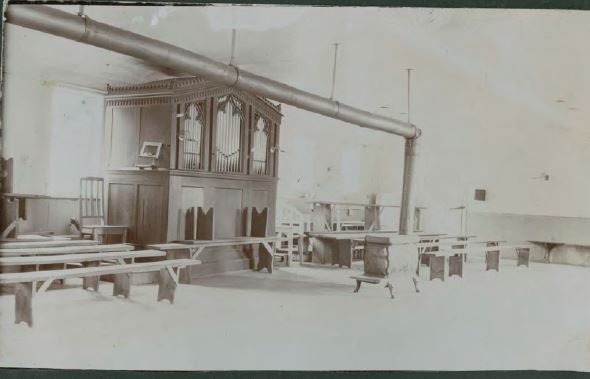
This undated photo offers a view of the interior of the Moravian Church at Okak, showing the church organ. Music played a large part in Moravian mission life. (Photo from the Kenn Harper collection)
In 1771, the Unitas Fratrum — known more commonly as the Moravian Church — established its first Labrador mission at Nain.
It would always be the church’s principal station in Labrador.
The Moravians hoped Inuit would congregate there and convert to Christianity. But the idea of a permanently settled congregation did not mesh well with Inuit needs for the mobility their hunting lifestyle demanded.
Very soon they realized Nain was a poor location for a winter settlement, and began looking for better places.
On an exploratory voyage in 1773, Jens Haven went as far north as Nachvak. While there, he met Inuit from Ungava Bay.
Little was known of that large bay to the west of the Labrador Peninsula. European explorers tended to avoid it because of its shallow water and extremely high tides.
Hudson’s Bay Co. ships that traversed Hudson Strait on route to Hudson Bay and the posts they established there seldom ventured into Ungava Bay.

Early descriptions of the area which referred to “the Labrador coast” were references not only to the coast of what we know as Labrador today, but also to Ungava Bay, the southern shore of Hudson Strait and the northeastern part of Hudson Bay.
The Moravian Church supported itself through trade conducted through its commercial arm, The Society for the Furtherance of the Gospel.
So Haven, in addition to looking for populations of heathens to convert, was also interested in the possibilities for trade with the Inuit — European goods in exchange for the produce of the land, which could be sold for profit in London.
He learned, to his surprise, that Inuit had extensive and well-developed trade networks, and that different communities specialized in producing different goods: “In one place they make kettles of soft stone to sell, in yet another they build boats, in another they have walrus teeth, and farther on another one whalebones and fins.”
Nachvak was the trade centre where Inuit middlemen controlled the flow of goods up and down the coast and across the peninsula to Ungava Bay.
The island group known to explorers as the Savage Islands, on the north side of Hudson Strait near present-day Kimmirut, was also a trading centre where Inuit bartered with Hudson’s Bay Co. ships bound for Hudson Bay and traded the goods they acquired both north into Baffin Island and south into Ungava.

On the map Haven acquired, probably drawn at his request by an Inuk, a place in Hudson Strait is shown with the name Igloarsuk. This name crops up a few times in connection with the Moravian interest in areas to the north of their existing missions. Sometimes it seems to refer to Resolution Island and sometimes to the Middle Savage Islands.
Inuit at Igloarsuk told Haven that Europeans had houses to the west. This must be knowledge they learned from the crews of passing ships and must refer to a Hudson’s Bay Co. post, perhaps Churchill.
Based on what Haven reported to Moravian authorities in Europe, the church determined to advance farther north. As a result, it opened a mission at Okak in 1776. Inuit north of Okak began to trade with the missionaries there, but many also continued to travel far into southern Labrador to trade with Europeans.
Inuit from Ungava continued to cross the peninsula to the Atlantic coast, but they began to bypass the Inuit middlemen at Nachvak and go directly to Okak, but only to trade.
They showed no interest in remaining or converting to Christianity.

Indeed, the missionaries at Okak thought these visitors were a bad influence on their flock of Labradorimiut who had already converted to Christianity — so much so that in 1801, they proposed building a guest house in the community “for the reception of Esquimaux strangers, when they come here on a visit, as they otherwise become troublesome guests in our people’s houses.”
The Moravians wanted to know more about Ungava Bay, with a view to possibly extending their missionary work to those shores.
To learn more about it, they recruited two Ungava Inuit whom they met on the Labrador coast.
The two men, Arnauyak and Uttakiyok, were middlemen traders who worked Ungava Bay and the northern Labrador coast on a two-year cycle. They shared their knowledge of the area with Benjamin Kohlmeister, a missionary at Okak.
Arnaujaq was from Kikkertaujak, a small island west of Akpatok which was a large island in Ungava Bay. As a result, Kohlmeister drew a map — not a very good one — noting the locations of settlements and their populations.
In 1803, Moravian authorities agreed to send a mission to Ungava. But the actual voyage was delayed by wars in Europe and lack of agreement on what kind of boat to use.
In the meantime, in 1804, what has been described as a Christian awakening took place in Hopedale and Nain, and the interest in Christianity spread north to Okak and beyond.
A missionary in Nain added a poetic flourish to his description of the change he saw in the Inuit; in a letter from 1805, he wrote: “The Lord himself has kindled a fire, by which the hard hearts of the Esquimaux, harder by nature than the rocks they inhabit, and colder than the frozen ocean around them, have been melted and softened.”
Finally in May 1810, Kohlmeister was told to organize an expedition for the following year.
In my next column, I will tell about the trip Kohlmeister made to Ungava.
I want to acknowledge the work of Carol Brice-Bennett who wrote The Northlanders as a report for the Labrador Inuit Association in 1996.
That unpublished work was recently (2023) revised and added to by Lena Onalik and Andrea Procter. It is an indispensable reference work on the Inuit of Northern Labrador.
Taissumani is an occasional column that recalls events of historical interest. Kenn Harper is a historian and writer who lived in the Arctic for over 50 years. He is the author of Give Me Winter, Give Me Dogs: Knud Rasmussen and the Fifth Thule Expedition, and Thou Shalt Do No Murder, among other books. Feedback? Send your comments and questions to kennharper@hotmail.com.
I want to correct a minor error in this column.
In my text (above) I wrote, “Inuit at Igloarsuk told Haven that Europeans had houses to the west.”
I should have said, “Inuit from Ungava told Haven that Inuit from Igloarsuk reported that Europeans had houses to the west.”
Haven did not go to Igloarsuk, which is on the north side of Hudson Strait. He did not leave the Labrador coast.