


Naujaat hunters want regulators to rethink Steensby approval
Company behind iron mine plans to start building 149km railroad and deepsea port to increase production
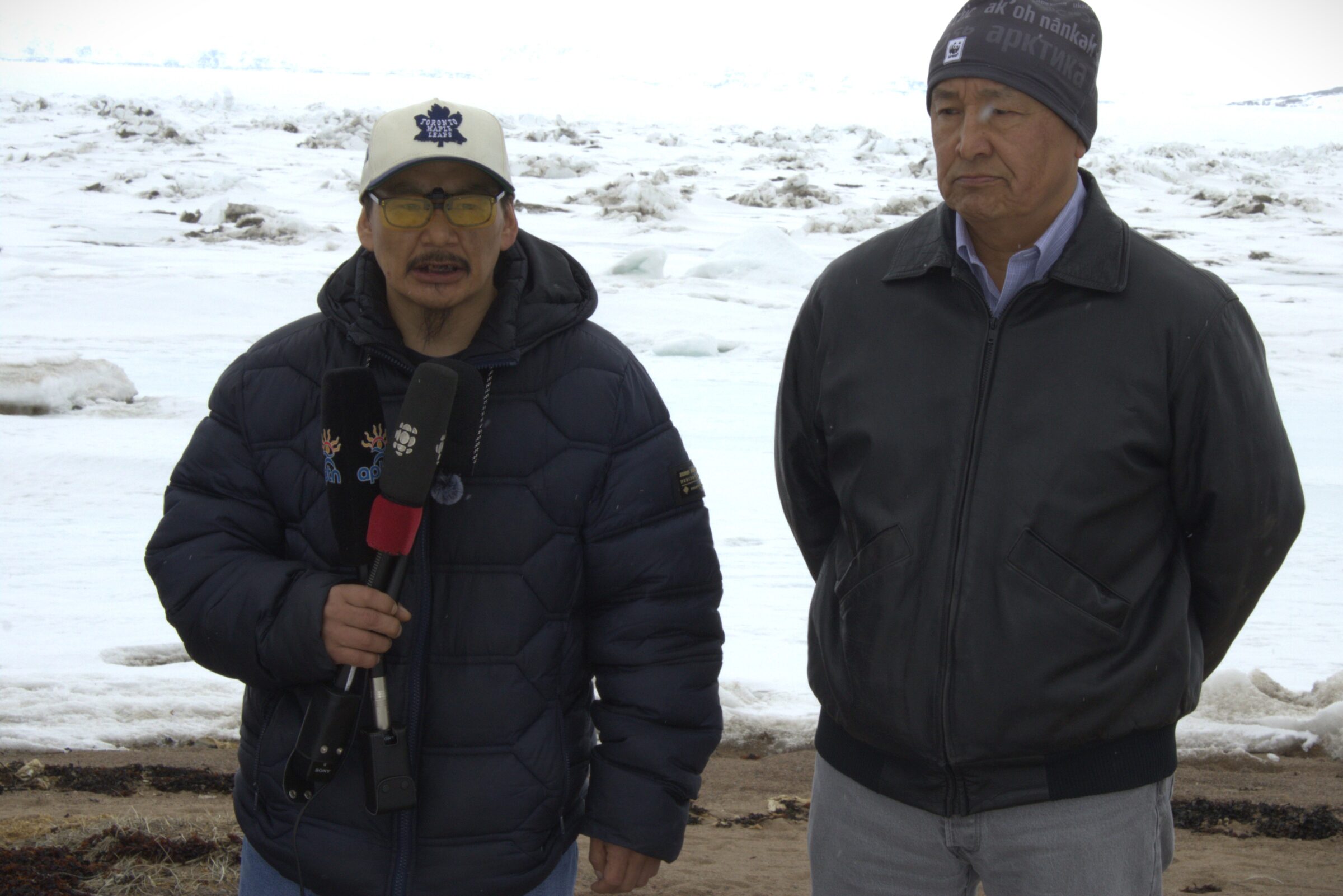
Arviq Hunters and Trappers Association chair John Ell-Tinashlu, left, stands next to former Nunavut premier and senior adviser to World Wildlife Fund Paul Okalik during a news conference on Apex beach Friday morning. (Photo by Daron Letts)

Naujaat hunters are threatening to go to court over an approved railway expansion and deepsea port planned for Baffinland Iron Mines Corp.’s Mary River Mine.
“Litigation is certainly a possibility,” said James Gunvaldsen Klaassen, managing lawyer with Ecojustice, an environmental law charity with offices across southern Canada.
He made the comments at a news conference his organization staged Friday on Apex beach in Iqaluit, with representatives from Naujaat’s, Igloolik’s and Sanirajak’s hunters and trappers organizations.
“There’s a lot of information out there that has not been communicated to Naujaat,” Gunvaldsen Klaassen said. “They’ve been frozen out of these discussions.”
Naujaat is located about 500 kilometres southwest of Steensby Inlet, where a deepsea port and 149-kilometre rail line would allow Baffinland to increase iron ore production to 22 million tonnes per year from the current 4.2 million tonnes per year.
The hunters’ main concern is that increased marine traffic might affect caribou and marine mammals, said John Ell-Tinashlu, chair of Naujaat’s Arviq Hunters and Trappers Association.
Railway construction is expected to begin later this year, with substantial completion in approximately three years.

“Baffinland has all key regulatory authorizations required to begin construction of the Steensby,” said Baffinland spokesperson Peter Akman in an email Friday. “The project has also been the subject of significant baseline studies, monitoring and regulatory review and key approvals remain in place.”
As for the alleged lack of consultation with Naujaat hunters, Akman said these concerns should be addressed with the Nunavut Impact Review Board.
“The Arviq HTO has never reached out to Baffinland for a meeting,” Akman said. “And we have met with the Igloolik and Sanirajak HTOs 48 times since 2023.”
Nunavut MP Lori Idlout told Nunatsiaq News in January that she believes the Steensby project should undergo another environmental assessment so that approval can be an “informed decision.” She represented the NDP at the time, but since crossed the floor to join the governing Liberal party in March.
In an email to Nunatsiaq News on Friday, she reaffirmed her support for “the views of the hunters and trappers’ associations who are the experts and the rights holders in Nunavut.”
“If their view is that another environmental assessment is necessary, I agree with them,” she wrote. “Indeed, it may be a requirement, and I will be looking into this further.”

For Ell-Tinashlu’s part, he is focusing his criticism at the federal government for shutting his community out of initial consultations back in 2012.
“This project is one that will impact our lives and our reliance on country food,” Ell-Tinashlu said, speaking in Inuktitut through an interpreter.
Meanwhile, Naujaat hunters remain hopeful that federal policymakers will listen to their concerns, said their lawyer.
“The next step will be to begin some conversations with the Government of Canada, which will at least allow Naujaat to communicate their concerns,” Gunvaldsen Klaassen said. “The ball is in the government’s court as to whether those concerns are listened to and whether they are accommodated.”
Baffinland currently employs 1,200 workers across Nunavut, including the mine site, port operations, marine, logistics and support staff.

I don’t get how the shipping would effect the caribou on mainland, let alone Naujaat being effected by the mine when they are on mainland. I think they should stay on the Kivalliq side and stay out of Qikiqtaaluk side.
Stick to your region and let us qikiqtaaluit people worry about this. How is shipping going to effect mainland caribou?
Caribou AND marine mammals. Baffin Island Caribou migrate from the mainland. Polar Bears are marine mammals.
They want a piece of the pie
There is no clear evidence there will be a negative impact, it is assumed there will be a negative impact. There may possibly a positive impact, perhaps there will be even more narwhale through out the whole spring summer and fall because of the shipping activity, we don’t know. I think it is premature to assume the worse.
Environmental Non-Government Organization fear mongering at its best. Its an attempt to further slow down or stop the troubled Baffinland already.
NGO need to start paying compensation for loss of economic opportunity / lively hood on Nunavut residents / Canadians.
The mine in is called “Baffinland Iron Mines” for a reason. Not “Kivalliq Iron Mines”. Stick to the mining in the Kivalliq region. I’m sure the mining in your region has some issues too. And, the tuktu are land animals, they just swim when they need to.
Maybe, just maybe, we should reconsider colonialism 2.0.
Maybe it’s time to stop exporting iron ore and other raw material from Nunavut and from the rest of Canada.
Maybe we should look at mining less, but using our minerals in the production of things that Nunavunniut and other Canadians want.
Don’t say that Canadian labour rates make production in Canada unaffordable. That is the lie of those who want to recieve a quick buck without doing any work.
In most manufactured items, direct labour accounts for less than 2% of the selling price. You can typically save more than that from reduced shipping costs.
Maybe it’s time to do the “value added” ourselves. We can take pride in producing top quality items, and get rich doing so.
To do this we need to bypass the branch plants of yesterday. We need made in Canada, by Canadian workers, employed by businesses that are owned and managed by Canadians who believe in quality and reliability.
Impossible? No. It was done by our grandparents during World War 2. Then the “powers that were” gave it all away to the get-rich-quick grifters.
That’s why we are looking at Colonialism 2.0, from coat to coast to coast.