


New polar icebreakers to carry Inuit names, minister announces
First ship expected to go into service by 2030; research crew leaving Iqaluit next week to gather ocean data
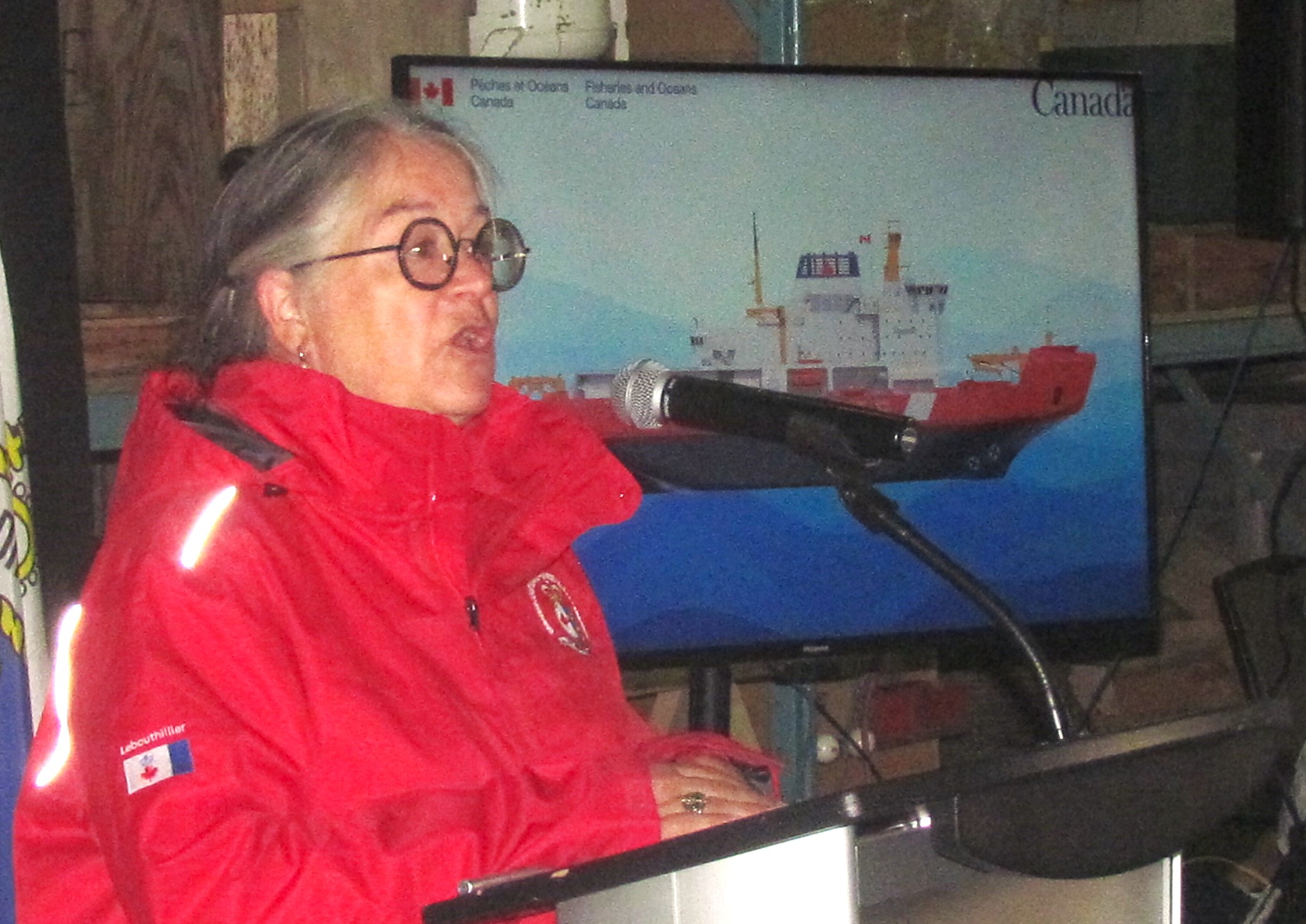
The Canadian Coast Guard’s two newest polar icebreakers will each carry Inuit names, says Diane Lebouthillier, the federal minister for fisheries, oceans and the Canadian Coast Guard, speaking during a visit to Iqaluit on Monday. (Photo by Gord Howard)

When the Canadian Coast Guard’s two newest polar icebreakers go into service over the next decade, they’ll take to the water bearing Inuktut placenames.
The CCGS Arpatuuq will be named for Akpatok Island in Ungava Bay, home to thousands of seabirds, while the CCGS Imnaryuaq’s name refers to an area at the southern end of Banks Island known as “big cliff,” which is culturally significant to Inuvialuit.
“Naming these vessels after significant Inuit locations signifies profound respect and is an important step along the path of reconciliation,” said Diane Lebouthillier, the federal minister of fisheries, oceans and the Canadian Coast Guard, at a ceremony in Iqaluit to announce the new ship names on Monday.
She said the coast guard worked with Inuit Tapiriit Kanatami, Canada’s national Inuit organization, to select the ships’ names. When they’re in operation, they will be the largest polar icebreakers in the coast guard fleet.
The federal government’s polar icebreaker project was announced in 2021 and expected to cost $8.5 billion, according to a June 28 report from the Office of the Parliamentary Budget Officer.
Work on the CCGS Arpatuuq is underway at Seaspan’s Vancouver shipyard and the vessel is expected to be delivered by 2030. The CCGS Imnaryuaq will be built at the Chantier Davie shipyard near Montreal, with no delivery date set yet.
Coast guard icebreakers are vital for providing national security in the Arctic and keeping the waters clear for sealift shipping to northern communities.

“To carry out these functions it needs a state-of-the-art fleet that’s modern, nimble and capable of handling emerging maritime safety and security challenges,” said Lebouthillier, who delivered her speech in French.
Currently, the coast guard employs an average of seven polar icebreakers per season in the Arctic and the addition of two more will be welcome, said Youssef Mani, assistant commissioner for the Canadian Coast Guard in the Arctic region, in an interview.
He acknowledged the coast guard’s total fleet of about a dozen icebreakers is aging.
“So this for sure will have an impact not by replacement but by taking over some of the work that maybe an icebreaker is doing while another one is going” for maintenance to extend its lifespan.
Noting the Arctic is warming at four times the global average, Lebouthillier also announced that for the second year the Canadian Hydrographic Service will conduct underwater surveying in the Arctic to collect data on the changing environment, supported by Iqaluit-based marine and underwater services company Sedna ROV.
A seven-member crew from the service will depart Iqaluit on Aug. 26 aboard the CCGS Polar Prince for about 50 days to carry out that work, said Chris Marshall, director of hydrography for the hydrographic service in the central and Arctic regions.

“While we’re out on the ocean we’re using sonar to map the ocean floor,” he said.
“That data is critical to allow us to produce modern, accurate navigation charts because many parts of the Arctic, while they are charted, the quality of those charts is not very accurate.”
In places, the ocean floor can be 1,500 to 2,000 metres deep.
“However, we’re most interested in those areas 40 or 50 metres or shallower where there is potential hazards to navigation and we don’t know what’s there. The sonar allows us to have a complete picture of the ocean floor.”
That information is useful to operators of tankers and large vessels as well as local people for hunting and fishing.

Through its community hydrography program, the hydrographic service works with people in northern communities so they can help with the mapping process.
“We are equipping them,” said Marshall, “and we are training them using their local vessels to expand into those shallow areas where it’s very difficult for us to survey with the size of the vessels we use.”
Not quite sure if you have heard about this little thing called climate change.
Ice breakers?!!!
Get your aerosol cans out. Spray!!!! I’m cold now. Bring on the thong bikinis ❤️
Like closing the barn door after the horses are gone?
Real Nunavut government.😂
This liberal MP dont know anaq. Anyone that follows question period will know.
Students in Nunavut, if you’re interested in working on these ice breakers, seek guidance from your parents, school counsellors, people you look up to.
Just fell out , the application .
NomaGorda sounds good
These vessels should be armed, the way the USCG vessels are. Otherwise, there’s not much “guard” in Coast GUARD, This would also help Canada to get just a little bit closer to the two-percent of GDP figure for defense.
For every dollar spent on beefing up the military an equal amount need be spent on the diplomatic corps. War is not cheap and the military industry complex that relentlessly seek war have to be told to take a hike, go fly a kite. There are bigger issues, the environmental degradation with a warming planet topping the list.
An ignorant and naive population is exactly what the military industry depend upon to maintain its grip in the geo political sphere. Needless senseless conflict is hailed in the media and in government administrations in the West. In the north of Canada they are getting a great return on their investment.