


NuBrew stops canning, blames regulatory changes
Territorial government now scales beer prices to alcohol content, making stronger drinks more expensive
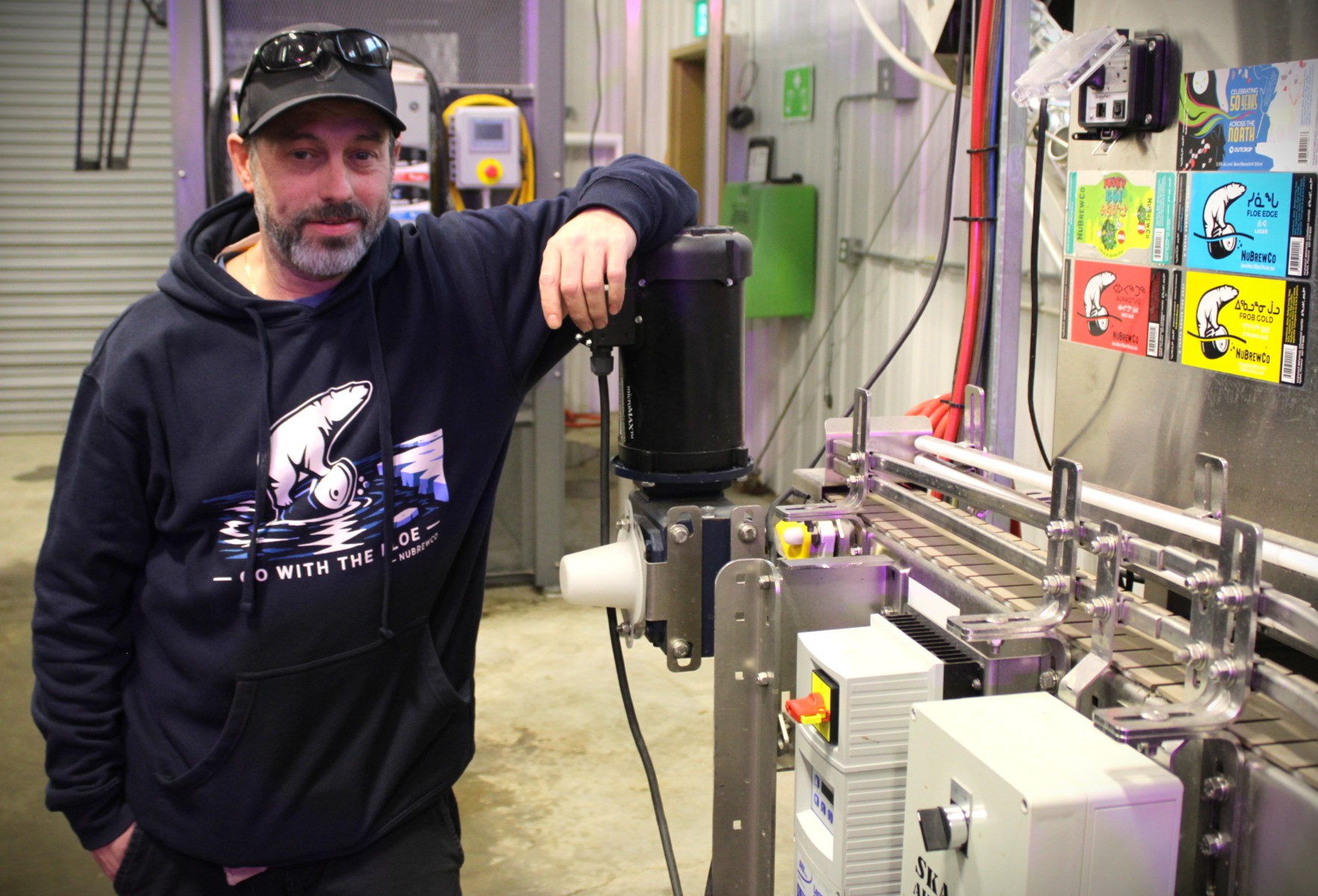
Jordan Kennedy, interim general manager of Nunavut Brewing Co. Ltd., leans on the canning machine, which stopped running in August. A new pricing formula made canned beer economically nonviable for the business, Kennedy says. (Photo by Daron Letts)

Nunavut Brewing Co., the sole local brewer in the territory, has stopped canning its beer after the territorial liquor commission made changes to the way it prices alcohol.
The markup applied by the Nunavut Liquor and Cannabis Commission to NuBrew beer used to be 76 per cent less than what’s applied to beer imported into the territory. As of June 1, that difference was reduced to 40 per cent less.
“The difference between our markup and the big brewers like Anheuser-Busch has shrunk,” said Jordan Kennedy, interim manager of Nunavut Brewing Co.
“Those big brewers do not provide anything to this territory. They don’t pay payroll taxes. They don’t pay property taxes. They don’t employ people. They don’t contribute to the local economy like we do.”
Kennedy said he first learned of the cost increase when a customer complained about an approximately $120 price hike to a keg of the company’s beer purchased through Iqaluit’s beer and wine store in late July.
Kennedy said when contacted the commission at the end of the summer, the response was a suggestion the brewery reduce the alcohol content in its products.
That’s because one of the changes Nunavut Liquor and Cannabis Commission made to its price structure is it started scaling its prices according to a product’s alcohol content.
Previously these markups were applied on a per-litre basis. Now, a 355-millilitre can of beer at 3.5 per cent alcohol by volume, such as a Corona Light, carries a standard markup of $1.46. A six-per-cent beer of the same size carries a $2.50 markup.
Nunavut Brewing Co. Ltd.’s core brands include Floe Edge and Aupaqtuq Red Ale, which are five per cent alcohol content by volume, and Frob Gold Strong Ale at 6.8 per cent alcohol.
Kennedy added he was disappointed that the brewery was not consulted in spring or early summer, in advance of the sealift season.
“That’s when you need to figure out what you need to bring up,” he said. “Then all of a sudden we’re hit with these changes.”
Lewis MacKay, director of the Nunavut Liquor and Cannabis Commission, said such consultation is not standard regulatory practice.
“Our key message is that this is a harm reduction initiative,” MacKay said in an emailed statement. “This encourages Nunavummiut who choose to drink to choose products with lower alcohol content.”

For now, these changes limit Nunavut Brewing Co.’s ability to raise prices to cover the cost of inflation, further cutting into the company’s profit margin. Which means the brewery is sticking to its standard beer recipes and its decision to cease canning operations, Kennedy said.
“If the government comes back to us with an option that is equal to what we’ve previously had we’d certainly consider opening up the canning line again,” he said.
“This encourages Nunavummiut who choose to drink to choose products with lower alcohol content.”
Bunch of baloneyy. Maybe in Iqaluit, but go anywhere where you gotta pay cargo, it is MUCH cheaper to buy liquor than beer. 24 corona in north baffin will run you damn near 300 bucks. 60 of hard liquor barely 150 bucks. 24 drinks for 300 or 60 drinks for 150? Based on this logic we NULC should be subsidizing freight on light beer.
“This encourages Nunavummiut who choose to drink to choose products more similar to Horse Urine.”
If that was the case, NuBrew’s sales will increase!
I didn’t realize Black Horse lager could be bought in Iqaluit.
Beer store not liking the competition.
“This encourages Nunavummiut who choose to drink to choose products with lower alcohol content.”
lol if this was true then orange juice wouldn’t be 4X as expensive as a regular alcoholic beer. Dumb reason is dumb.
I suspect that this comment will be very unpopular with readers but I’m going to make it anyway. I’ve never liked the idea of a commercial brewery in Nunavut and I’ll tell you why: Nunavut historically has and continues to be a place that has been uniquely ravaged by alcohol abuse. No other jurisdiction in Canada has struggled with this as much as this place. The societal damage caused by alcohol in terms of ruined lives and impoverished families has been staggering. There’s no other way to describe it as simply tragic. With that backdrop in mind, why on earth would anyone in Nunavut support the commercial manufacturing of an alcohol product here?? Is that the kind of business that we want our entrepreneurs to building??? Brewing an alcohol product?? That’s what we want to be known for in other provinces and beyond?? A brand of beer?? That’s beyond inappropriate for me.
Don’t get me wrong, I’m completely against banning alcohol in Nunavut. That doesn’t solve the problem. It doesn’t educate people to drink responsibly and only benefits the bootleggers. I am for the beer and wine store. But, at the same time, I acknowledge the unspeakable harm caused by alcohol here. Consequently, I think it’s so inappropriate that a commercial brewery has set up shop in our territory, and has been making an exporting a Nunavut brand of beer.
Nunavut should be known by the rest of Canada and beyond for things other than a brand of beer in my humble opinion. Hope that brewery finally shudders.
Bah humbug !!!!!!
I’m confused. You want to see the brewery shut down because of alcohol abuse in Nunavut and you don’t think anyone should make alcohol in Nunavut, but you don’t want the B&W Store to close. That’s quite the contradictory narrow minded tunnel vision view you have there.
Regardless of whether you like the brewery or not, it employs people, it pays taxes to the city and territorial government, it spends money for goods and services in Iqaluit, and it also provides a nice venue for locals and tourists to enjoy.
Meanwhile, the big guys like Anheuser-Busch, Diageo, Heineken, Molson, etc. do absolutely nothing for Nunavut other than take money $ from the territory that will never be returned to Nunavut.
In regard to safe consumption, considering alcohol abuse was part of your argument, you won’t find a bunch of people drinking outside the brewery in the parking lot like you will at the B&W, and if you did the Government liquor inspectors would fine or suspend its licence pretty quickly.
Anyways, I think the brewery is good for the city. The Government should support local businesses and industries where it makes sense, and I think this is one of them.
Let me use a couple of hypotheticals to further illustrate my point:
Hypothetical 1: You have a city or town that has one of the highest rates of chocolate and junk food consumption per capita in Canada, and along with that one of the highest per capita rates of obesity and associated health problems. In that town, some person thinks “ You know what? I’m going to set up a nice sugary chocolate factory in my town, and it would be cool in the circumstances to use the town’s name and location for branding purposes to help market my chocolates elsewhere”. The factory starts producing. Sure, it employs people and pays taxes etc. But, does anyone really think that it’s an appropriate business for the town to have given the town’s own struggles with that very product?
Hypothetical 2: You have a city or town that has one of the highest rates of smoking per capita of anywhere else in the country and, of course, the problems associated with that. A local entrepreneur thinks “ You know what? I’m going to start manufacturing cigarettes in this town and it’ll be cool to use the town for branding purposes to market my product elsewhere. “. The factory is set up and it does those nice things like employing people and paying taxes etc. But, is it really an appropriate business for that poor town to be known for given its own struggles with that very product?
I hope this helps you understand at least a little bit of where I’m coming from.
You do have hypothetical one, it’s called the Newfoundland Chocolate Company in St. John’s. Newfoundland and Labrador has the highest obesity rate in North America. Nobody minds that they make chocolate there.
Hey there, don’t forget that it’s tied with New Brunswick!
With your logic, Nunavut must be a world powerhouse in tobacco processing and manufacturing, since Nunavut seemingly has the highest rate of adult tobacco abuse in the world.
Imagine being so self-centred and self-glorifying that you wish for the failure of a local business and the loss of local jobs.
Gross comment.
Imagine being so obtuse you purposely avoid the substance of valid criticisms and trying to make an economic argument for what, like 6 jobs?
One thing I’d love to see, especially after visiting Yellowknife and seeing their brewery there recently start doing it, is the brewery making sparkling water. I tried the 3 different flavours the Yellowknife brewery made, and it was delicious! I understand it probably won’t sell as well as beer, but especially during this time where canning beer is unprofitable for them, would be cool to see them experiment. Would be nice to have a non-alcoholic drink made locally, and the added benefit is that it could be sold locally at stores, which could make it cheaper than imported sparkling water and would make for great souvenirs for visitors!
The way that NUBrew, as a local business, contributing to Nunavut’s economy, employing local people, is treated by the government is atrocious.
Nunavut Brewing got half a million dollars in free public money at startup through the Stratigic Investment Program.
Then had a 76 percent markup subsidy for the first nearly decade. And still have a 40 percent one through the government store, and a 100 percent markup subsidy on direct sales to other bars.
The law was changed to allow them to also sell spirits in their pub.
The law was also changed to allow them to sell directly to other bars at a 100% markup subsidy.
If they can’t survive with all those supports then they are not a viable buisness.
It’s clearly not made to be a viable operation. You can fit 30 people at their location. Without canning and selling outside of their store they have zero hope of becoming any kind of profitable operation. that’s why it’s 12 bucks for a beer there.
If this comment is true, and a business manufacturing an alcohol product got a massive amount of GN subsidies and support, that turns this whole thing into a scandal in my view. I would love to hear Premier Main explain why a brewery in Nunavut deserved subsidies while we struggle with substance abuse every day, and our prison is full of offenders who have committed alcohol related crimes. I would love for him to explain why beer manufacturing is something that Nunavut should be proud of and proud to subsidize given Nunavut’s ongoing struggles with alcohol. Fascinating for me.
I’d rather drink molsen dry than anything from that place.