

Nunavik leaders eye banishment for bootleggers, drug traffickers
Makivvik lawyer says it’s possible but remains a complex legal issue
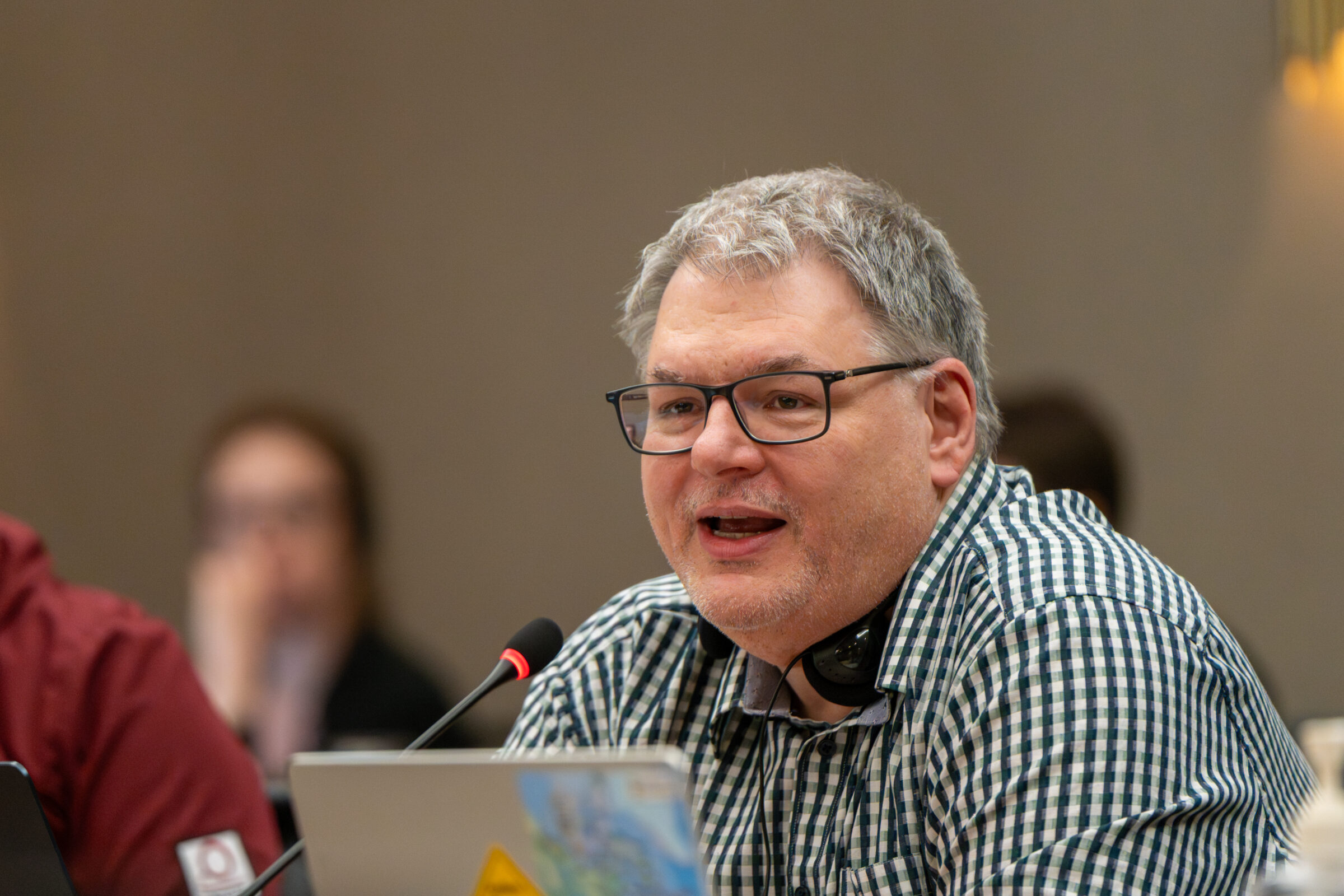
Makivvik lawyer Jean-François Arteau offers a preliminary analysis of what a banishment strategy could look like in the region, during a meeting Wednesday with leaders from Nunavik. (Photo by Cedric Gallant, special to Nunatsiaq News)
Nunavik leaders are exploring the idea of using banishment to deal with people found to be selling illegal drugs or alcohol in their communities.
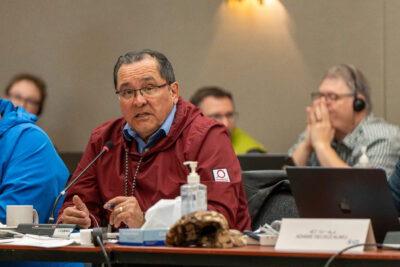
Makivvik president Pita Aatami says he does not want Nunavimmiut to remain silent when it comes to drug trafficking in the region. (Photo by Cedric Gallant, special to Nunatsiaq News)
“People are dying because of illicit drugs,” said Pita Aatami, president of Makivvik Corp., on Wednesday at the second day of the three-day Nunavik all-organizations meeting being held in Montreal.
Makivvik lawyer Jean-François Arteau gave three options as to how banishment could be implemented to remove drug traffickers and bootleggers from Nunavik. Discussions are still preliminary, and Makivvik plans to continue working on it with Nunavik organizations.
Arteau said practices used in the criminal justice system — such as arresting suspects and seizing evidence and proceeds of crime — carry limitations in remote communities such as lengthy court processes made worse by a lack of support for circuit courts to function properly.
The James Bay and Northern Quebec Agreement does not allow for the creation of a banishment policy. However, in a written report Arteau provided to the leaders he said more “muscular measures” could still be found to “reduce suffering caused by intoxication-related violence.”
He said banishment is used by some First Nations communities in the West through bylaws that are approved by band councils.

“If they can do that, we too as Inuit, we can do that,” said Aatami.
“We are not trying to scare Inuit; we want this illegal activity to stop, because they are only thinking about money at the price of life.”

Nunavik Housing Bureau president Sammy Duncan expressed concerns Wednesday about how a banishment strategy would affect Inuit beneficiaries in Nunavik. (Photo by Cedric Gallant, special to Nunatsiaq New)
Arteau proposed using what he called a “multi-prong” approach to implementing a policy of banishment.
The first option is through employers, he said.
Because southerners working in Nunavik are housed through their contracts, a Nunavik employment policy could prohibit drug or alcohol use, possession and trafficking. Discipline for infractions could include termination and removal from Nunavik through the loss of employer-provided housing.
A second option is through the landholding corporations, which can control occupancy and residency on Inuit-owned land through anti-drug and alcohol-trafficking policies.
A more cautious approach could be applied to beneficiaries caught trafficking by using support measures, Arteau said.
“It is very touchy because they are our fellow Inuit,” said Sammy Duncan, president of the Nunavik Housing Bureau, regarding banishment of beneficiaries.
“They have children, they have parents; if we ever have to evict them, are we going to kick out the whole family?”
A third option proposed by Arteau would involve co-ordinated action between Makivvik, the landholding corporations, northern villages and Kativik Regional Government.

That would combine the authority of an employment policy to evict someone from their house with stronger regulatory rules for municipalities and more rigorous transportation rules enforced by airlines.
There would be some obstacles in implementing a banishment framework in Nunavik, he said, including the Canadian Charter of Rights and Freedoms.
“Every citizen of Canada has the right to enter, remain in and leave Canada,” Arteau said.
Aatami said that even so, “us as Inuit, when we are aware that there is illicit dealing we want to stop it. Life is more important than the Charter of Rights.”
In the hand , of some lawyer , can become , a charter of rights challenge , but i m all for it , with all the hard drugs coming in.
I think this should be considered in Nunavut as will, in particular hard drugs. and maybe a graduated teer system for lesser drugs and alcohol.
With overall health and safety in mind banishment may be supported despite the charter of rights as long as the health and safety remain the paramount to the reason. Health and safety of the population is more important than the few pushers.
Won’t banishment become a continuous community musical chairs loop?
Banishment is going after the lowest-hanging fruit. While the precursor chemicals to make the drugs still arrive like clockwork from the country, we are now to love. The cartels, triads and…over 200 criminal gangs keep on expanding.
Why not go right to the top and ask the Fed’s what the heck is going on? Why every city, town across Canada and now northern and arctic hamlets must become ____-holes?
Canada has top-notch prosecutors who do take on drug manufacturing and trafficking. But they are a extremely tiny number. Meaning there is no money to take on to cut off the snake’s head. The snake has many, many, many heads.
Thus police can’t do the long investigations and even if they do, Jordan legalities set them free.
They too, like top prosecutors, are restricted to the low-hanging fruit and as spectators watching the known criminal sources continue full speed ahead, as if protected.
The money is in defending drug trafficking, keeping them out of jail.
Time to get serious. Put extreme Indigenous pressure on the Liberals as if there is no tomorrow. To hire and big-time fund prosecutors to take on the source. If not, “People are dying because of illicit drugs,”… will be taken as wanted.
Banishment is already allowed. How many people have been bullied out of their communities or jobs because of rumors?