


Nunavut braces for trade war impacts
U.S., Canada escalate tariffs after Canadian officials walk away from negotiations, citing ‘unfair’ last-minute changes
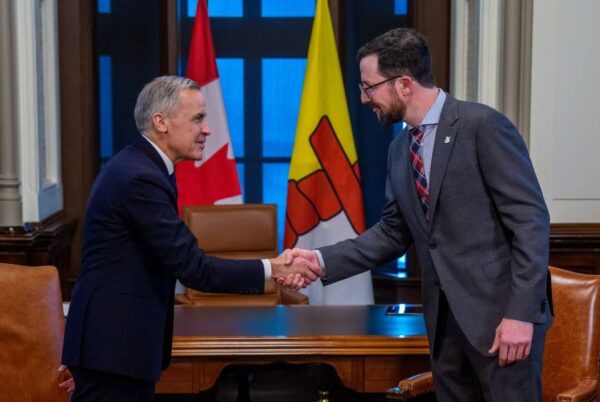
Prime Minister Mark Carney and Nunavut Premier John Main shake hands at a meeting in January. Main says he’s concerned that trade negotiations with the United States were suspended last week. (Photo courtesy of the Prime Minister’s Office)
Nunavut Premier John Main said he’s “disappointed and concerned” that trade talks between Canada and the U.S. were suspended last week.
“Our government will assess the impacts of tariffs on our territory, businesses, and residents,” the premier wrote Monday in a statement.
On Friday, he said he was “encouraged” Canada could reach a good deal.
That was hours before Canada walked away from negotiations for a new Canada-U.S.-Mexico trade agreement. Prime Minister Mark Carney said the U.S. attempted to insert “unfair” last-minute changes.
“We did make some progress in recent weeks,” Carney told reporters while in Lévis, Que., on Monday. “In the end, that momentum reversed and we could not accept what the U.S. had offered, nor could we give what they asked.”
In a speech on Saturday, Carney said that industries such as steel, aluminum and auto manufacturing would have been undermined had he agreed to the deal and that Canada wasn’t willing to compromise its “sovereignty.”
Building at home and diversifying trade abroad is where Canada will now focus, he said.

As a result, the U.S. has imposed 50 per cent tariffs on close to $30 billion of Canadian goods that include dairy, alcohol, cement and other consumer goods.
Canada will launch counter tariffs that come into effect after Labour Day. They will target $27.6 billion worth of American goods, federal Finance Minister François-Philippe Champagne announced Tuesday.
Included are metals, agricultural products, pulp and paper, and electronic goods, with levies ranging from 25 to 50 per cent for most, with a smaller number set to 15 per cent.
Though there are minimal exports from Nunavut to the U.S., the territory still relies heavily on American goods for essential items, infrastructure and services, making it vulnerable to rising costs and disruptions to supply chains.
Premier John Main said new trade opportunities for Canada will be discussed later this week in Iqaluit, during Federal, Provincial and Territorial Committee meetings hosted by Nunavut Trade Minister Craig Simailak.
Nunavut MP Lori Idlout said she hopes Internal Trade Minister Dominic LeBlanc, who is on the committee, will ensure there’s relief for businesses in the Arctic that will be vulnerable to the tariffs.

“We all know that the cost of doing business in the North is much higher,” she said in an interview. “We have so much reliance on the south; we have to be concerned about all areas.”
The MP said counter tariffs also risk harming the territory’s economy but agreed they are the right move.
“Hopefully this will be a wake-up call for them to realize that Canada has more strength than what they think,” Idlout said.
Former Nunavut premier P.J. Akeeagok, the sole Inuk voice on Carney’s Advisory Committee on Canada-U.S. Economic Relations, said the failed talks are a sign Canada must accelerate nation-building from “coast to coast to coast.”
“The map of our future will be written from within: driven by bold investment, economic sovereignty, and Inuit-led Arctic determination,” he wrote in a social media post.

In a statement to Nunatsiaq News, Udlu Hanson, the Baffin Regional Chamber of Commerce board chairperson, said the organization will monitor the potential impact that increased tariffs and trade uncertainty could have on Nunavut businesses.
She said she’s especially concerned about how tariffs could impact construction, retail, transportation, mining and tourism because pricing, equipment, shipping and operating costs are “central to business viability.”
“Strengthening northern supply chains, expanding Canadian procurement, and investing in transportation, warehousing, infrastructure, and local business capacity must be part of the response,” wrote Hanson, who is also an executive for Baffinland Iron Mines Corp.
“Nunavut businesses are resilient, but they need practical policy decisions that recognize the realities of doing business in the North.”
The premier was expected to host a media scrum about the tariffs later Tuesday in Iqaluit.
Polaris and Arctic Cat suck. BRP all the way!
Whenever a conservative leader in America is in the office and a Liberal in the Canadian office…”Brace yourselves.”
Humans are always going to make a mess of things.
Trudeau imported, and Trump be deporting and we’re still not satisfied with what either are doing/did.
But with the tariff threats is a bit extreme and to play around with other countries like that for one’s own wealth.
2001-2003: Chretien/ Martin, G.W. Bush.
1981-1984: Trudeau/Turner, Reagan.
In neither case did things get as bad as they did in 2017-2021, and 2025-now. In both cases there is only one thing in common, so don’t try this “both sides” nonsense.
As someone new to watching politics, I should more into it as Ive been watching the news on Trump and Trudeau(2015).
Isnt Trump after oil and minerals after all?
put your elbows down and vote CPC
Might as well drop 3 meters onto a bicycle without a seat, it would hurt less…