


Nunavut health minister again warns of shortfall in Non-Insured Health Benefits funding
John Main says Health Department struggling to secure deal with Indigenous Services Canada
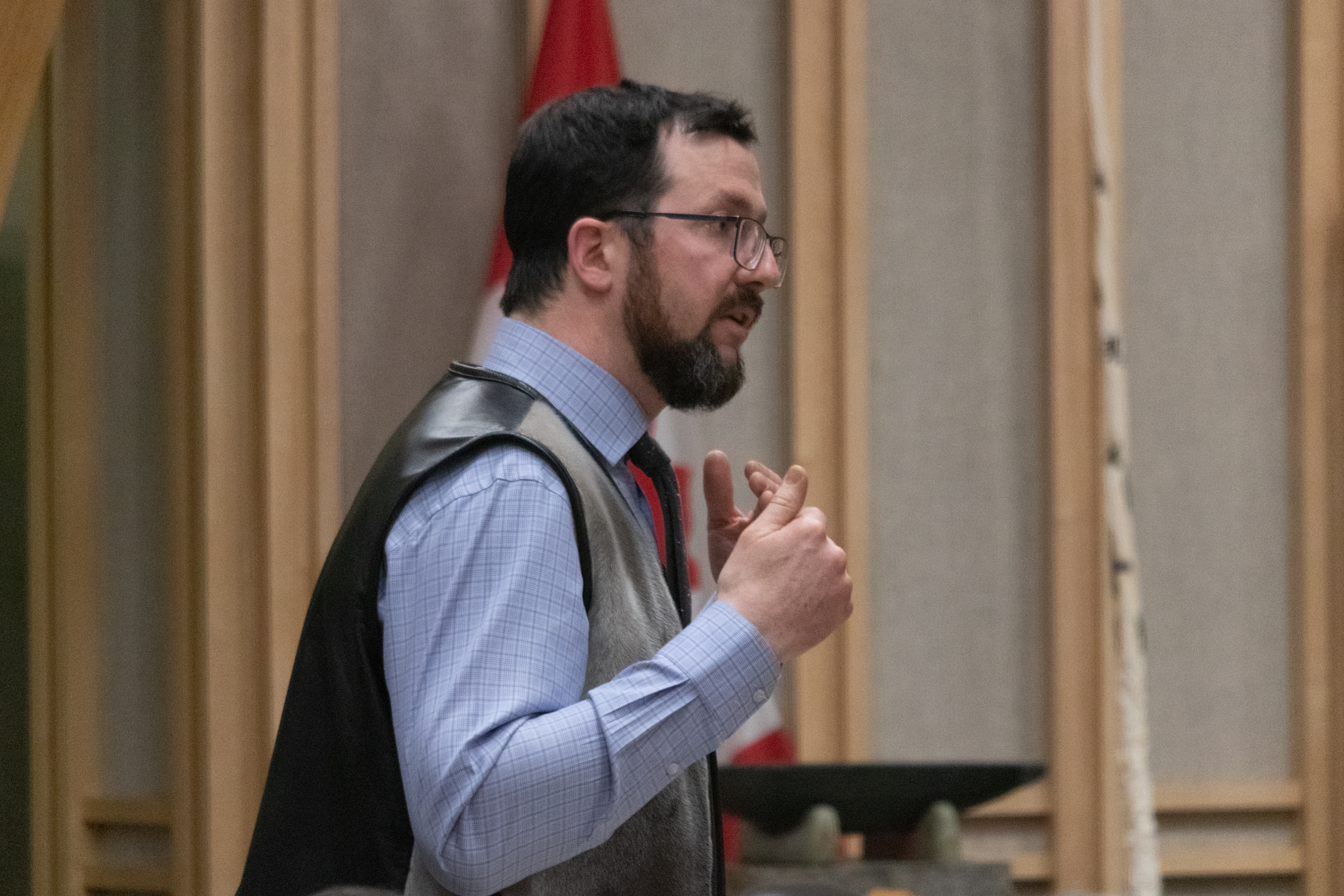
Nunavut Health Minister John Main says his department is in a “difficult situation” as it works to negotiate a Non-Insured Health Benefits deal with Indigenous Services Canada. (Photo by Jeff Pelletier)

This story was updated on Monday, Feb. 24, 2025, to include comments from Indigenous Services Canada.
The Government of Nunavut is still struggling to reach a deal with the federal government to fund a health services program covering medical boarding homes and dental care for Inuit, says Health Minister John Main.
Speaking in the Nunavut legislative assembly Feb. 20, Main told MLAs his department has found itself in a “difficult situation” with Indigenous Services Canada for a funding agreement for the Non-Insured Health Benefits program.
The comments came up when Rankin Inlet North-Chesterfield Inlet MLA Alexander Sammurtok pressed Main about the possibility of building a medical boarding home for patients travelling through Rankin Inlet — something he’s asked the GN about many times in the past.
For the boarding home, Main said his department is still working on a feasibility study.
“The plan would be to take that study to Indigenous Services Canada, who pays for the boarding homes, and use that study to say, ‘Look, this is what’s need and let’s work together to make it happen,'” Main said, adding the federal government would be responsible for operating a boarding home in Rankin Inlet, if one were built.
Main then went on to give a broader update on discussions between the GN and federal government regarding funding for the program.
“I’m sad to report that we are again running into delays and barriers to securing a contribution agreement for the upcoming fiscal year for non-insured health benefits,” Main said.
“It’s very concerning, because it’s tens of millions of dollars of expense.”
The non-insured health benefits program is a “federal responsibility,” Main said. Therefore, he stated, Ottawa needs to cover “100 per cent” of its cost.
“We want to use the Nunavut government dollars for things that Nunavummiut need,” Main said.
“We don’t want to be covering bills on behalf of our federal partners.”
Main declined to speak further on the issue when asked by reporters after the sitting.
He said he would have more to say this week.
Main made similar comments about a year ago in the legislative assembly. At the time, he threatened to send administration of the Non-Insured Health Benefits program to Ottawa.
Main announced in May the two sides had reached a $190-million interim deal, which is now set to expire next month.
Nunatsiaq News asked Indigenous Services Canada for a response to Main’s criticisms, as well as an update on negotiations.
Spokesperson Jacinthe Goulet said the federal government recognizes the “complex and unique” challenges in Nunavut in regards to access to health care.
She also pointed to the interim $190-million funding agreement and said the federal government “remains committed” to working with the GN and Nunavut Tunngavik Inc. to “ensure Nunavummiut continue to have seamless access to the health supports they need through the existing integrated territorial health system.”
If GN would cut wastage in the Non-Insured Health Benefits program it could make up for any shortfall in a heartbeat.
For that matter, if GN was to cut 40%, 50%, 60% of its wastage (spending for which there is no benefit gained) we could save 40%, 50%, 60% off our annual $3,000,000,000 spending budget – all of which is funded by small-businesses owners and working-class people in Canada
Need Elon to come to Nunavut?
Thanks for your expert analysis. Where do you suggest the GN cuts budgets by 30%, 40%, or 50%?
Please give us specifics.
Accountability for a start. There’s software out there that can determine if someone’s actually working or not. Cutting duty travel to only trips that are actually required would also save this gov a ton of $.
In 2022, Alaska spent $13,642US per person on health care, and had a life expectancy of 74.5 years. Also in that year, Greenland spent $6,500US per person on health care, and the life expectancy in Greenland is 72 years. In 2022 in Nunavut, we spent $12,475US per person on health care, and our life expectancy is 72 years.
We are spending almost double what Greenland does, and achieving basically the same result. Alaska spends slightly more than us, and achieves a marginally better result than us.
No doubt there are vast differences in health program approaches between the 3; I assume Alaska focusses heavily on state of the art primary through tertiary health care interventions, and Greenland focusses more so on health promotion, and prevention.
From what we can surmise from a quick look at Arctic health spending is that Nunavut could reduce health care spending significantly by adopting public health measures with no effect on overall life expectancy.
Our continual focus on increasing primary through tertiary care in Nunavut. similar to Alaska, will increase life expectancy, but not dramatically.
Ideally, whether Ottawa supports us with full Non-Insured Health Benefit coverage should not matter.
Inuit in the Government of Nunavut are charged every pay day for this service despite having NIHB. It doesn’t make sense.
Not sure what you are referring to as there are no fees/deductions on pay checks for clients to access their NIHB benefits.
Many people confuse these two insurances. NIHB are only for indigenous people. It only pays when there are no other insurances. I believe all GN GNWT and Federal employees who would go for medical travel will always get “better” treatment, meaning staying in hotels and not a boarding home, getting a higher per diem, etc. because they pay for insurance through their employer. If you are only on NIHB, you get their service alone, which is usually less. The GN administers NIHB for Canada FOR FREE and actually, at a deficit, because they just do what they always have. Nunatsiaq has articles from 20 years ago where the Health Minister says the same thing.
its that time of the year again
I don’t understand why the Government of Nunavut hasn’t considered closing the transient center in Churchill, Manitoba. While this center was very active in the 1990s, it now sits empty for the majority of the year. Patients who are sent to Churchill could easily be accommodated in local hotels instead.
It makes more sense to open a boarding home in Rankin Inlet. Rankin’s hotels are frequently fully booked, leaving patients without suitable accommodations. This issue becomes critical when Calm Air cancels flights due to unpredictable Kivalliq weather, which can change drastically without warning. Calm Air provides hotel accommodations only if cancellations are due to mechanical issues—not weather—leaving many patients stranded, sometimes forced to sleep in terminals/ trailers at the airport or even being sent back to Winnipeg.
If Churchill staff prefer not to relocate, perhaps their positions could be transferred or new positions created in Rankin Inlet or at Larga in Winnipeg. Winnipeg, in particular, could greatly benefit from additional staff who understand and practice quality customer service.
It’s time for GN to prioritize solutions that genuinely benefit patients and communities in Kivalliq, ensuring reliable access to medical services and accommodations.