

Nunavut will not declare intimate partner violence an epidemic
‘It feels like open season on Inuit women,’ says YWCA-Agvik executive director
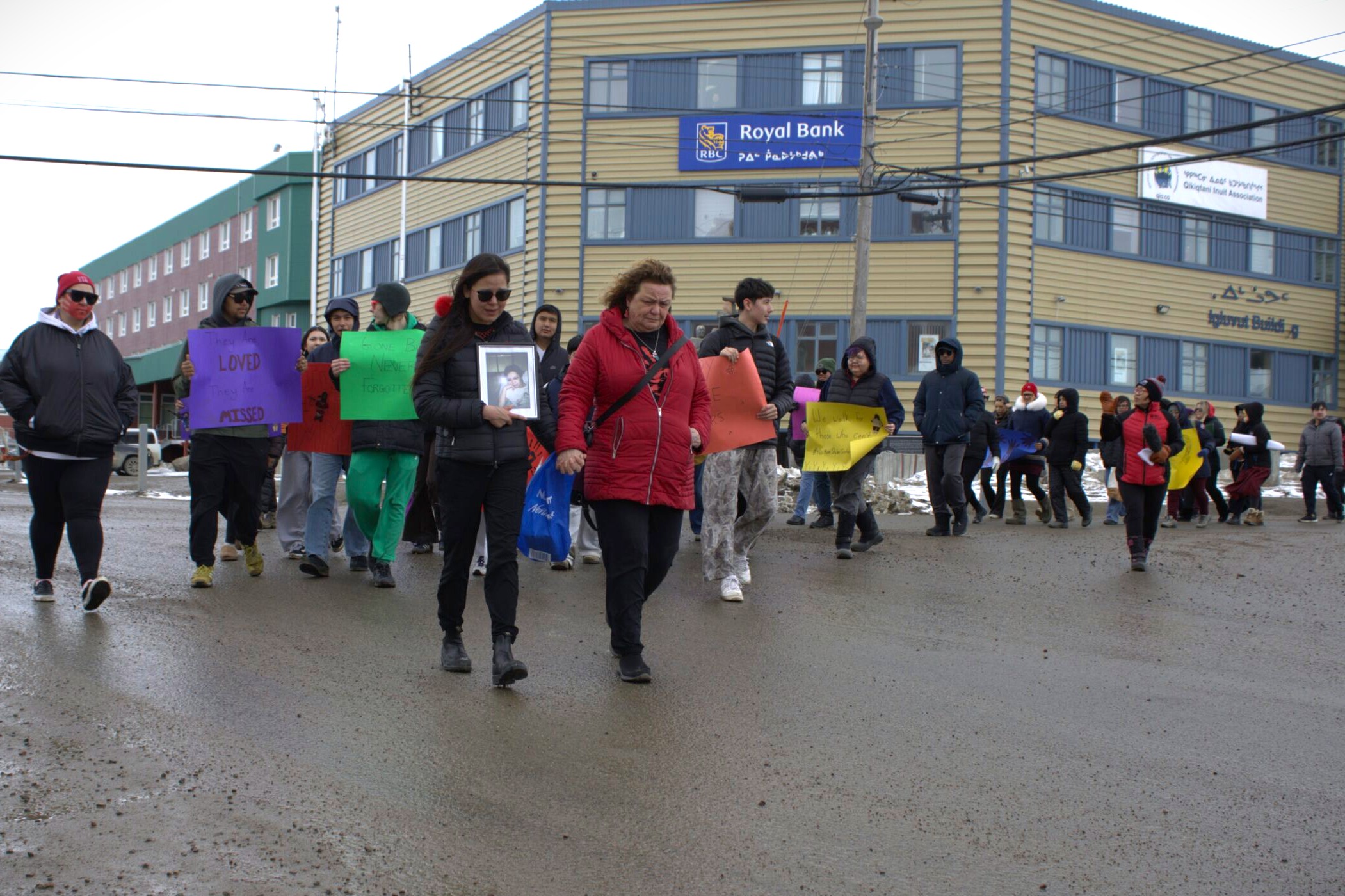
Iqaluit residents walk in recognition of Red Dress Day on May 5. Carrying a picture of her late mother is Della Ootoova, who was murdered in Iqaluit in 2008. Holding her hand is Sherri Robertson, executive director of YWCA-Agvik Nunavut. Robertson is calling on the territorial government to declare intimate partner violence an epidemic, followed by justice reform. (Photo by Daron Letts)

Nunavut will not follow the lead of other Canadian jurisdictions by declaring intimate partner violence an epidemic in the territory.
On May 27, Newfoundland and Labrador became the latest province or territory to make the declaration. It followed suit with Nova Scotia, which, in 2024, created a Ministers’ Table on Gender Based Violence that includes victims, families, community organizations and front-line workers.
“We are aware of and respect the decisions of other jurisdictions that they’re making in declaring gender-based violence an epidemic,” said Gwen Healey Akearok, Nunavut’s minister responsible for the status of women, in a phone interview Wednesday.
“Work has been underway for years and it’s guided by the voices of Inuit women and the organizations that represent them,” she said.
YWCA-Agvik executive director Sherri Robertson said she is “disappointed” the minister has chosen not to declare intimate partner violence an epidemic in Nunavut.
“I think it’s good to validate how big the problem is,” she said Thursday in a phone interview, while acknowledging words alone are not a solution. “It would only have meaning if it were accompanied by substantial systemic change.”
Close to 60 per cent of women in Nunavut have experienced physical or sexual assault, according to 2021 data from Statistics Canada.
Robertson said she wants to see the territorial government look at justice reform. Too many repeat offenders are serving too little time for violent crimes, she said.
“People hurt people because they’ve been hurt — I understand that,” Robertson said. “Systems are supposed to intercede and protect and they are not. It feels like open season on Inuit women. It feels very much like there’s literally no consequences.”
Back at the legislative assembly, Akearok said the formal declaration is not necessary because the territorial government is already acting. She says the GN has improved crisis response, shelter systems and victim support services.
It is also spending more than $4 million to support gender-based violence initiatives that focus on awareness campaigns and education.
As for documenting patterns of intimate partner violence, she said her department is on it.
“We’re working on tracking those trends and developing more comprehensive analysis with all of our partners,” she said.
This goes both ways, there is a huge problem in Nunavut, on both sides, it’s not one gender specific. The problem in Nunavut is men generally do not report the assault done to them by their partner.
Majority of suicides are men and this has a part in it. This has to be looked into on both sides and not just one side.
Again more proof that it is far to normal to over look the abusers.
If anyone uses that they were abused as an excuse for why they did something they should have to name their abuser. If you aren’t willing to name your abuser then dont use it as an excuse to get so lighter sentence and to pass on the trama.
Many of us have lived it, seen it in our families, or supported someone through it. When nearly 60% of women in Nunavut have experienced physical or sexual assault, that is not just a statistic—it reflects the scale of pain carried across generations.
At the same time, refusing to call it an “epidemic” can feel dismissive. Words alone do not protect us, but they do signal whether leaders fully grasp the urgency. When other regions make that declaration, it can feel like they are at least willing to say out loud what we already know. Some may see the refusal to declare an epidemic not as denial, but as a choice to focus on action rather than labels. If funding, shelters, and supports are expanding, that is a meaningful step.
There is also truth in what Minister Akearok says. Inuit women’s voices have long been ignored or overridden. If the work being done is genuinely guided by Inuit organizations and community knowledge, that matters. Solutions imposed from outside have failed us before.
Still, there is deep frustration. Many people feel that the justice system does not protect them. When repeat offenders face limited consequences, it sends a message about whose safety matters. The feeling described as “open season on Inuit women” resonates because too many cases end without real accountability.
Understanding that violence is often rooted in trauma does not excuse it. Healing must happen alongside protection. Right now, many people feel they are asked to be patient while systems slowly improve, even as harm continues.
What we need:
Safer, accessible shelters in every community; Faster and more reliable crisis response; Justice systems that prevent repeat violence; Long-term healing programs; Support for both victims and those who need to break cycles of harm.
A declaration could help bring attention and resources, but without these changes, it would ring hollow.
For many people, the question is simple: do we feel safer today than we did before? The answer, too often, is no. Whether the government uses the word “epidemic” or not, the expectation remains the same—real protection, real accountability, and real healing in our communities.
The conversation is not about terminology; it is about whether people can live without fear in their own homes.
I agree, without substantive changes or steps to alleviate the problem declarations like this often feel performative, as if that were their only purpose.
Make the education system better instead. That would solve many issues. We haven’t made much strides the way we’ve been doing education,…we are doing it wrong!
Lets heal together ❤️
Though violence is rampant in society, it occurs substantially less now than it did a generation ago or many generations ago. And of course, outside of one tribe against another (whether that be between rival gangs or rival countries) most violence is between people who know each other.
That violence, whether community of family, occurs for the same repeated reasons (lust, greed, jealousy, …) and is compounded by alcohol and drug use, emotional and mental disorders, as well as fatigue, hunger, fear and pain. Are those factors multiplicative in Nunavut? Yes. Do they occur elsewhere? Yes. Nonetheless we see violence throughout societies- among rich and poor, able and disabled folk, sober and drunk people.
There are common denominators.
Domestic and Intimate Partner violence in Canada, as reported by Statistics Canada, was on the decline until around 2016/17, when it started going up again, reaching pre-2010 levels.
This coincides with the start of the Me-Too Movement which did a great deal to empower victims to step forward and disclose the crimes committed against them. That is to say, the amount of this crime did not necessarily increase, rather the willingness of victims is now much greater to report and not tolerate the criminal behavior.
Domestic and Intimate partner violence in Nunavut tends to run at around 4x the rate seen in southern Canada. These types of crime in the North follow a similar pattern as in the south, with steady increases in reporting since 2017.
Increasingly, women in Nunavut know it is not right that they be treated this way, and will get their spouse charged for abusing them when in the past, they would tolerate this in silence.
I have a legitimate question about this. If the primary aim of declaring this kind of crime an epidemic seen mainly as a means of acknowledging the scale of the problem? If so, I do not think it is necessary. The Me-Too Movement seems to have accomplished this already.