


Obed’s Arctic security message has separatist undertones
Talk of Inuit ‘looking for other partners’ an alarming twist on national unity front
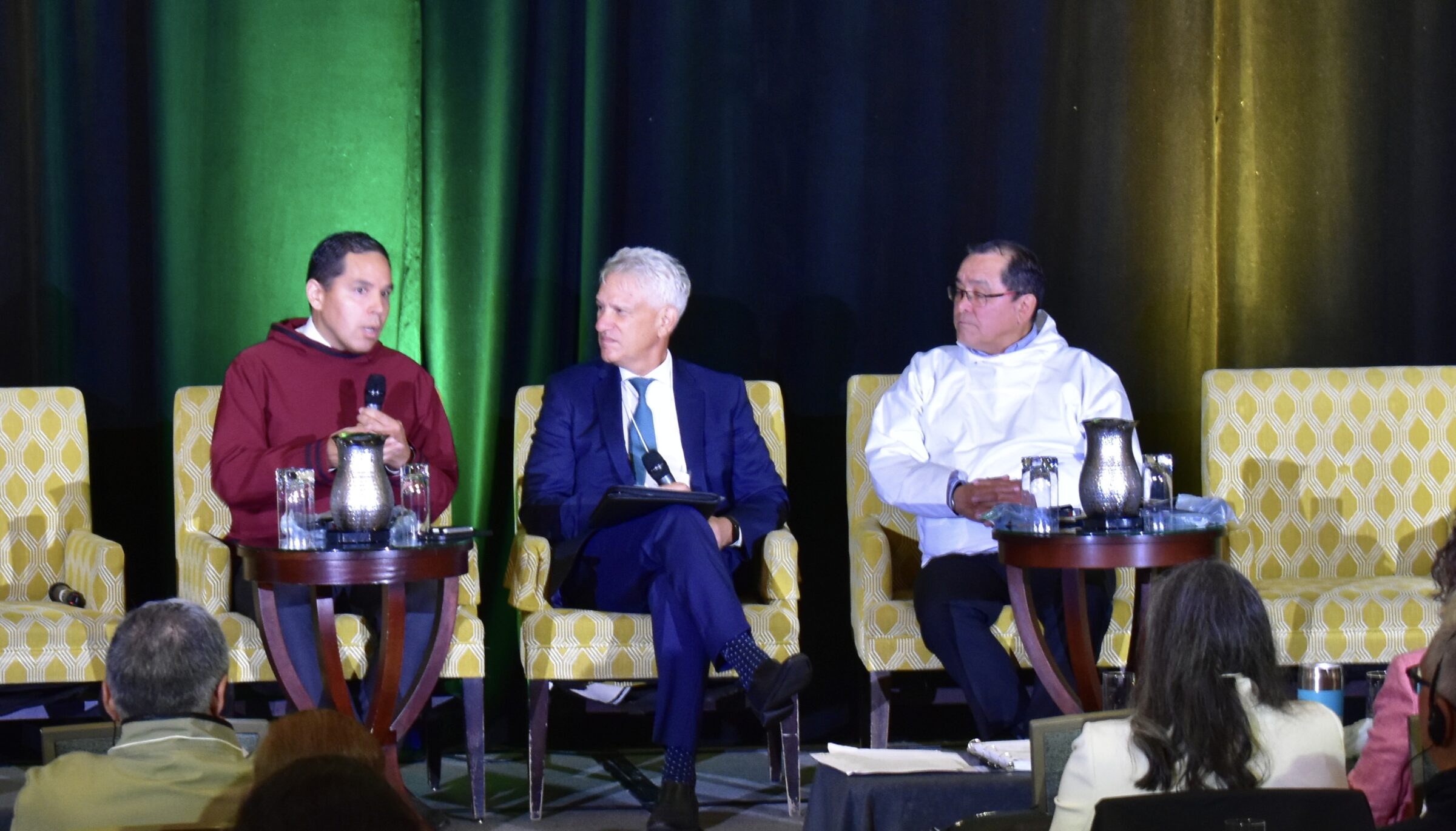
Inuit Tapiriit Kanatami president Natan Obed, left, moderator Rob Russo of the Economist and Makivvik Corp. president Pita Aatami discuss Arctic sovereignty, defence and security during ITK’s Nilliajut conference in Ottawa on June 19. (File photo by Nehaa Bimal)

If Inuit Tapiriit Kanatami president Natan Obed were a provincial premier, you might think he was toying with something akin to separatism after he mused publicly about Inuit forging new partnerships.
Obed’s speech at an Arctic security conference on June 19 should be cause for alarm.
“If a partnership with Canada is not on the table, if we are not going to be respected partners, then should we not be looking for other partners as well to uphold our interests?” Obed said during ITK’s Nilliajut – Asserting Inuit Rights in Arctic Security conference in Ottawa.
Looking for other partners? That sounds like ITK — the national voice for Inuit in Canada — is suggesting Inuit might leave Canada if Ottawa doesn’t uphold their interests the way they want them to be upheld.
It’s the kind of rhetoric we expect from Quebec separatists, and that is increasingly popular in Alberta.
What other partners was Obed talking about? The United States? Denmark? China? Russia? He didn’t name the other partners he had in mind. And he didn’t take questions from reporters.
ITK’s one-day conference, he said, was held to “reorient the conversation” about casting Inuit as “central actors” in Canada’s approach to Arctic security.
The past few years have seen a new focus on Arctic security and defence — the result of Russia’s war on Ukraine, U.S. President Donald Trump’s talk about Canada’s and Greenland’s sovereignty, worldwide demand for minerals and the opening of the Arctic to shipping.
“Canada is our preferred partner,” Obed said.
But then he compared the Inuit relationship with Canada to the Canada-U.S. relationship. Until two years ago, Canadians never imagined “forging paths” outside of that traditional partnership. But times change.
“This isn’t a threat,” Obed said.
Evaluating who Inuit partners should be is the same kind of “practical consideration” the Prime Minister’s Office also makes on Canadians’ behalf. When a partnership isn’t working, you might need to forge new ones.
But whenever someone assures you what they’re saying isn’t a threat, it’s because they know their comments are likely to be perceived as a threat.
Obed’s talk comes amid national unity tension from Alberta separatism. And Quebec separatism — relatively quiet lately — is always simmering in the background.
Alberta Premier Danielle Smith has used similar rhetoric to promote her province’s interests.
“I support Alberta remaining in Canada,” Smith said in a May 21 televised address.
“But I truly believe our country is so much stronger and more prosperous when we respect the rights of provinces and empower them to govern themselves with minimal federal interference.”
Many Albertans want to leave Canada because they feel their province’s partnership with Canada is — to borrow Obed’s phrase — not on the table.

They say the federal government, and Canadians generally, don’t respect Alberta’s perspective on resource development, provincial rights and energy policies.
Sound familiar?
Obed’s suggestion that Inuit might look for other partners was an unexpected twist and a bit of a head-scratcher.
He’s right that Inuit leaders need to educate Canadians about the Arctic. Canadians don’t understand Inuit history or their rights. And it’s fair to argue that Inuit should be more deeply integrated in Canadian decision-making about Arctic security.
But seeking to reorient the conversation while hinting about looking for other partners is a bizarre, dangerous strategy that is unlikely to be very productive.
… the United Provinces?
Who does he speak for? Where did his comments originate from? Did he ask all Inuit of Canada that this is our or his views? I think his comments should be considered for resignation.
Agreed. And don’t forget, he took away the edmonton eskimos name.
He speaks for all aboriginals groups of Canada (Alberta and Quebec, specifically), who seem like the odd man out when it comes to talks of separation. He gave voice to this deep concern of anyone involved or keeping up with the issues
I’m not an “Aboriginal” as I’m not from Australia. I’m an Indigenous person from Nunavut, Canada.
No, he doesn’t speak for ‘all’ Indigenous/Aboriginal people in Inuit Nunanagat. He speaks for Inuit in those regions only.
See, not hard to understand.
@ Ummm, No
“He speaks for Inuit in those regions only.” = FAKE NEWS!!!!!
He is the “MOUTHPIECE” for the “Regional Inuit Organizations” only and solely!
He does not represent individual Inuit.
There I fixed it for you.
It is worth noting the Regional Inuit Associations can barely lay claim to “represent Inuit in the (their) regions.
For the most part Inuit participation in the elections that deliver a representative to oversee their respective Regional Inuit Organization’s rarely reaches above 50% of eligible voters and more often than not, is lucky to get 35% of eligible voters participating.
Further, of the roughly 35% participation rate, the candidate “winning the election” would require 1/2 + 1 voters therefore they “win” to represent all with 17.5% + 1 of eligible voters.
We’ve seen how at least one RIO is resorting to paying their members to vote, in an attempt to legitimize themselves.
Preferred partner. Your only partner. Where would you be without this preferred partner. Get real
Majority of ITK’s funding comes from the Government of Canada including all the infrastructure funding that has flowed to the four Inuit organizations from capital funds to operating funds to program funds to project funds.
Do not bite the hand that feeds you because it might just slap you in the face and walk away.
This column makes a bigger leap than the evidence supports. Asking whether Inuit should seek “other partners” if Ottawa ignores their interests is not the same as advocating separatism. That’s one possible interpretation, but far from the only one. A little more context and a little less speculation would have made for a stronger argument.
You say separatism is “one possible interpretation, but far from the only one” and suggest a little more context would make for a stronger argument.
Fair enough, but since you mentioned it what other interpretations do you have in mind? Added clarity and less speculation would indeed strengthen your argument.
Looking forward to it.
It’s very simple Mark carney is not spoon feeding Ntan like Justin Trudeau did for years, The new premier of Nunavut told Carney he is the elected leader of a public government that is in charge, Natan will have to stand in line like everyone else, and Natan is not an elected leader.appointment.
Yep , he is not elected , he is anointed by god !!
Fair question. My point is simply that “other partners” doesn’t automatically mean separatism. It could refer to stronger relationships with other Arctic governments, Indigenous organizations, or international forums to advance Inuit interests while remaining part of Canada.
The columnist is free to interpret it as separatism, but presenting that as the obvious conclusion without more evidence is where I think the argument falls short. Looking forward to your thoughts Mr.IBM Thinkpad
If it does mean what you suggest it seems a pointless threat, as those organizations have no jurisdiction or political authority around defense in the Canadian Arctic.
Given the context his comments only make sense as a veiled threat to remove Inuit Nunangat from Canada, though I doubt he is brave or stupid enough to say it plainly. Natan is overplaying his hand here, a sign, in my opinion, of a delusional sense of self-importance.
Now, there are several possibilities:
One he was issuing a threat, which makes him either a fool or a bigger fool.
He saw statements like that online from people like Smith and thought it made him sound edgy and cool, which makes him a fool.
He wasn’t aware of how it would be perceived, which makes him inept.
Or he thought he was cool imitating Carney’s discussions regarding Canada and the US, which makes him…a fool.
Overall, not many good options. And I think someone should challenge him on it by pressing him to identify who, precisely, he had in mind when he made that statement.
Here is some context and how this headline gets it backwards.
Obed explicitly said this is not a threat but a practical consideration, and that Inuit have no interest in forging other paths. Canada is the partner Inuit have worked with for 50 years and he wants that to continue.
Here is why he said it. Canada is about to spend tens of billions on Arctic defence, including a new network of military support hubs, and Ottawa announced it without deeply consulting the Inuit whose homeland every one of these projects sits on. That is not a courtesy Ottawa skipped. Consultation is a Crown obligation under the modern land claims agreements like the Nunavut Agreement, which are constitutionally protected treaties the government negotiated and signed. Moving on major decisions in Inuit Nunangat without proper consultation breaks a commitment Canada made in law.
There is also a straightforward economic argument. Inuit have projects ready to go and the organizations capable of delivering them. They are asking that when Canada spends this money in the Arctic, it flows through Inuit hands and builds lasting Inuit capacity, rather than southern firms flying in, doing the work, and flying the profits back out. Remember this is being built on the very land Inuit surrendered to Canada through those land claims agreements. The people who gave up that land should benefit from what gets built on it.
Now look at the double standard. When a highway, port or military base is needed in the south, Ottawa does not ask local Canadians to fund it themselves. It just builds it, because that infrastructure is treated as a national necessity. The same logic vanishes up here. When the project is a defence asset that serves Canada’s interests, the remoteness and the cost are no obstacle and the money appears. But when Inuit ask for that same investment in housing, water and infrastructure that would actually raise the quality of life for people living here, the answer is suddenly that the North is too remote and too expensive. The land is worth defending but the people on it are treated as too costly to support. That is the imbalance Obed is naming.
The history sharpens it. When the North was militarized during the Second World War and the Cold War, it facilitated the forced relocation of Inuit families and left behind abandoned fuel, equipment and waste that still scars communities today. So when Ottawa moves fast on Arctic security with Inuit shut out of the room, the alarm is earned.
Obed is also turning Canada’s own logic back on Ottawa. Carney is diversifying Canada’s trade partners beyond the U.S. precisely because leaning on one partner who stops respecting you is a risk. Obed’s point is that Inuit are in the same position. If Ottawa stops treating them as real partners and stops honouring its treaty obligations, of course they would weigh other options to fund their own development and self determination.
And on national unity he could not have been clearer. Inuit take threats to Canadian sovereignty seriously and want to be active players in defending it. That is the opposite of separatism. Inuit are offering to help secure the Arctic and asking only to be treated as the partners the treaties already make them.
Ya this is it. The thought of Inuit, generally, separating from Canada is such an outlandish and absurd idea, it probably never crossed Natan’s mind when he spoke. Like how would you even start this. Seriously. Inuit Tapiriit Kanatami = Inuit are United in Canada. Equating Natan’s comments to the news of the day about Alberta separating is annoying and sidetracks the good work his words do. These two issues are oceans apart.
Me thinks Natan’s comments are clearly motivated entirely by the dire need to address well known Inuit social indicators of health, through legal and economic means …. ie building the very basic infrastructure and services widely available for most southern Canadians but not in Inuit Nunangat. Housing, hospitals, schools, roads. Inuit want to get things moving yesterday. So sure why not through Inuit orgs working with international industries, even governments to finally make tracks on neglected/urgent issues that Inuit orgs are begging to address. Issues that would be heard and responded to swiftly in one part of the country, but not another.
The historic lack of these conversations with Inuit on big national interest projects, spending, is DIRECTLY linked to the lack of economic and social prosperity in the Canadian Arctic. It’s a sad opportunity missed to do both the defence thing and build a healthy, sustainable Arctic. It’s a disappointing signal from Ottawa that it doesn’t prioritize or consider Canadians in Inuit Nunangat. Like…Canada can’t even be bothered to invest in eradicating TB(!) for the love of god.
Natan’s comments should raise eyebrows high in Ottawa. He is using leverage and it’s a bold and ambitious hand to play, all with the intent of getting the adequate attention and needs met of Inuit who, by every statistic, are not receiving equitable life standards and rights compared to southern Canadians.
Canada really doesn’t want unscreened foreign actors walking in the door, creating better relationships with right holders with access to 1/3 of the landmass of Canada. Pick up the phone Carney.
Now that’s a comment that reflects much more the reality. Indeed, the honour of the Crown mandates the gouvernements to consult with Indigenous people and obtain their free and informed consent before projets that affect their rights and territories are conducted. Canada failed to honour its treaty obligation and it’s fair for the Inuit to push back. Partnerships doesn’t necessarily mean secession and for instance Quebec has international partners in matters under its constitutional jurisdictions.
Further, there is also the right to self determination under international laws and an obvious partnership with Greenland for instance since that territory is manly inuit (Kalaallit) and is considering its own independence while the US is threatening annexation the same way they are threatening Canada’s annexation as the 51th State.
Finally, Canada’s sovereignty over the Arctic is challenged by many countries starting with the US and that’s why Inuit were relocated to the High Arctic. In a changing world where the law of the mighty is replacing the rule of law, the issue may come back to haunt Canada for its neglect of the Arctic under its claimed jurisdiction.
“Now look at the double standard. When a highway, port or military base is needed in the south, Ottawa does not ask local Canadians to fund it themselves.”
———-
The Federal government builds under 2% of the roads in Canada and hasn’t built a military base since Suffield in 1971. The last major harbour project in Canada was Clyde River.
“There is also a straightforward economic argument. Inuit have projects ready to go and the organizations capable of delivering them. They are asking that when Canada spends this money in the Arctic, it flows through Inuit hands and builds lasting Inuit capacity, rather than southern firms flying in, doing the work, and flying the profits back out.”
——————–
This policy has proven to be a complete failure when addressing the housing shortage however, likely because you are incorrect that “…there are organization capable of delivering them”.
Your comment doesn’t hold up under scrutiny.
Fair pushback on a couple of points, but it actually reinforces the argument rather than sinking it.
On jurisdiction, you are right that Ottawa builds a small share of Canada’s roads directly. But that is exactly the point. In the south, that is because the provinces have the tax base, the road networks, the ports and the contractors already in place, built up over a century of federal and provincial investment. The North never got that foundation. So when Ottawa says the North is too remote and too expensive to build in, it is pointing at a gap that its own historical under investment created. You cannot starve a region of infrastructure for decades and then cite the lack of infrastructure as the reason not to invest.
Now, you’re correct on housing that progress has been slower than promised. But look at why. About 75 percent of the skilled trades are still flown in from the south, which means most of the wages leave the territory instead of building a local workforce that could build faster every year. That is the whole argument. When the money flows through Inuit hands and trains Inuit workers, you build lasting capacity. When it flows to southern firms who fly in and fly out, you are back to square one on the next project. The slow pace is not proof the model fails. It is proof of what happens when you only half commit to it.
So the housing struggle doesn’t refute the point. It is the clearest evidence for it.
Come on Corey, post my previous comment.
The editor of this paper has no standing to push opinions on whether or not Inuit independence from Canada is a valuable project or not.
Why not?
Does Natan have a mandate to push independence?
He’s not pushing independence, he’s pushing re-alignment. But with whom? A foreign state?
The Government of Canada should refuse to meet with ITK until he is replaced.
Does Corey have a mandate to push for federalism?
An editor can write about whatever they feel matters, and they don’t need your pemission to do it.
Here is a briefing to help get the bigger message across the board. I may get some thumbs up, or some thumbs down. We’ll see…
There is a recurring error in how the Crown’s representatives approach the Nunavut Land Claims Agreement, and it needs to be named plainly. The Agreement is repeatedly treated as a federal program: a discretionary set of services to be administered, budgeted, and adjusted at departmental convenience. It is nothing of the kind.
The NLCA is a land claims agreement protected under section 35 of the Constitution Act, 1982. It is a constitutionally entrenched treaty between the Inuit of the Nunavut Settlement Area and the Crown in right of Canada. Its provisions are not policy. They cannot be amended by a Minister, reinterpreted by a directorate, suspended in a fiscal cycle, or narrowed through administrative practice.
A program is created, funded, and cancelled at the government’s discretion. A treaty is none of those things. It was negotiated between two parties, ratified by legislation, and given constitutional protection precisely so one side could not unmake it. Treating the Agreement as a program inverts that relationship. It recasts a binding, reciprocal, constitutionally protected obligation as a gratuity, something Canada provides rather than something Canada owes. That framing is not neutral. It quietly strips Inuit of the status the Agreement guarantees.
This has consequences at the table. When an official does not know the Agreement they are bound to implement, that knowledge gap does not fall equally on both parties. It becomes leverage. An obligation that is not understood can be declined, deferred, or administered down to something smaller than what was agreed, and the burden of correcting the record falls on Inuit. The Crown does not discharge a constitutional obligation only to the extent its current representatives happen to be briefed on it.
The consideration has already been given. Inuit surrendered claims over an immense territory. What remains is Canada’s performance, and that performance is held to the honour of the Crown: a legal standard, repeatedly affirmed by the courts, requiring the Crown to act with integrity and to interpret its obligations generously rather than narrowly. Defaulting to the thinnest possible reading does not meet that standard.
Every official who works this file inherits the Crown’s obligations whole, whether or not they were briefed, whether or not they were present at signing, whether or not the history is comfortable. The Agreement is the floor, not the ceiling.
The expectation is straightforward. Approach the NLCA as what it is, a constitutionally protected treaty carrying binding, reciprocal obligations, not a program to be administered at departmental convenience. Anything less is not an interpretation of the Agreement. It is a failure to honour it.
It was my understanding that NTI is a Federal Non-Profit organization. It is made up of Inuit from the whole Inuit Nunangat.
Although it is made up of Designated Inuit Organizations that fall under the Nunavut Agreement, NTI, as its own entity, dis not a Designated Inuit Organization under the Nunavut Agreement. As this would then include people from Quebec, NWT, and the Yukon having a say in how Nunavut is run. (I could be wrong on this and please correct me if I am. I apologize if I am).
ITK and the Regional Inuit Orgs, and the Hunters and Trappers Organizations are also Designated Inuit Organizations who are in, and part of enforcing, the Nunavut Agreement, along with the Government of Nunavut and the Government of Canada.
The Nunavut Agreement sets out a Public Government, represented by the elected officials (MLA’s) who select the Premiere and Cabinet.
The question is, how does an NGO, based in Ottawa partner with a foreign entity?
It is like my five year old planning to run away if he didn’t get his way. Packs up his backpack and sits on the frontage and waits for someone to come and comfort him.
Natan’s comments are clearly hinting at an act of treason.
It’s unbelievable that he thinks he can speak in this way, but it’s not surprising. His entire career as ITK President has taken place inside a very insulated bubble lacking much meaningful contact with the real world.
Giving no kudos to Obed at all but be aware that he represents the delusional people on the board of directors of ITK and similar organizations such as NTI
“Clearly he hasn’t been to Kugluktuk “ to see the overcrowded houses, the government buildings that are boarded up from broken windows, the cost of real life in the community and rampant booze drinking all over town. Beautiful but not for the faint hearted.
Reminds me of a childhood song. Obed cannot speak for adults with real accomplishments. Clearly, Inuit through years of effort have made enduring goals by joining and assimilating ignorant, biased pretenders of the saviors of the planet. I applaud those incredible friends. Oh that song? “BS NGO BS NGO BS NGO cus BS IS All you know oh!”
Being part of Scandinavia might actually be better for Nunavut, more northern similarities, our education standards and system would be a lot better in Nunavut.
Part of Greenland and Denmark maybe. Better infrastructure, education, housing,, culture and language would be stronger. The list goes on. There are options out there.
The org in in need of much more local, regional action and car fewer galas.
far fewer, less galas.