


‘One Canadian Economy’ could end ‘balkanized’ Canada, professor says
Bill C-5, passed in the Senate on Thursday, aims to break down trade and professional barriers
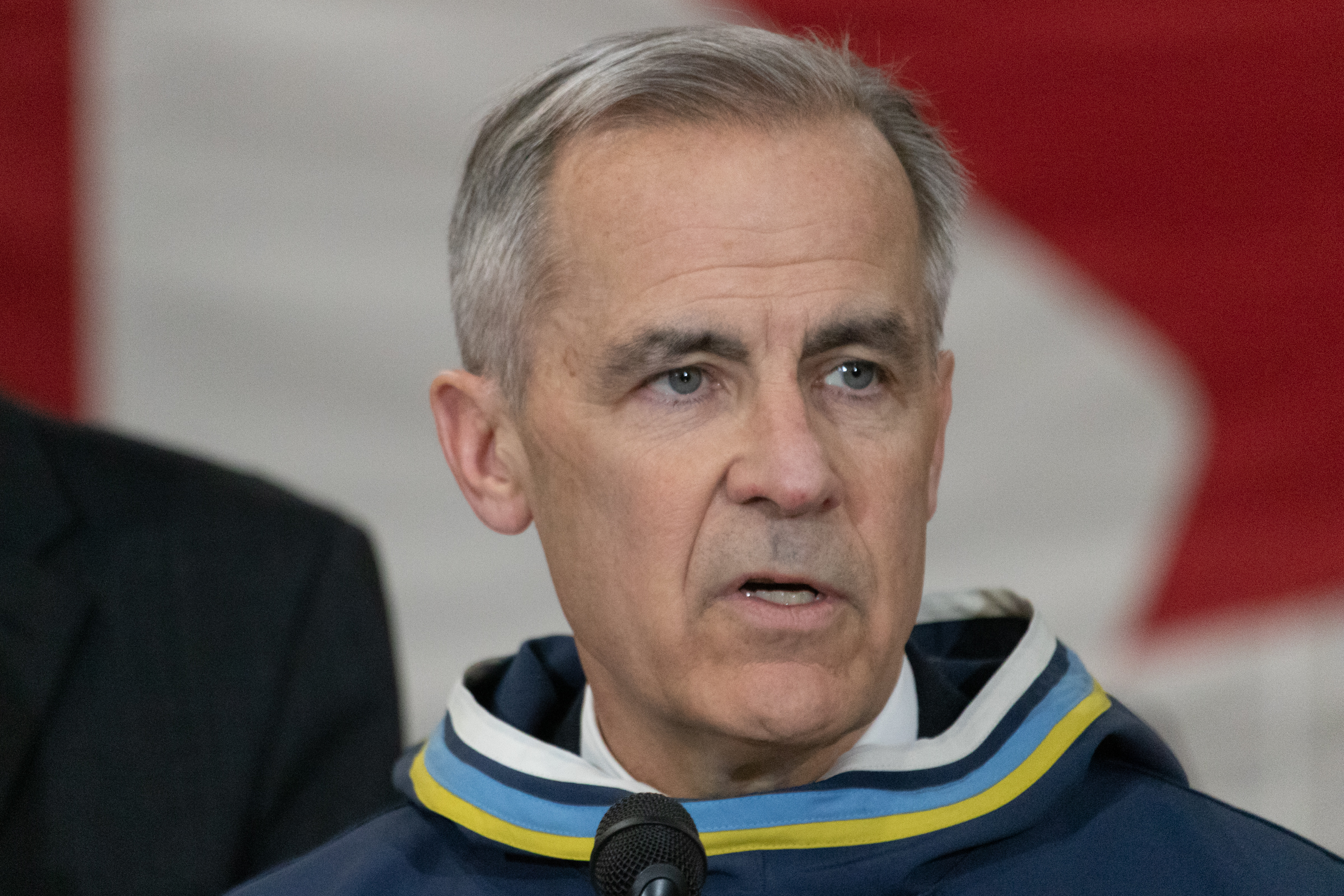
The Liberal government led by Prime Minister Mark Carney, pictured during his March visit to Iqaluit, is aiming to ease interprovincial trade barriers with Bill C-5, a new law that passed through Parliament on Thursday. (File photo by Jeff Pelletier)

Getting rid of barriers to interprovincial and territorial trade and labour was on the new federal government’s agenda for a while.
It was part of Prime Minister Mark Carney’s election campaign; included in the government’s throne speech; and it materialized into Bill C-5, which passed quickly through the House of Commons and was approved in the Senate on Thursday.
Bill C-5 actually has two parts: the One Canadian Economy Act, and the Building Canada Act. Here is what the new bill is set to do, and how it could affect Nunavut.
Canada is ‘balkanized’
For years, the provinces and territories have imposed barriers limiting movement of professionals and products across their borders.
That means, for instance, that Ontarians would have a hard time buying British Columbian wine and vice versa.
And a nurse from Nova Scotia who wanted to move to Quebec to work would have to pay a $350 fee, fill out paperwork and go through a Quebec licensing exam. Similar rules apply to many other trained professionals across the country.

Ian Lee, a professor at Carleton University’s Sprott School of Business in Ottawa and longtime critic of internal trade barriers, that’s a sign of a “balkanized” Canada.
Balkanization is a term that refers to the Balkan countries of central Europe and is used to describe a region divided into small territories that are often hostile to each other.
“Because the Balkans are balkanized into these tiny little postage stamp countries — Bosnia and Herzegovina, Serbia, Albania, Macedonia and on and on and on,” Lee said, adding that the One Canadian Economy Act could be the first step in reversing that effect in Canada.
The many rules that were meant to protect Ontarians, Quebecers, Albertans and others ended up hurting Canadians overall by making local industries and workers less competitive, Lee said.
So what does the bill say?
The second part of Bill C-5 — the Building Canada Act — is designed to streamline approval and development processes for projects deemed to be in the national interest, such as mines, ports, roads and pipelines.

While it caused some controversy among Indigenous leaders, including Inuit Tapiriit Katantami president Natan Obed, who called for more consultation, the part relating to trade was an easier sell.
It’s called the “Free Trade and Labour Mobility in Canada Act,” and it removes federal barriers to trade.
Under the new law, “a good produced, used or distributed in accordance with a provincial or territorial requirement is considered to meet any comparable federal requirement.”
The same principle applies to services and worker mobility.
Just removing the federal barriers will contribute $200 billion annually to the Canadian economy, Rechie Valdez, the federal secretary of state for small business and tourism, said in an interview Tuesday.

She didn’t have an estimate for the potential economic value in the event provinces and territories follow the example and also remove their barriers.
Can Nunavut contribute to removing the barriers?
Lee said the territorial governments have historically been less prone to protectionism because they have fewer industries to protect.
“They have very small economies. They don’t have to worry about protecting an industry, because many of those industries just don’t yet exist.”
However, Nunavut, like other jurisdictions, does have licensing requirements for lawyers, doctors, nurses and teachers, and possibly eliminating that paperwork is one of the issues Nunavut is “exploring,” Premier P.J. Akeeagok said after the Northern premiers’ forum in May.
“The challenge we’ve always had is securing nurses or doctors, but the opportunity for the movement of the professions within this country might open up a lot more for us,” he said.
He didn’t mention other barriers the territorial government is eyeing to eliminate or how much economic benefit that might bring, saying that those conversations are “very preliminary.”
The Nunavut Department of Intergovernmental Affairs didn’t respond to an enquiry from Nunatsiaq News on that.
They should look to Australia as an example of internal cross-border movement and regulation. For example, once you’re licensed in one Australian state or territory (ex.: lawyers, doctors, nurses, engineers, etc), you can work in any other state or territory without having to get requalified. I think there’s just an application and you pay a fee to register.
Trim the fat off the bureaucracy .
… don’t try to take any sort of produce or fresh food across state lines.
It should be clear to all that trade barriers are a drag on commerce and in most cases are completely without justification. Doctors and nurses have to be the best example of local markets restricting supply by licensing barriers to prop up the cost/salaries of the existing practitioners. The human body functions exactly the same in every geographic location on the planet. It is understandable that practitioners would need to demonstrate an understanding of local laws and regulations, but beyond that these barriers are just a mechanism to restrict supply and prop up cost.
No more liquor permit fees please biggest scam in nunavut