


Planned heritage centre will show Inuit ‘belongings,’ not artifacts
Public meeting in Iqaluit on Friday to give public chance to comment, ask questions
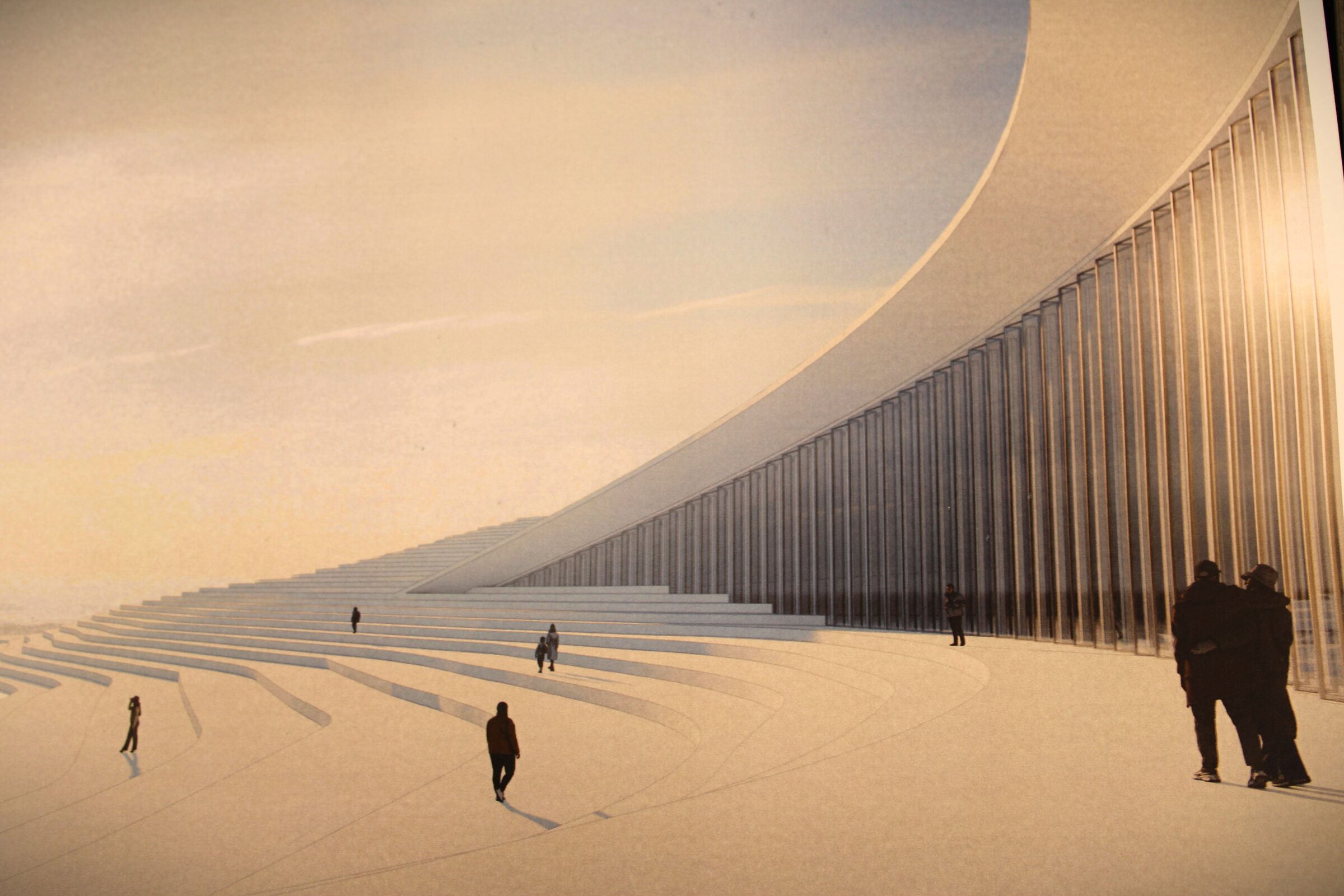
This diagram of the planned Nunavut Inuit Heritage Centre in Iqaluit shows the view from the Frobisher Bay side of the structure. (Illustration courtesy of Annette Kurtzmann/Dorte Mandrup Arkitekter)

No Inuit “artifacts” will be housed in the planned $150-million Nunavut Inuit Heritage Centre, where construction is expected to be completed by 2030.
Instead, organizers say, the centre will display Inuit “belongings.”
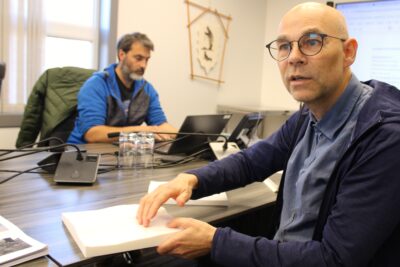
Project architect Thomas Jørgensen of Dorte Mandrup Arkitekter, the Danish firm selected to design the centre, describes the materials used in the build. Torsten Diesel, director of projects with Inuit Heritage Trust, works in the background. (Photo by Daron Letts)
Recasting what are regarded as artifacts in southern museums as Inuit belongings is an important distinction for the centre, said Torsten Diesel, project director with Inuit Heritage Trust.
“It’s really about rethinking and breaking through colonial principles,” he said.
“We want to provide a space where Inuit can have full ownership over the interpretation of their own culture, history and presence. And a huge component of that is language.”
Organizers are establishing a language committee to help guide construction of the centre, he said.

The public can share their own ideas for the centre at a community meeting scheduled for 6 p.m. Friday at the Aqsarniit hotel in Iqaluit.
“We want to make sure that we have as much Inuit input as possible,” said Diesel.
Project manager Annette Kurtzmann and project architect Thomas Jørgensen of Dorte Mandrup Arkitekter, the Danish firm selected to design the centre, will attend to answer questions and offer feedback.
So far, the Inuit Heritage Trust has received funding commitments of $50 million from the federal government and $20 million from Nunavut Inuit organizations. It also plans to seek private donations.
The design for the approximately 55,000-square-foot centre — by comparison, the Iqaluit airport terminal is about 100,000 square feet — includes a museum, woodworking shop and theatre.
Construction is expected to start in 2027 or 2028 and organizers hope the centre will open in 2030.

About a year after that, historical Inuit belongings can be brought in once the centre has achieved Class A designation from the federal Department of Canadian Heritage. That ensures the building offers humidity and temperature controls suitable to safely store old items that might be composed of fur, sinew, ivory and other materials.
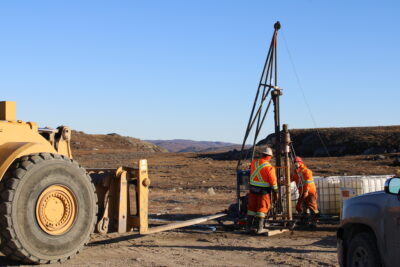
A crew conducts geotechnical sampling on the road to Apex, on Monday. The current design for the proposed Nunavut Inuit Heritage Centre would span the gap between the two hills pictured here in the background. (Photo by Daron Letts)
Once the designation is confirmed in 2031, the centre will import Inuit collections from the Winnipeg Art Gallery, the Canadian Museum of Nature in Ottawa, and from Parks Canada.
This week, a crew is drilling bore hole samples near the proposed building site to give architects insight into what kind of foundation would work best in the soil.
“We have no confirmation from the city right now that we can build there,” Diesel said. “But we’re working with the city and other stakeholders to unlock that land for development.”

With a design mimicking the contours of a natural snowdrift, the centre will bridge a gap between two existing hills overlooking Frobisher Bay, with the Arctic Winter Games Arena a few hundred metres to the west.
The building’s profile is inspired by a qarmaq, a traditional semi-subterranean Inuit stone structure embedded between the slopes of two hills, Kurtzmann said.
Inside, the walls, ceilings and floors will incorporate natural rock from the area along with imported wood to provide a sense of warmth, Jørgensen said.
Sections that will house exhibitions will be large enough to display Inuit watercraft such as a kayak or umiak, which can average close to eight metres long. The smallest items on display might be flakes of stone recovered from an archeological dig.
So inuit can just take whatever they want from the center if it belongs to them?
Are pre-Dorset artifacts Inuit belongings? Because they were the predecessors of Inuit, not their ancestors. That’s why we have differents words for different things. Artifacts is apt.
Oh please house humans not belongs again are homeless inuit will be looking inside warm place where belongings are kept warm not the homeless people of nunavut how lower will nunavut get already been living long enough like we’re in 3 world class citizens sad & many across go with out daily keep up with the sad decisions that are being made day inn day out .
Frobisher bay boy, I hear CBC radio everyday! Heard this exact same on inuktitut news but different location NTI paid lots to show these, my personal mouth comment said exact same! Like 4 years ago! Finally someone commented👏
There are plenty of proto Dene archeological sites on mainland Nunavut.
There are also plenty of Tuniit archeological sites all across Nunavut.
Over the years, many of these proto-Dene and Tuniit sites have been investigated, and most assuredly artifacts recovered from these separate and distinct peoples have entered into heritage collections controlled or owned by the IHT.
I think IHT needs to pump the brakes on this “Inuit belongings” claim.
Unless of course, they intend to completely purge the archeological collections of artifacts derived from these distinct peoples to perpetuate the ridiculous present day myth that only us Inuit have lived here for thousands of years.
If I understand correctly. These are owned and managed by the government of Nunavut. Collection staff are employees of Culture and Heritage who does the permitting for archeological research.
Rather than purging history of the evidence that this land was occupied by others long before Inuit, the effort seems to be to subsume their stories, their history, their identity into the Inuit story. Basically, to pretend they too were Inuit. Your ancestors.
This is a very clever, expedient way of erasing those identities while leaving them in plain sight. Still, it’s a fiction, told for political benefit.
The test of maturity in modern Inuit culture will be the admission that these kinds of narratives were falsely made, while looking at them clearly and acknowledging why that was done.
There’s nothing quite like being lectured about colonialism, by European white guys making huge money off this project.
So colonial. All the arts and artifact already belong to Nunavummiut. Government of Nunavut manages all the collections that were either donated or acquired through purchase. These are managed with public funds so they already belong to Nunavut. Nunavut is a child of the Nunavut Agreement. This is in no way colonial practice. Pertendians juujaqtut. I hope they are working with the government on these government assets.