


Prehistoric fish crawls into spotlight at Canadian Museum of Nature
Tiktaalik roseae, discovered on Ellesmere Island in 2004, on display in Canada for 1st time
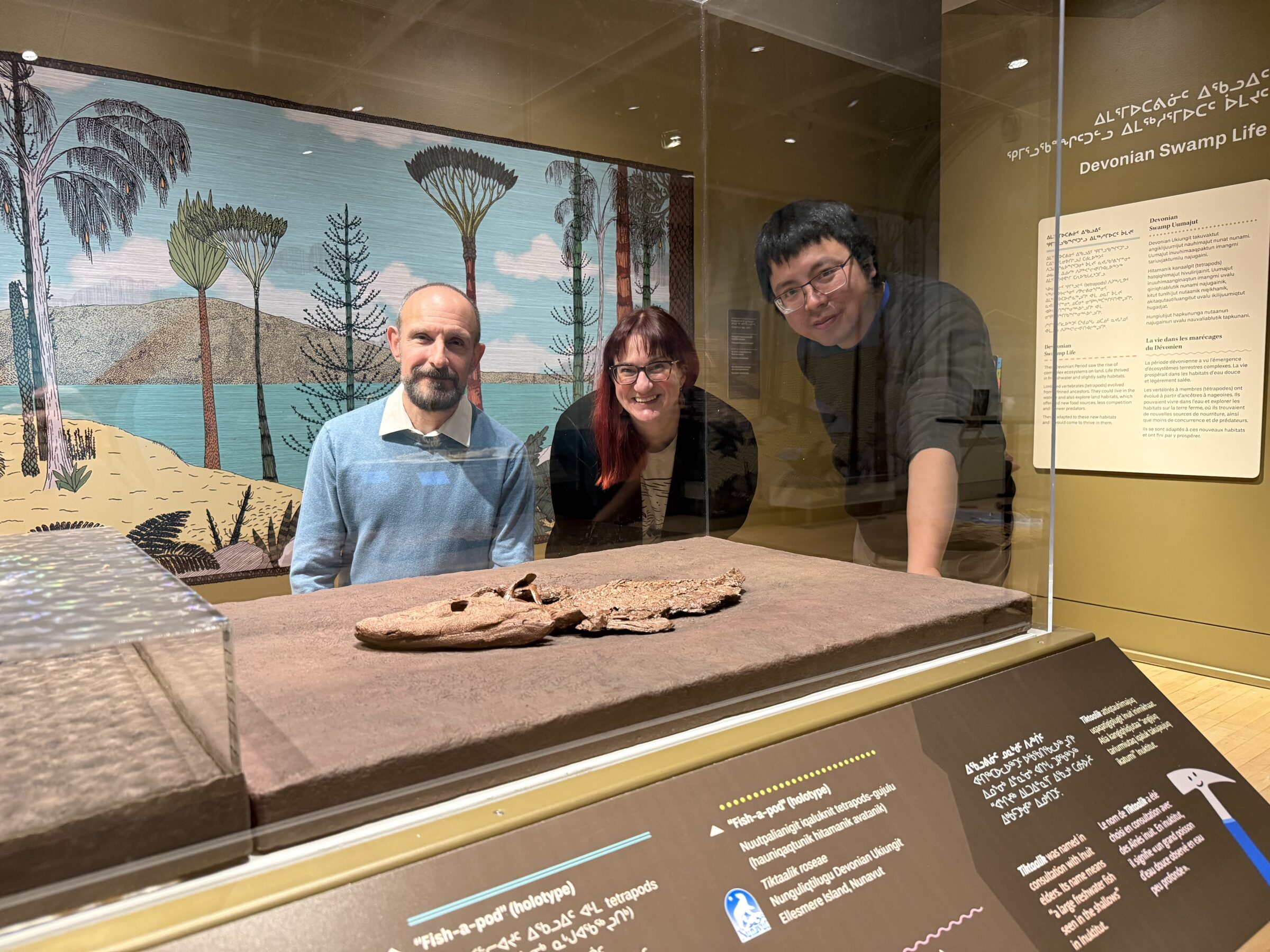
A 375 million-year-old fishapod, unearthed in Nunavut in 2004, is the main attraction of a new exhibit at the Canadian Museum of Nature in Ottawa. Seen here from left: Scott Rufolo, the museum’s curator for paleobiology, Michelle Anne Olsen, the museum’s exhibitions and content developer and Tetsuto Miyashita, research scientist in paleobiology at the museum. (Photo by Jorge Antunes)
The fossil of a prehistoric fish with strong, wrist-like bones is on public display for the first time in Canada as it awaits the final leg of its long journey back home to Nunavut.
Tiktaalik roseae was discovered on Ellesmere Island in 2004 by two American paleontologists. It made headlines in 2006 as part of a study published in the journal Nature that described Tiktaalik as a “missing link” between fish and land creatures.
Now Tiktaalik is the star of a new exhibit at the Canadian Museum of Nature that examines the Devonian Period, a pivotal era in the history of life on Earth when fish began to make the transition to land.
Tiktaalik roseae lived its life about 375 million years ago, on the shallow banks of a river or lake in a warm climate. At the time, the landmass and islands that would become Nunavut straddled the equator.
The ocean was teaming with life and predators, and it’s believed these pressures may have helped spur Tiktaalik’s move toward land, said Scott Rufolo, curator for paleobiology at the Canadian Museum of Nature.
Known as a “fishapod,” Tiktaalik had scales, fins and gills like fish, but its front fins also had strong bones and a partial wrist, allowing it to push its upper body upwards and out of shallow water.
It grew up to almost three metres long, had a wide and flat head and tail fin similar to an eel’s.
After its discovery, Tiktaalik was stored in the United States in the custody of American researchers. But the specimen is jointly owned by Inuit and the Nunavut government under Article 33 of the Nunavut Land Claims Agreement.
Tiktaalik was transferred to the Canadian Museum of Nature in 2015 for safekeeping until the Nunavut Inuit Heritage Centre in Iqaluit is complete. When that happens, the plan is to move Tiktaalik there.
The Devonian Period ran from 420 to 350 million years ago.
“This is a period dynamic change,” said Michelle Anne Olsen, exhibitions content developer for the Canadian Museum of Nature.
“There are foundations being laid down during this period that are going to inform the natural world as we understand it today.”
The Devonian Period began with little life on land except for insects, bacteria and basic plants. By the period’s end, the land was filled with lush plant life and towering trees. As well, the first vertebrates were making their way on land.
Tiktaalik could have been the ancestor of of all four-limbed land animals on the planet, including humans. Its importance to the paleontology world has been compared to the likes of the hominid fossil Lucy, which provided the first evolutionary link between humans and other species.
“This is our link between [land animals and fish],” said Olsen.
The word Tiktaalik means “a large freshwater fish seen in the shallows” in Inuktitut.
The Canadian Museum of Nature’s exhibit, called Life Onto Land: The Devonian, also features more than 70 other fossils of ancient fish and plants, videos, large murals and photographs, a “living fossil” and a replica of the head of a giant carnivorous fish called a dunkleosteus.
Throughout the exhibit there are signs in English, French, Innuinaqtun and Inuktitut.

Like all exhibits at the museum, admission is free to Inuit and other Indigenous people.
The exhibit opened Friday and runs until Oct. 12, 2026.
“Tiktaalik roseae, discovered on Ellesmere Island in 2004, on display in Canada for 1st time.”
Not quite. I saw it on display in Grise Fiord, about 15 years ago. It was spring-time, days were long and seaice was solid, probably 2009 or 2010.
Tiktaalik roseae is an amazing transitional fossil found on Ellesmere Island in 2004. With respect to your comment about seeing it in Grise Fiord, we checked with the curator of our palaeontology collection who also manages the Nunavut palaeontology collection while it is temporarily in our care. It turns out that what you saw on display in Grise Fiord was a high-quality replica that was donated to the school there in 2006 by the scientists who discovered the fossil. The actual holotype fossil (original specimen) has never been exhibited in Grise Fiord or elsewhere in Canada until now. Our current Life onto Land exhibit marks the first time that the holotype is formally on public display in the country.
Three hundred and seventy-five million years old (375,000,000) fossilized animal specimen, and found laying like that intact on the surface; What an amazing find.