

Qikiqtarjuaq port backers seek federal support in Ottawa
Deepsea port project price tag climbs to $350M as Inuit-led partners urge Ottawa to ‘focus on the North’
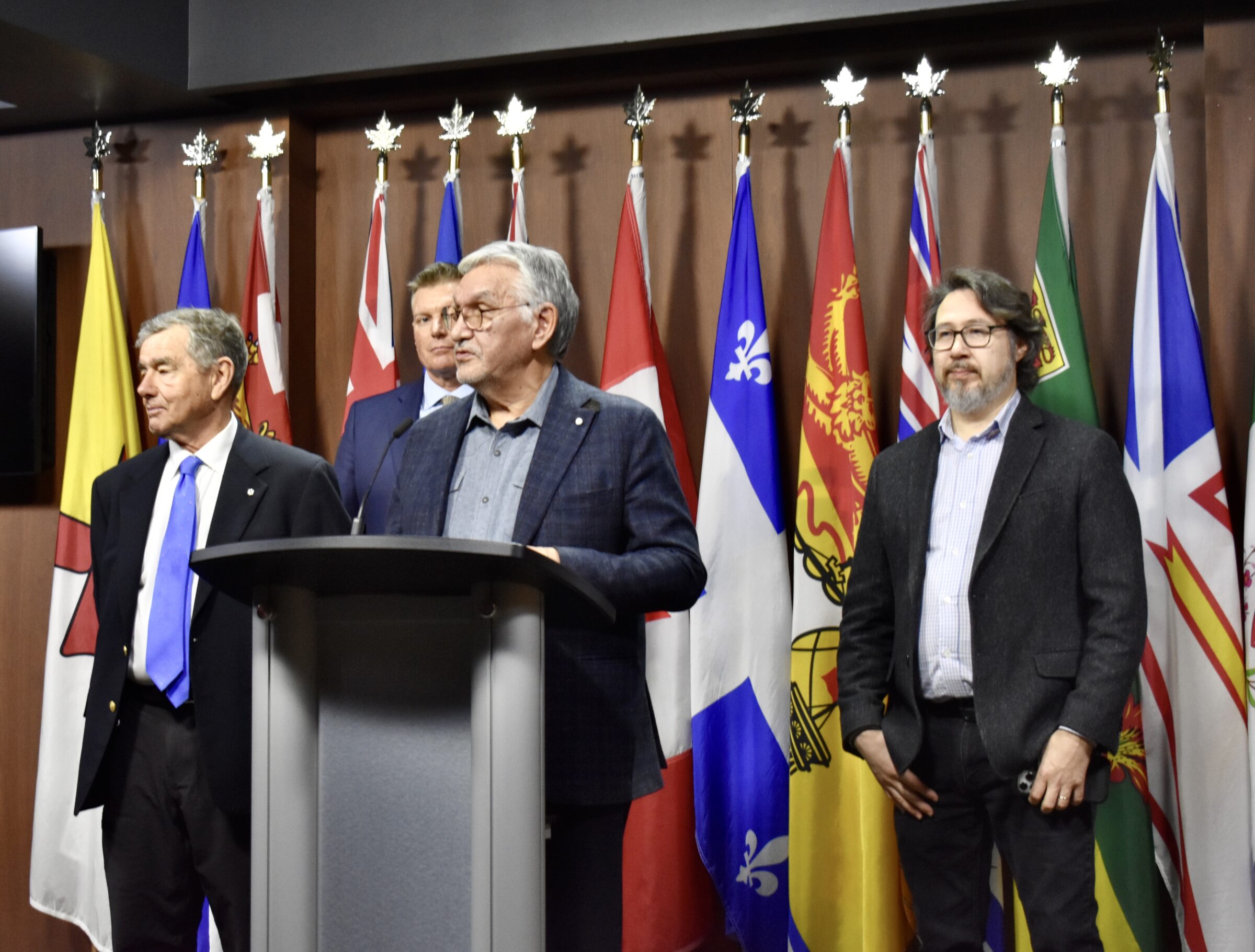
From left, John Risley, chairman of Arctic Economic Development Corp.; Sean Leet, director of AEDC; Harry Flaherty, president of Qikiqtaaluk Corp.; and Jeff Maurice, vice-president of partnerships at AEDC, speak at a news conference in Ottawa Tuesday. (Photo by Nehaa Bimal)
The estimated cost to build a deepsea port in Qikiqtarjuaq has risen to more than $350 million, project leaders said Tuesday while urging the federal government to help advance what they called Canada’s most “shovel-ready” Arctic sovereignty initiative.
“There is only one project that is fully permanent with environmental approval, with the support of the local community, that can start construction right now. And that’s the Qikiqtarjuaq port,” said John Risley, chair of the Arctic Economic Development Corp., one of the companies working on the project.
The project was previously estimated to cost more than $200 million.
So far, $53.4 million has been secured — $13.3 million from the Nunavut government and $40.1 million from the federal government.
At a news conference on Parliament Hill, representatives from Qikiqtaaluk Corp., the business arm of the Qikiqtani Inuit Association, and the Arctic Economic Development Corp. said the Inuit-led companies are ready to begin construction in the spring.
That’s earlier than the previously stated start date of summer 2026. Construction is expected to finish in 2029, with operations starting in 2030.
“Something has to happen, and we hopefully represent that coming together between private sector, Inuit community and government,” Risley said.

Updated engineering puts the first phase price tag at $350 million, with multiple phases planned with users to include fisheries, the Department of National Defence, commercial transport and the Canadian Coast Guard, he added.
Risley, a co-founder of Nova Scotia-seafood company Clearwater Seafoods Inc., that’s now co-owned by a coalition of Mi’kmaq First Nations, noted 56,000 tonnes of seafood caught in the Davis Strait were sent to Nuuk for processing in 2024.
“We would hope to capture a portion of that activity,” he said.
Qikiqtaaluk Corp. president Harry Flaherty said the port would allow Nunavut to finally benefit from increased economic activity in its own waters.
“Unfortunately, the North, the Arctic is never on the radar. It’s about time the federal government should start focusing on the North,” he said.
Arctic Economic Development Corp. director Sean Leet said the facility’s location in Qikiqtarjuaq, at the gateway to the Northwest Passage, would allow ships to refuel, unload waste and take on drinking water.

“This is where all the traffic will pass,” he said, calling it a “true dual-use facility” that could also support national defence, search and rescue, as well as cruise ship tourism by offering easier access to Auyuittuq National Park.
Leet said there’s already a 3,800-foot, or 1,150-metre, airstrip beside the port site which “can be extended to be able to have a tactical fighter base.” He said Arctic Economic Development Corp. has talked with the Department of National Defence about building a facility there.
He said the first phase of the project will create an operational water depth of 10 metres directly alongside where ships would berth. Later phases will reach 12- and 14-metre depths so “the largest ships in Canada’s fleet can be docked at our facility.”
No comparable deepsea port exists in the region, Leet said.
The plan also includes a 75-metre wharf, a crane for off-loading cargo, security and operations offices, and a 275-metre-long access road.

Flaherty said part of the reason for holding Tuesday’s event in Ottawa was to place the Qikiqtarjuaq project squarely before federal officials, now that all environmental and regulatory work is completed.
“We’ve been working on this particular project initiative for 15 years, and we just feel that today is the time to come here, put it in front of you and say, Canada, we are ready,” Flaherty said.
(0) Comments