


Rare sightings of yellow warbler, brown bat reported in Nunavut
Sightings in Baker Lake, Arviat signal possible ecological shifts
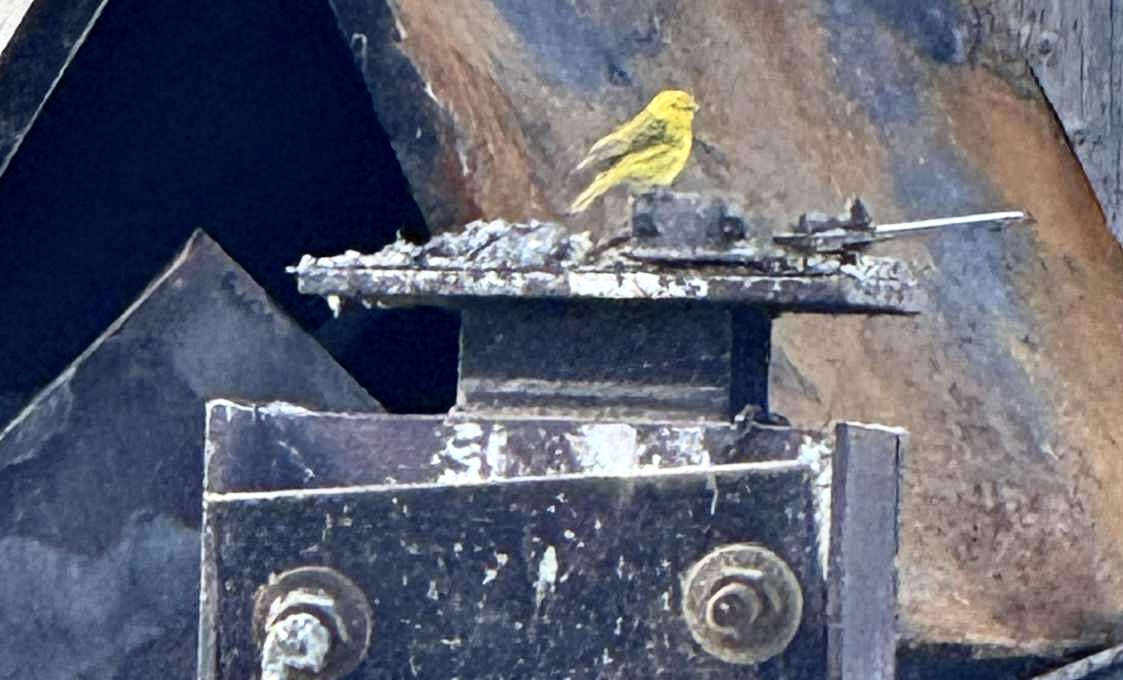
A yellow warbler perches in Baker Lake, on July 4. The brightly coloured songbird is rarely seen so far north and may be expanding its range due to changing Arctic habitats, experts say. (Photo courtesy of Natasha Tapatai)

Sightings of a yellow songbird and a brown bat in Nunavut over the past month, both far from home, are prompting experts to reflect on ecological shifts unfolding in the North.
On July 4, Baker Lake resident Natasha Tapatai photographed a yellow warbler.
“It was my first time to see the bird, but a couple of my friends told me they had seen it before,” Tapatai said over Facebook Messenger.
The yellow warbler, not typically found on the tundra, has a migration range in Canada from Newfoundland and Labrador to the Yukon and the west coast. It typically breeds in willow thickets.
Paul Smith, a Carleton University professor who researches Arctic ecology, said the birds have been spotted in Kugluktuk and Bathurst Inlet, and turned up in Cambridge Bay and Iqaluit in recent years.
They’ve even nested near Baker Lake, he said.
“A colleague of mine was a graduate student working on birds at the Agnico Eagle Amaruq site in 2018-2019, and found a nest in a willow shrub in town,” Smith said in an email.

Warblers prefer shrubby habitats near lakes or wetlands — areas that are expanding in the Arctic due to what scientists call “shrubification,” a trend linked to a warming climate.
“As temperatures warm and vegetation shifts, you might get willows and thickets further north,” said Mark Maftei, founder of the High Arctic Gull Research Group. “The range of the species is going to expand further north, too, and it’s not unprecedented.”
Maftei said warblers can overshoot their typical breeding zones during migration, occasionally ending up farther north than usual.
“Any bird that has the ability to fly thousands of kilometres, as all migratory species do, has the potential to show up somewhere else,” he said.
Maftei said sightings like these are an important reminder that birds can be indicators of broader environmental change.
“Birds capture people’s imagination because they’re colourful and obvious, so paying attention to a new bird is a nice way for people to practise being more engaged with nature around them,” he said.
“You will then start to see cool patterns and appreciate how the whole ecosystem is put together.”
In Arviat, a video circulated on Facebook on July 6 showing a tiny brown bat crawling on a resident’s porch. The bat appeared injured and unable to fly.
Wildlife biologist Jesika Reimer, who studies bats in Alaska and the Northwest Territories, called the sighting “pretty rare.”
“Looking at the geography of Arviat, it’s above the tree line, and so we don’t typically see bats above the tree line.”
Reimer suggested the bat may have been blown off course by coastal winds or hitched a ride on a boat.

The Arviat bat was likely a brown bat, she said, one of the most common species in North America. “They’re generalists, so they tend to go to places that other bats aren’t necessarily.”
Bats have limited ability to survive and breed up North.

A dead brown bat found in Arviat on July 6 was a rare sighting above the tree line. (Photo courtesy of Kelvin Ukutak)
“Bats need somewhere to have their pups and to live, such as trees, big rock cracks and crevices, and occasionally they will use human buildings as well,” said Reimer.
Reimer said she’d like to obtain the carcass or even a clip of wing tissue by mail if any other bats are sighted in the region.
Researchers could then conduct a genetic analysis and identify the species. If it’s a little brown bat, they may be able to determine where it came from or how closely it’s related to other bats in Alaska, Yukon and N.W.T.
Anyone who comes across a bat in Nunavut can contact Reimer at jpreimer@taigaresearch.com.
Tons of those birds in Kugluktuk, I bet that bat hitched a ride in someone’s temmu order.
Until recently, Nunavut was buried beneath a two-kilometer thick sheet of ice that had been in place for nearly 100,000 years. There is still some evidence of that massive glacier at high altitudes (even in the southern Rockies) and at high latitudes. That is why Greenland is covered in ice – it’s high altitude and high latitude.
Plants, animals and insects have been migrating North since the last ice age started to reverse 10,000 years ago. Sometimes the movement is rapid, sometimes slow. That is nature.
As far as the current environment and climates change, we are in a period of slow progression. In the past there have been numerous instances of rapid climate change events (RCCEs aka rickies); almost always into an ice age. That will happen again and soon enough. I have no say in climate change, whether gradual, like modern day, or when the next RCCE occurs.
There are over 120 different species of migratory birds in Nunavut.
My coworkers are scared of houseflies. Bats in Nunavut should be both terrifying and funny at the same time
I was expecting a possible reference whether forest fires across Canada may also play a factor in these sightings (as well as an eagle spotted in Nunavut recently).
But it’s not mentioned at all in this article.
Bats can carry rabies and it’s possible to become infected without even knowing you have been exposed. Bats’ teeth are so small you may not feel a bite, and it is possible to be infected through bat saliva or other fluids without a bite.
If you have handled a bat or find one in your home, please go see your health centre immediately to report it and get the vaccine as rabies is 100% fatal. A child in Ontario died in October after contracting it from a bat that had gotten into their bedroom.
When the top down agenda is stuck on repeat-repeat so people believe without questioning. That climate change is true and to become tied in knots with intense fear.
Yeah, so don’t think about forest fires (around 92% + human started). Or the increasing magnet north movement, shift in the earth’s magnetic field causing airports to renumber their runways used for navigation. Started around 2009. Or the late Rankin Historian who’d talk about the yearly spring arrival of a few bats in Eskimo Point, Rankin Inlet, Whale Cove and Baker Lake back in the 70s, 80s.