


Reconciliation belongs in the kitchen
Op-ed | Qajuqturvik Food Centre calls on governments to acknowledge state of Indigenous health is rooted in access to food
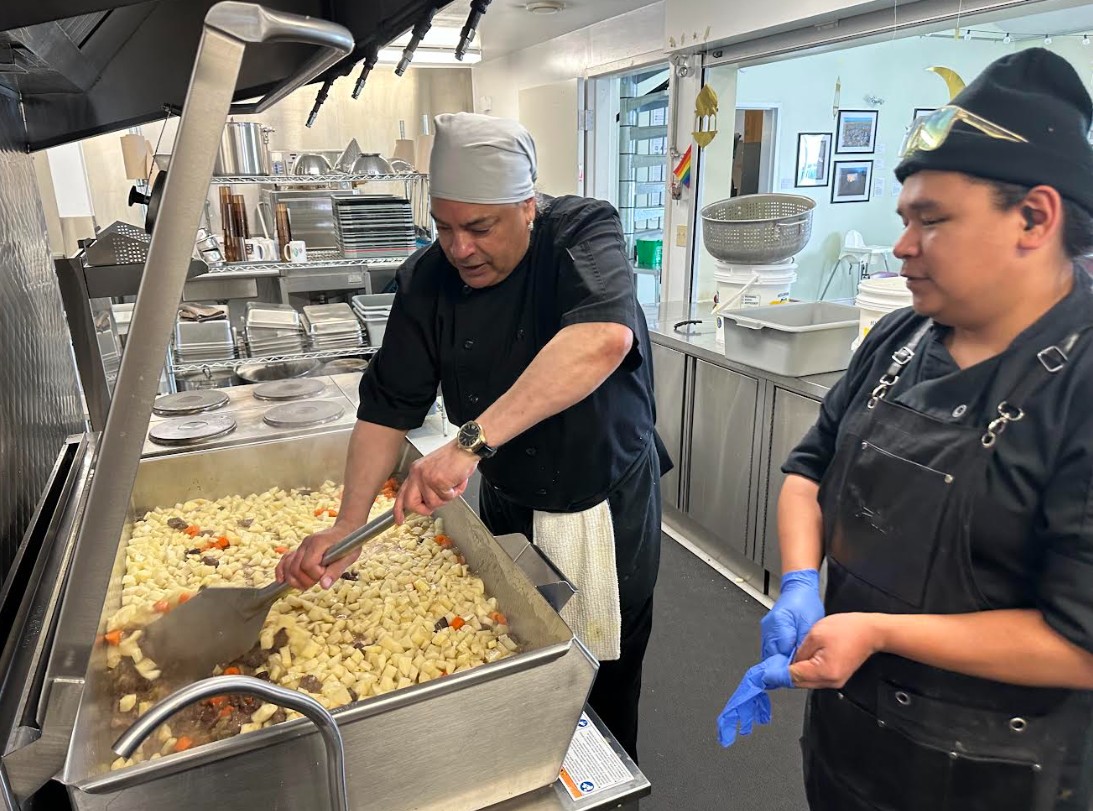
Qajuqturvik Community Food Centre cooks Carlos Foyn, left, and Jamie Papatsie work in the kitchen at the Iqaluit non-profit. On Canada’s National Day for Truth and Reconciliation, Qajuqturvik’s director Joey Murdoch-Flowers writes that part of reconciliation involves the recognition that Indigenous health challenges are rooted in the policies of past Canadian governments. (Photo courtesy of Qajuqturvik Community Food Centre)

Joey Murdoch-Flowers
On National Day for Truth and Reconciliation, I wanted to provide Qajuqturvik’s perspective on the food insecurity crisis. What are some hard truths?
And what might reconciliation look like?
We are seeing unprecedented levels of food insecurity.
In the past few years, we have seen a sharp and steady increase in the community’s need for lunches:
- In 2022, we prepared almost 58,000 meals
- 2023, over 67,000
- 2024, nearly 70,000
- 2025, we are on pace to serve nearly 83,000 meals.
Two weeks ago, we hit a new record: We served 639 meals in a single day. In a community of 8,000 people, that’s one meal for approximately 7.9 per cent of the population. That would be like serving 80,000 meals in Ottawa, 139,000 in Montreal, or 220,000 in Toronto.
We employ competent kitchen professionals who take pride in their work and make foods that warm the soul and fill the belly. After the daily meal service, the team starts all over again, preparing buckets of chopped vegetables and cleaning up mountains of dishes.

Cooking and cleaning is a daily expression of Qajuqturvik’s care and commitment to the community.
It takes significant resources to pull this off every day, including human resources, storage space, food product, industrial equipment and administrative support. All of this takes funding.
The need to eat doesn’t stop at lunch time. It doesn’t stop on Friday afternoon. It doesn’t stop on holidays. While the need to eat never stops, I cannot ask my staff to work every day, because they need a break, too. Where do those who rely on our lunch service eat in the evening?
Qajuqturvik is stretched to the limit. Staff are maxed out. While we are fortunate to rent a beautiful space from the Anglican diocese, the community’s needs are greater than the space can accommodate. Our food preparation and storage spaces are tight. Our building is barely accessible to those who have limited mobility.
The Truth and Reconciliation Commission of Canada called on governments to acknowledge that “the current state of Aboriginal health in Canada is a direct result of previous Canadian government policies, including residential schools.”
So, what might reconciliation look like?

Governments and major funders can start by acknowledging the above truths. They can provide Qajuqturvik with short- and long-term support to address these issues.
First, by supporting an immediate injection of funding to hire more cooks, and secure space required to increase Qajuqturvik’s daily meal program from five days a week to seven days a week. And second, by collaborating with us to identify a location for a facility to meet these community needs.
Today is a statutory holiday. Ordinarily, Qajuqturvik would be closed. Instead, we have made the decision to prepare and serve a meal for the community.
Take out service only will be available at 11:30 a.m. While we would love to welcome community members to dine-in, we only have the resources for a takeout meal today. See you then.
Joey Murdoch-Flowers is the director of the Qajuqturvik Food Centre in Iqaluit.

While I support and applaud the work of Qajuqturvik Community Food Centre, the kind of emotional blackmail and hijacking of Truth and Reconciliation Day to elicit funding for whatever your project is, is extremely irritating.
While I applaud public discourse, the gaslighting and veiled racism contained in comments like this one aimed at dismissing the importance of funding investments in organizations like this one as a means of reconciliation is, is extremely irritating.
There are some people who go in to have lunch for a free meal as if they can’t afford it, for example one black man (not being a racist, he is what he is) that is a security guard at the northmart. Staff should consider that as a problem and look into it, quite literally taking meals away from people who actually need it. Staff housed and northern allowance people like that security guard taking advantage while bringing more of their buddies up to take over and look down upon inuit. Same as the boarding home and the aqsarniit hotel the black security guards there look down on inuit and recruit more to come up.
True story.
That could be from ignorance.
A lady from South Africa (White) said she’s happy to meet and learn about Inuit without the preconceived notions that are told immigrants by Qabloonaat in Canada.
Thank you Joey for writing this and thank you to the Qajukturvik team for doing incredible work everyday. Everyone deserves the right to food and I hope we can all work together to get the government to make the commitments to ensure this.
Skills training. Absolutely one of the best programs of Corrections/Wellness. Great job here!