


Repatriation of Kugluktuk sealskin boots brings back warm memories
Kamiks will be placed in hamet’s heritage centre
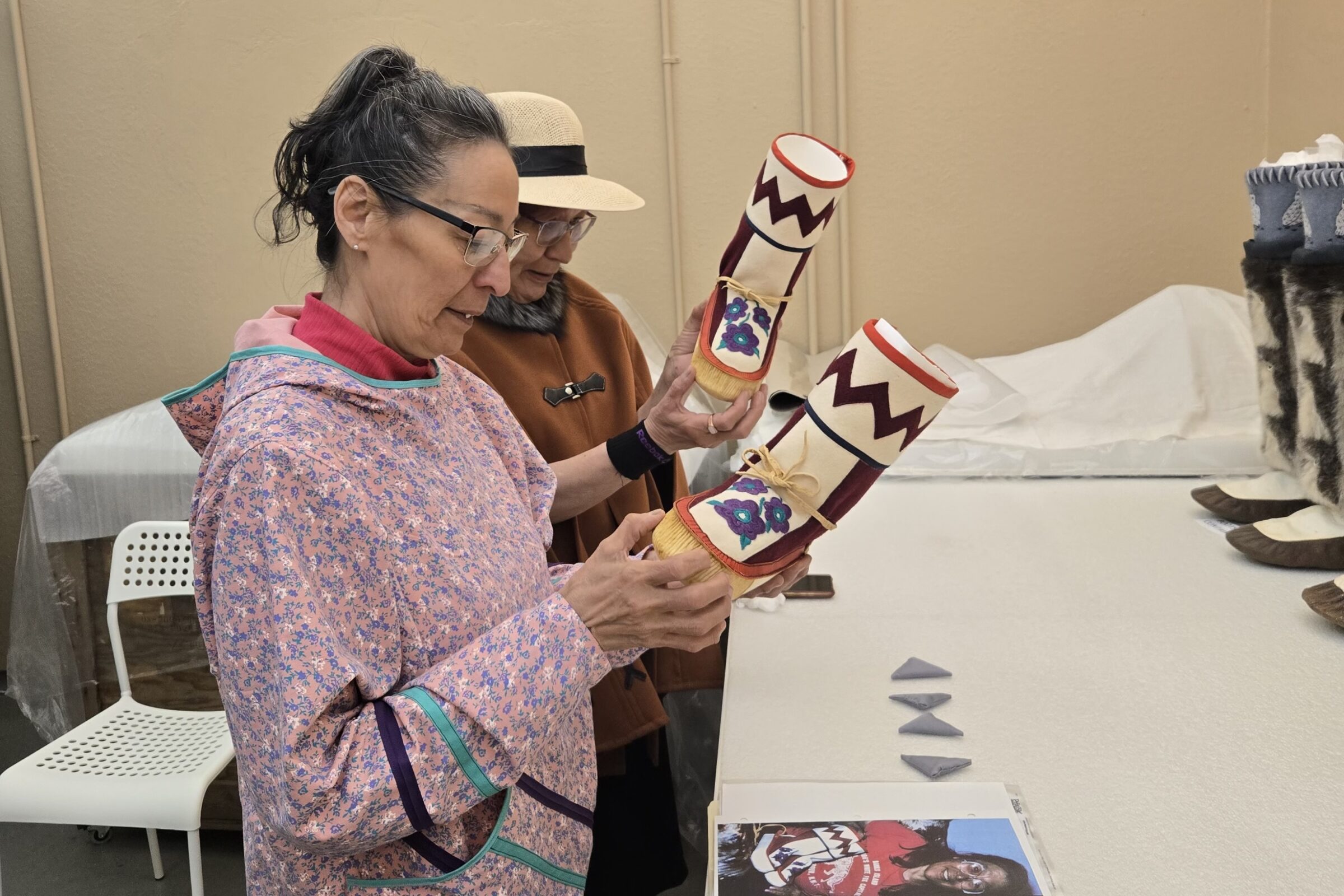
Rita, front, and Wilma Pigalak pick up kamiks made by their mom Elva, as part of a repatriation process with Bata Shoe Museum. The sisters made the trip to the museum, located in Toronto, this summer. (Photo courtesy of Rita Pigalak)

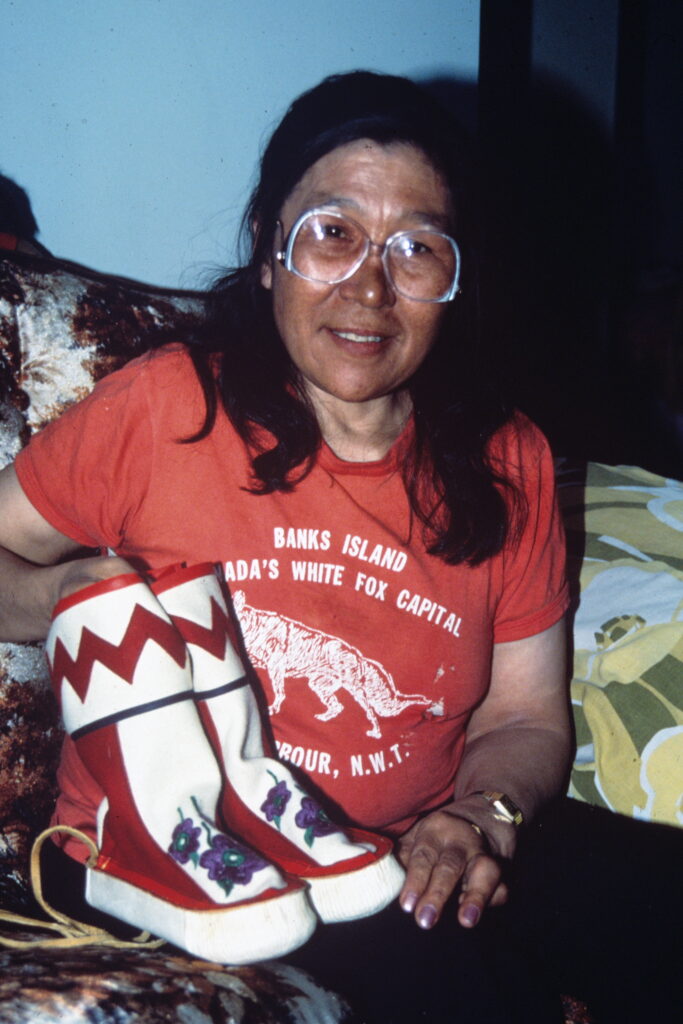
Elva Pigalak holds her freshly-made kamiks in Kugluktuk, then called Coppermine, in 1986. (Image courtesy of Bata Shoe Museum, Toronto, Ontario Canada © 2025)
When Rita Pigalak entered the storage area of the Bata Shoe Museum in Toronto with her sister Wilma, they were already both getting a little emotional.
Surrounded by ancient Egyptian sandals, Queen Victoria’s slippers, Elvis Presley’s loafers and John Lennon’s boots, they could feel the weight of history.
But they were about to see an item that was particularly special to them, as Pigalaks.
Accompanied by Justine Woods, Bata’s curator of Indigenous collections, the sisters had the chance to see a pair of small white and red kamiks. The sealskin boots were embroidered with purple flowers and a red zig-zag near the top. With the boots was a photo of a seamstress in a red T-shirt and big white glasses.
The two sisters couldn’t hold back their tears. The woman in the photo was their late mother, Elva Pigalak, and the boots were her creation, from 1986.
“It was just an amazing feeling. I still remember coming back home for Christmas from high school in Yellowknife and seeing her working on them,” Rita said in a phone call from Kugluktuk, about a month after the Bata Shoe Museum invited her to come to Toronto and take back the boots, which had been in the museum’s collection for the past 37 years.

The repatriation process was uncharacteristically quick.
It took only two months after Emily Angulalik, executive director of the Kitikmeot Heritage Society, visited the Bata Shoe Museum in May and connected the museum with the Pigalak family, Woods said in an email.
Another recent repatriation process that Angulalik took part in dragged on for nine years. It was that of a century-old loon dance hat, returned to Cambridge Bay this summer.
This time, things were different, thanks to meticulous notes taken by a pair of scientists, Jill Oakes and Rick Riewe, who bought the boots from Elva in 1986 for the Bata Shoe Museum.
The notes not only included Elva’s name, photo and exact location, as well as measurements of the kamiks, but the price for which they were purchased — $80 — a hefty sum at the time, Rita said.
“I’m just so over the moon thrilled that by documenting everyone’s name and all the details, that now we’re able to connect the boots back to the North,” said Oakes, professor emeritus at the University of Manitoba, in a phone interview.
Oakes and Elva bumped into each other by chance in Kugluktuk in the 1980s (the hamlet was then called Coppermine). Elva, a lifelong seamstress, taught her guest the art of making sealskin boots.
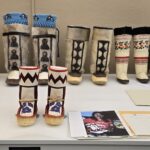
Elva Pigalak’s sealskin boots at the Bata Shoe Museum before they were picked up by her family to be brought back to Kugluktuk. (Photo courtesy of Rita Pigalak)
“She was just so incredibly warm and caring and, oh man, those memories are just one of those gifts that you hold on to,” Oakes said.
Now that the kamiks are back in Kugluktuk, the Pigalak family hopes to put them in the local heritage centre — the family is large, so they want to be able to all share and give the community the chance to admire them as well, Rita said.
“As an outsider, when I pick them up I hear only what Elva taught me,” Oakes said.

“But it’s just a tip of the iceberg of what they actually mean to the family. To Inuit, those boots must carry a whole library, rather than just one story. And to me, it’s very exciting.”
“Repatriation”? That term is usually used to refer to items that were essentially stolen from their homelands by outsiders. These were made and freely sold by their maker for a client. While it’s nice for the Bata Museum to send them back, they were certainly under no legal or ethical duty to do so.
While u gotta commend Bata for reaching out to these ladies and offering an olive branch, this whole thing reeks of corporate publicity stunt. Could they do this without letting the media know?
I’m guessing Bata paid for these two ladies’ plane tickets and accommodations? Food as well? Why not just send the boots back to Kugluktuk?
Purpose? To see their corporate social credit score go up a few notches?
Of course it’s corporate PR. So is the Bata Shoe Museum. At least the boots and the family are real. I can think of a lot worse examples of corporate publicity that are wild exaggerations if not outright lies, by oil and mining companies, for example.
It may be the case of this one that it was sold but there are so many more items that have been taken from archaeological sites over the decades, from grave sites also that I think repatriation is a fitting term to use,
Every museum seem to have hundreds if not thousands of Inuit collections in their storage rooms.
My late uncle from Ulukhaktok, used to tell me about an archaeologist named Jon from France would go down the coast and dig sites up and ship them to France for years, without anyone stopping him in the late 70 to 80’s. and that’s just one guy, Imagine the amount of our culture from across the arctic sitting in museums today. Just look at Ottawa’s one!
That should not have happened… still, better to have those artifacts in a museum than buried underground.
That is not for you or anyone else to decide for Inuit, this is their ancestors their family and history, not yours or some European thinking they know better,
It’s theft plan and simple, we have a lot of stories of people coming up and stealing human remains, artifacts and other cultural belongings from Inuit.
Inuit will decide what they want to do with their property.
Nothing like a good photo op eh?
I bought qamiks in 73, wore them into the ground, with warm feet. The next pair I bought in 78. They were equally beautiful and functional they wore out in 83. The next we’re a givt (misspelled on purpose). Those I kept on display in my home. They dried up and disintegrated without any purpose other than eye candy. Inuit technology. Very cool.
This is great news! The heritage center in Kugluktuk is beautiful and way better than other communities. Communities should learn from them on how they can preserve and promote their local history including finding community connections from museums around the world
Let’s hope Kugluktuk’s heritage centre can care for the kamiks (sealskin boots) as well as what the Bata Shoe Museum did for the last 40 years.
No security there i guess so just wait tell it get broked into
I know an ex KIA, edo, and mine representative that used to openly display artifacts he found on the land from camping sites around Kugluktuk in his house.. Its an issue