


Sanikiluaq students get out-of-this-world experience
Could one small question from a student be a giant leap for student-kind?
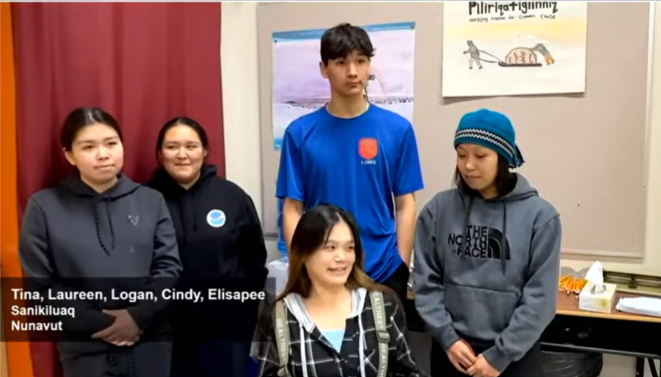
Five Sanikiluaq students — Elisapee Arragutainaq, Cindy Alariaq, Laureen Ippak, Tina Novalinga and Logan Arragutainaq — took part in last week’s question-and-answer session with astronauts on the Artemis II mission to the moon. They asked Canadian astronaut Jeremy Hansen what he eats in space. (Screenshot courtesy of Canadian Space Agency/YouTube)

Five Sanikiluaq students had the right stuff when it came time to ask Canadian astronaut Jeremy Hansen about what astronauts eat in space.
They were among a dozen Canadians who took part in a question-and-answer session with Hansen that was streamed very early last Sunday morning on the Canadian Space Agency’s YouTube channel.
Elisapee Arragutainaq, Cindy Alariaq, Laureen Ippak, Tina Novalinga and Logan Arragutainaq used their six seconds of screen time to ask about astronauts’ meal options. They let Elisapee do the talking.
“What type of food do you eat in space and how do you cook it?” she asked.
It was a delightfully charming question from the Sanikiluaq students.
The answer was just as good: “Here’s the maple syrup that we opened up at lunchtime today,” Hansen answered.
Our news story about it is on the front page of this week’s paper.

Just by watching the comments in the chat window, you could feel the buzz about the event. There were jokes about why there isn’t dehydrated poutine and how a Canadian astronaut could survive in space without Tim Hortons.
The 30-minute Q-and-A session took place at 12:10 a.m. on Sunday apparently because that’s when these things have to happen. For those of us who stayed up late Saturday night to watch the livestream, it was worth it.
Could that brief virtual encounter with Hansen inspire one of the Sanikiluaq students to go on to become an astronaut? Why not?
The Artemis II mission has been a bright spot at a time when a lot of other news from around the world has been bleak.
The four-astronaut mission left Earth on April 1 with a plan to travel to the moon, circle it, and return home. It’s laying the groundwork for a moon landing in 2028 — the first in more than 55 years.
Over the past 10 days, millions of Canadians have been inspired by the Artemis II mission and Hansen’s role in it. Both the mission to the moon and the students’ interaction with an astronaut should remind us all of the nearly unlimited opportunities that exist.
Nunavut students face a lot of challenges when it comes to getting a good education. Hopefully, the connection the Sanikiluaq students made with this historic event will serve as an example to them and other students in the territory of what they can accomplish.
Who knows where inspiration comes from, or how a small connection to a huge event could lead a young person on a path to greatness?
Hansen, now 50, grew up as a farmboy in a small town in southern Ontario. His own interest in becoming an astronaut began when he was five years old and he stumbled across a photograph of Neil Armstrong, the first person to walk on the moon.
If not the Sanikiluaq Five, then maybe one of the thousands of other Canadians who watched the livestream might find the inspiration to become an astronaut or to go on some other exciting path.
Yes, Nunavut students do face a lot of challenges when it comes to education. Brain twisters and silly word scrambles are stuff preschoolers love to dive into, except this is high school
Who’s worried if students don’t ask the delightfully charming questions?
Instead, ask to see live video and photos past the 60th south parallel, plus to zoom in for detail? Inexpensive consumer cameras can zoom in on the moon from the Earth to show amazing detail of the moon.
Imagine the detail a very expensive spaceship camera could show of the Earth. Especially when the spaceship is so much closer to Earth than we are on land to the moon.
Okay, the Antarctic Treaty would squash that question. So let’s watch from space now, jets on Earth flying upside down and landing.
Wait, one last question before the feed is cut. Are you wearing augmented virtual reality contact lenses to be able to see and play with the digital stuff we see floating in front of you?