


Strong winds, frozen gravel caused plane to drift off Sanikiluaq runway, safety board says
Transportation Safety Board of Canada identifies what caused plane to drift off runway into snowbank in December 2021

The Transportation Safety Board of Canada’s investigation into the Beechcraft King Air BE20 aircraft that overshot the Sanikiluaq airport runway on December 17, 2021, has released its final report. (Photo courtesy of Transportation Safety Board of Canada)

Strong crosswinds, limited tire traction and frozen gravel at the Sanikiluaq airport caused a medevac flight to drift off the runway in December 2017, an air transportation safety investigation concluded.
The Transportation Safety Board of Canada released its final investigation report Thursday into the Dec. 17, 2021 “lateral runway excursion” of a Beechcraft King Air BE20 aircraft operated by Keewatin Air, that flew in from Winnipeg, Man.
Two flight crew members and two medical staff were on board when the aircraft began drifting left while landing. The pilot started to initiate a “go-around” — to take off again and land again — but crosswinds of approximately 57 kilometers per hour made controlling the aircraft difficult, the TSB report said.
The aircraft then exited the south side of the runway, striking a snowbank and ending up nose-down as it came to a stop.
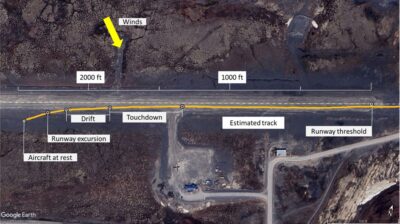
The estimated track of the Beechcraft King Air BE20 aircraft operated by Keewatin Air on December 17, 2021 over Runway 27 at Sanikiluaq Airport, along with points where the aircraft touched down, drifted to the left, exited the runway, and came to rest (Photo courtesy of Google Earth, with Transportation Safety Board of Canada annotations)
“The danger with this manoeuvre comes when you don’t have enough speed to take-off, or sufficient control of the aircraft or space to bring your wheels in to incline safely,” said Kristina Schoos, a senior investigator for the Transportation Safety Board of Canada, who conducted the investigation.
“In this situation, the aircraft went off the runway without having time to gain speed, so it was risky,” she said.

Despite one minor injury reported, all four passengers were able to exit safely by jumping approximately two metres from the aircraft into the snow.
The report reveals that due to winds blowing snow on the runway, which had been cleared earlier that day, Sanikiluaq airport staff did not see the accident happen.
After evacuating the aircraft, the passengers walked down 500 meters of runway through strong winds with “reduced visibility due to darkness” and temperatures of −4 C.
The airport’s emergency response plan was only activated once the passengers arrived at the terminal.
The TSB’s report highlighted the risk of aircraft operators like Keewatin Air authorizing flights while having little information on northern runway conditions and associated aircraft performance, which are often not provided by the flight’s manufacturer.
“If you don’t have any data from the aircraft’s manufacturer about the flight’s capacity to land on gravel runways or performance limitations when dealing with crosswinds, you just don’t have it and that’s a risk” Schoos said.

Beech Aircraft Corporation, the American manufacturer of the King Air B200, was not required to publish the aircraft’s crosswind limitation. The manufacturer also only has data on the aircraft’s performance on hard surfaced runways, which differ greatly from gravel runways which are often compacted with snow.
The report also highlighted the risks associated with the northern practice of “taking off and going to see” when there is no data available on runway surface conditions. Instead of depending on unavailable data, flights are authorized based on the pilot’s experience, TSB reported.
As the King Air B200’s pilot-in-command had successfully landed in Sanikiluaq airport before in similar conditions, the flight was authorized to “go and see” despite the weather conditions.
“I hope the report’s message will help operators reflect on the risks in their northern operations and how to mitigate them through their operations and training” Schoos said.
Keewatin Air could not be reached for comment Thursday to react to the TSB report.

This was bound to happen; Once in long awhile to any aircraft operators. This company is instrumental in saving lives on many occasions throughout Kivalliq and Baffin. Keep the great job going, thank you Keewatin Air for your great services. I know you’ll be there for me someday but (I hope not).