


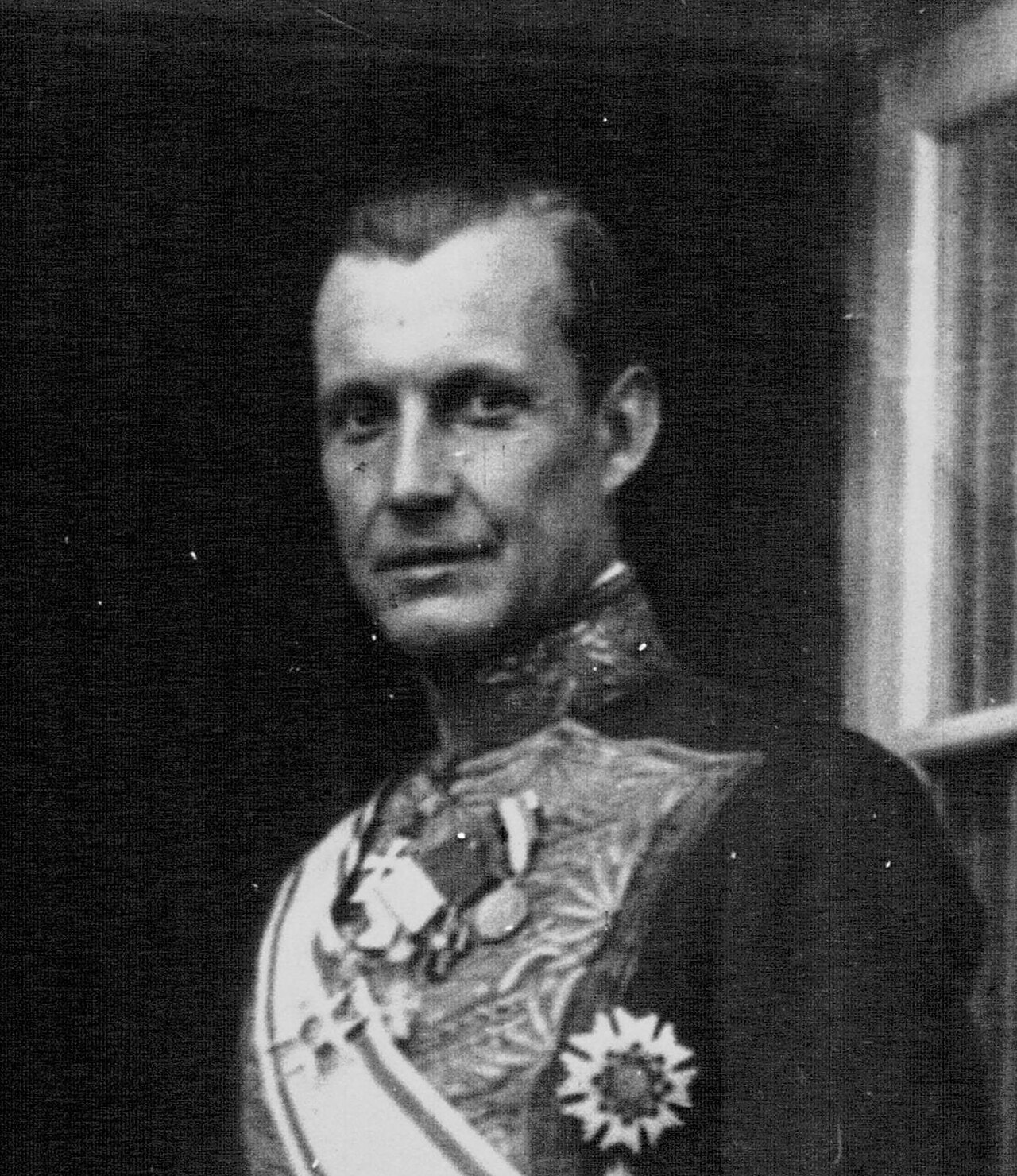
Henrik Kauffmann from a 1932 picture when he was the Danish ambassador to Japan. (Photo courtesy of National Library of France/Wikimedia Commons)
The defence of Greenland Part 3 | Henrik Kauffmann
At the time of Germany’s invasion, Denmark’s ambassador to the United States was Henrik Kauffmann.
A Dane born in Germany, he was trained as a lawyer. After serving in a number of foreign posts, where he was known for his high-quality political reports as well as his lavish spending, he was appointed Danish ambassador to the U.S. in 1939.
On April 9, 1940, the day of the occupation, Kauffmann addressed the U.S. State Department, the American version of Global Affairs Canada.
He told the Americans that, in his opinion, the Danish government, which had agreed to co-operate with the German occupation forces, was no longer free, and that he would not be taking direction from them. He would act independently — on behalf of Denmark, but independently of the Danish government. This was an extremely bold move.
Greenland’s two governors, Eske Brun and Aksel Svane, believed that they represented the remains of the sovereign Danish government and that Kauffmann acted as their envoy in the U.S.
It followed that he could act only under the authority that they gave him. Kauffmann believed just the opposite — that he and he alone represented “Free Denmark” until such time as Denmark might be liberated, and that the two governors were therefore under his authority and could only act under his direction.
The U.S. government supported the position of the governors, believing that they represented “free Denmark” and were “in a sense regents carrying on the true Danish sovereignty.” Kauffmann worked diligently over the next year to change that position.

In Greenland, the two governors were in constant communication and concluded that Greenland would need American protection.
On May 3, 1940, the two territorial councils, advisory councils to the governors, held a joint meeting and issued a resolution.
After expressing their loyalty to the king, the councils stated their hope that “as long as we remain cut off from our mother country, the United States Government will continue to hold in mind the exposed position of the Danish flag in Greenland, of the native Greenland and Danish population, and of established public order.”
As if to rub salt in a wound, the governors included a personal message for Kauffmann; they expressed their pleasure that “responsibility as spokesman to the American Government on behalf of the responsible Greenlandic authorities… is in such good and capable hands.”
Knowing that the American government was sympathetic to their position, Brun and Svane felt secure in the knowledge that they, and only they, were what remained of sovereign Greenland. And they wanted nothing to do with Canada.
Despite its official neutrality, the United States felt that Greenland needed to be defended. They didn’t want to do it themselves, for obvious reasons, nor did they want Canada to do it. They thought that Danes and Greenlanders should do it themselves, but with weapons and munitions supplied by America.

So in May, the U. S. Coast Guard cutter Commanche sailed for Greenland carrying armaments and a newly-appointed American consul. At about the same time Canada dispatched the Hudson’s Bay Company vessel Nascopie for Greenland carrying two official RCMP officers, but other officers and a military man in plainclothes, ostensibly as passengers, as well as mining engineers. And the Julius Thomsen set out from Britain with more military officers and a Canadian consul and vice-consul.
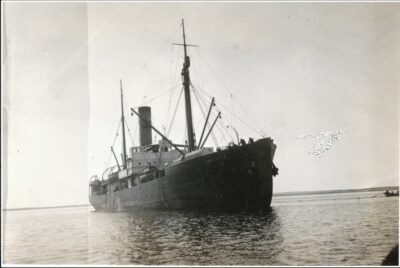
The Hudson’s Bay Company vessel Nascopie, as photographed in 1923. (Photo by Knud Rasmussen, courtesy of Arktisk Institut, Denmark, #00363)
The U.S. Secretary of State was outraged to learn of the Canadian and British initiatives and called an emergency meeting of the two countries’ diplomats in Washington. He viewed their actions as an attempt to take over the cryolite mine and he would not tolerate it.
The Commanche was already there when the Nascopie arrived on June 1. The Greenlandic authorities, briefed by the Americans, refused to allow the RCMP officers and military man on the Nascopie ashore. The standoff lasted for three weeks, during which time the island’s governors nationalized the mine.
When the ship left, she carried a cargo of cryolite destined for Canada. But Canada had lost a strategic battle of wits, and her credibility was damaged in Greenland.

Meanwhile, in Washington, it appeared that Kauffmann was fighting a losing battle and that the two governors had the upper hand in the battle for legitimacy.
But in the fall of 1940 things began to change. Slowly. Washington became aware that Canada and Britain were considering building one or more air bases in Greenland to facilitate the movement of aircraft from Canada to Europe as part of its war effort. This was definitely not to Washington’s liking.
By November the American government had decided that it needed to have access to an air base in Greenland. They advanced their plans through the two Greenland governors.
In late January 1941, the governors, with the urging of American consul Penfield, invited the Americans to send a group of experts “to view the prospect” of an airfield. In a slap in the face to Canada, Governor Svane said that this course of action was “much more to Greenland’s advantage than the possible alternative.”
To be continued…
Taissumani is an occasional column that recalls events of historical interest. Kenn Harper is a historian and writer who lived in the Arctic for over 50 years. He is the author of Give Me Winter, Give Me Dogs: Knud Rasmussen and the Fifth Thule Expedition, and Thou Shalt Do No Murder, among other books. Feedback? Send your comments and questions to kennharper@hotmail.com.
It was at 12 a.m. on 5 September 1871 that a landing party from the USS Polaris came ashore on Greenland at Repulse Harbor lead by Charles Francis Hall and took formal possession of Greenland “in the name of Jehovah (YHVH), POTUS, SecNav, with three times three and an American Tiger”.
This act from a landing party was repeated on 13 September 1871 at eight bells. [As of now, I am uninformed of that time of eight bells, since my reference source was
Sir William Eric Beckett, then Second
Legal Advisor of the British Foreign Office, circa April 1930 at the Hague.] On 13 September 1871 at Thank God Harbor 8 bells on a USN ship could of been one of seven times, viz., 12 a.m., 4 a.m., 8 a.m., noon, 4 p.m., or 8 p.m..
During the Conference on the Codification of International Law of the Legue of Nation at the Hague, Dr. Samuel Wittermore Boggs (Geographer of the United States Department of State) requested talks with W. Eric Beckett on islands exchanges, viz., concession of Machias Seal Island, Washington County, Maine for the Plover Group of islands to the north of Alaska in the Arctic Ocean. It was on 1 August 1850 at 8:30 p.m. that the British Royal Navy annexed that Plover Group in the name of Queen Victoria.
Beckett informed Boggs that he agreed that this island exchange was an Imperial Question and External Affairs of Canada should be excluded from the talks even though it had an affect on New Brunswick, but the U.K. would not proceed with these talks until the Governors of both Maine and Massachusetts appointed commissioners to said talks. Boggs reply was that on 4 August 1916, U. S. Secretary of State Robert Lansing issued the Biltmore Declaration (Lansing Note) by which the act of Charles Francis Hall on 5 and 13 September 1871 was superseded.
Beckett reply was that the United States Senate never gave advise nor consent to the terms of this Lansing Note. The talks failed to go forward
in 1930 with the U.K.
Boggs tried again, this time in 1938,
At Ottawa with Dr. Lester Pearson. Dr. Pearson also rejected the idea of exchanging Machias Seal Island for the Plover Group. Boggs stated in his 1938 trip report to Ottawa back to the Secretary of State that Pearson and others in External Affairs Canada were “all provincial” persons. Pearson wrote of Boggs that he was “pedantic” and talked down to the Canadian Official he met at Ottawa in 1938.
Then the issue came up again in 1958, between Ike Eisenhower and Primer W. A. C. Bennett of British Columbia at Ottawa. Primer Bennent told Ike Eisenhower that he wanted the Plover Group with Herald and Wrangell Islands attached to British Columbia, “so British Columbia could become an “Arctic Power”. [Note Bennett used Kellett’s Island name in his talk with Ike Eisenhower. Ike then referred to
Bennett as “Wacky Bennett”.
W.A.C. told me personally about the 1958 meeting with Ike in the summer of 1959 at the Butchard Gardens during High Tea, since I was with my parents at the time. My mother was born in Montreal in 1904 on June 10 and married by father in Santa Ana, California in 1935. She had family in Victoria in 1959 who where friends with Primer and Mrs. Bennett so High Tea was arranged and I got to talk with W.A.C. Bennett at the time. Bennett at that meeting was interest also in Bennett Island, Alaska to the north of Siberia because we talked about the Yup’ik Aneguin (alternatively spelt Anequin) of St. Michael, Alaska who on 11 July 1881 discover Bennett Island to the north of Siberia and told George Washington DeLong of that discovery, so DeLong took formal possession of Bennett Island on 29 July 1881 for the USA at Cape Emma. [Note the Anequin House at Valdez, Alaska was named for Anequin the Yup’ik of St. Michael, Alaska on 7 April 2023.]
Cool story, bro.
I absolutely love reading history of the arctic, thank you Nunatsiaq News and Kenn Harper for keeping it alive.
My guess is Kenn Harper has not viewed the movie “The Good Trator” which in the end seen showed Henrik von Kauffmann being murdered by his wife Charlott then she does hari-kari on herself in a bath tub.
In 1925, the Canadian Coast Guard ship Arctic visit Etah, Greenland and
direct Richard Byrd not to fly over the American Arctic Archipelago without permission of the Canadian Federal Government. Even though land Surveying for decades were being conducted in those lands by the United States Biological Survey under the direction of its Chief Edward Nelson of the United States Department of Agriculture.
It was Edward Nelson in the landing party from the ship Thomas Corwin at Cape Corwin on 12 August 1881 at New Columbia Land that helped John Muir construct the cairn at the delta of the Clark River at Cape Corwin during the official formal possession of what was declared Wrangell Island, Alaska on 29 July 1901 bu the United States Board on Geographic Names, which was created by POTUS Benjamin Harrison and who advocated on 17 December 1883 that Greenland should be attached to Alaska. Adding Greenland to Alaska as Harrison suggested would be better than making it the 51st American State.
Doing that action would not increase the US Senate membership by two and not even move an increase in membership in the House of Representaive from its present one member of Alaska.
Alaska and Greenland combining as suggested by Benjamin Harrison on 17 December 1883 would be a good think for both the people’s of Greenland and the USA.
Details, the devil is found in the details 😐
Mark Seidenberg – Of course, your guess is wrong, as are most of your other unhinged statements. I enjoyed the movie and it provided a nice context for my research into this subject. Now it’s my turn to hazard a guess – that you have not read (as I have) DEFIANT DIPLOMACY: HENRIK KAUFFMANN, DENMARK, AND THE UNITED STATES IN WORLD WAR II AND THE COLD WEAR, 1939-1958, by Danish scholar Bo Lidegaard. It is essential reading on this subject.
Also a news flash for you: Wrangell Island belongs to Russia, not the United States. Greenland is a part of Denmark. Ellesmere Island is a part of Canada. You may wish it were otherwise, but it is not, and no amount of wishing will make it so.